

Business owners across the UAE keep asking me the same question this year: does my company actually meet the UAE Personal Data Protection Law?
The uncertainty is real, and so is the risk.
Organizations that process personal data of UAE residents must comply by 2026. Miss that deadline, and administrative fines reaching AED 5 million become a real possibility. 2
I walk clients through this every week, so I built this checklist to cut through the noise and protect customer information the right way. 3
Here’s the plan: who must comply, what your business needs to build right now, and the security steps that keep the UAE Data Office off your back.
Key Takeaways
- Companies holding UAE resident data must comply with Federal Decree-Law No. 45 of 2021 by 2026 or face fines reaching AED 5 million, with some violations carrying much steeper penalties.
- Organizations must appoint a Data Protection Officer where the law requires one, conduct data mapping, identify lawful bases, and develop consent mechanisms immediately.
- Companies require standard contractual clauses and binding corporate rules for cross-border data transfers to non-adequate countries.
- Data breach response plans must notify the UAE Data Office within 72 hours and affected individuals of security incidents.
- Encryption, access controls, data minimization, and Records of Processing Activities form essential security measures for PDPL compliance.
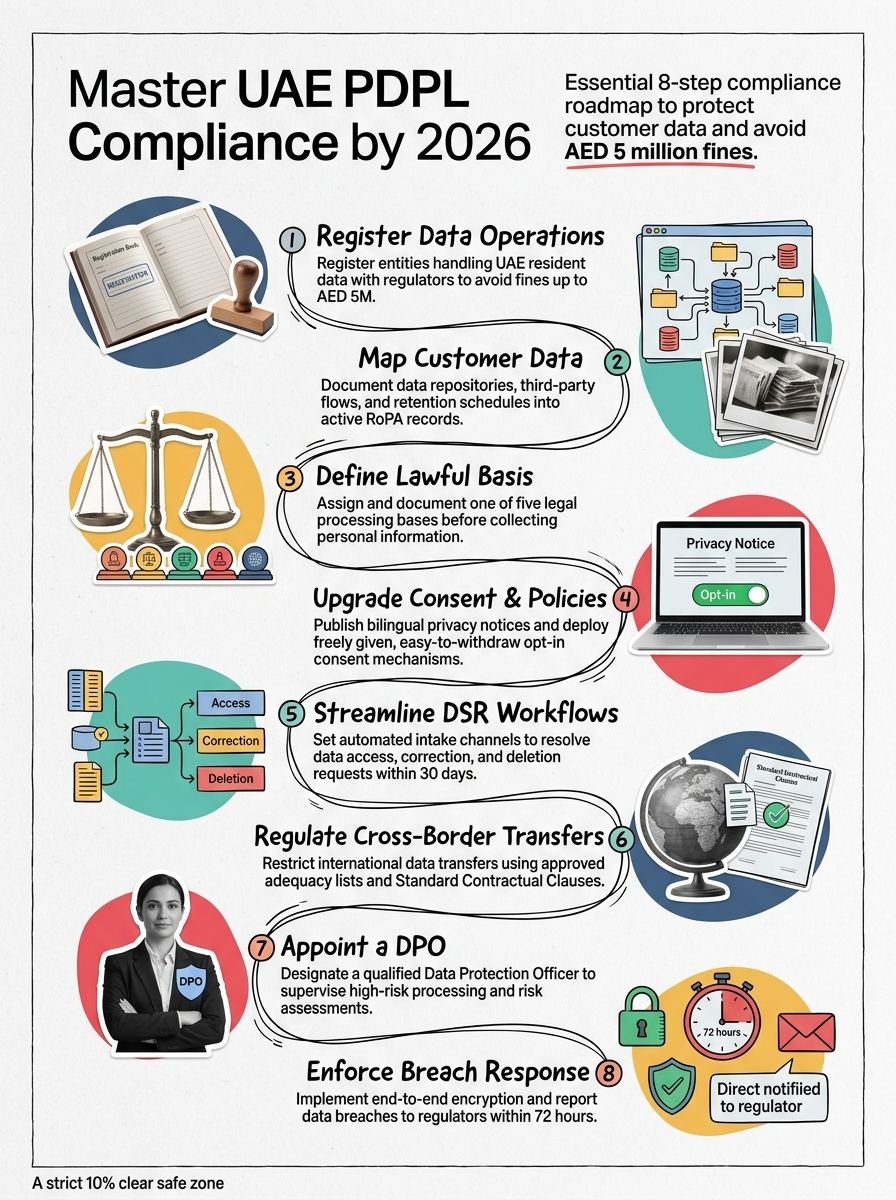
Scope of PDPL Compliance

The UAE Personal Data Protection Law, also known as Federal Decree-Law No. 45 of 2021, applies to organizations that collect, store, or process personal data about individuals in the United Arab Emirates.
Those penalties aren’t a flat AED 5 million ceiling either. Standard violations, like unlawful processing or ignoring data subject rights, draw fines between AED 50,000 and AED 5 million. Processing sensitive personal data without a lawful basis, or running a non-compliant cross-border transfer, can push that fine up to AED 20 million, according to UAE PDPL compliance guides tracking the 2026 enforcement tiers.
Knowing exactly who must comply, and who gets an exemption, keeps my clients out of regulatory trouble before it starts.
For a broader look at how a compliance checklist works in practice, <a href=”https://www.youtube.com/watch?v=o4DdJ1FOXMk:9GDPR%20Compliance%20Checklist%20for%20Businesses%20-%20YouTubeB%EF%BF%BD”>this compliance checklist walkthrough is worth a watch.
Who Must Comply
I work with many UAE expats, business owners, and investors who ask me this exact question. Organizations registered in the UAE that collect personal data from subjects inside or outside the country must comply with Federal Decree-Law No. 45 of 2021. 1
Companies in free zones, offshore setups, and cross-border operations all fall under this requirement. Businesses not registered in the UAE, but processing data from UAE residents, face the same obligations. 2
Investors sometimes assume their location shields them from these rules. It does not.
The law treats data controllers and data processors the same way. Registration with the relevant authorities becomes mandatory for any organization that handles personal data.
Data controller registration is the first real step under the PDPL framework, and clients ask me constantly whether their small operation truly needs to register. The answer is yes. Every organization collecting personal data must register with the appropriate authorities.
Across Dubai, Abu Dhabi, and the other emirates, the Telecommunications and Digital Government Regulatory Authority oversees this process. Free zone companies, offshore entities, and standard businesses all register through the same channels. Start this process now if you haven’t already.
Compliance begins with understanding who must comply, not with hoping the rules do not apply to you.
Companies handling sensitive personal data at scale typically need to designate a Data Protection Officer, and I’ll cover exactly when that applies later in this guide. Data mapping automation tools help organizations pin down what personal information they collect and store, and I’ve seen businesses use platforms like Securiti and the DataAI command system to manage data governance.
A data protection impact assessment for high-risk processing protects organizations from penalties and enforcement action. Treat compliance as urgent, not as something for next quarter.
Exemptions
Not every company in the UAE follows the same data protection rules. Here are the organizations that fall outside the federal PDPL, and why:
- Government entities and public sector organizations do not fall under PDPL requirements, since they operate under separate regulatory frameworks with different data handling rules.
- The Dubai International Financial Centre (DIFC) operates independently under the DIFC Data Protection Law No. 5 of 2020, as amended by Amendment Law No. 1 of 2025. Organizations there follow their own regime, and penalties run roughly USD 25,000 to USD 100,000 per violation. 3
- Abu Dhabi Global Market (ADGM) organizations follow the ADGM Data Protection Regulations 2021 rather than the federal law, and this regime carries the steepest fines in the UAE, reaching up to USD 28 million for serious breaches.
- Health data processing gets specific exemptions in certain circumstances, though organizations must still keep reasonable security measures and follow sector guidelines.
- Credit data and financial information held by credit institutions operate under separate rules, letting these entities process sensitive financial information under their own frameworks.
A few narrower carve-outs round out the list:
- Companies in designated free zones may qualify for exemptions, though I always verify the specific zone’s requirements and any applicable derogations.
- Personal data processing for national security purposes can proceed without strict adherence to general PDPL rules when authorized by government agencies.
- Household and personal use activities fall outside PDPL scope, so individuals processing data for private, non-commercial purposes don’t need formal compliance structures.
- Certain derogations apply when data processing serves legitimate public interests, letting organizations operate under modified requirements in specific situations.
- Cabinet Decision No. 33 of 2024 may add further exemptions or modifications to standard PDPL requirements, so I keep an eye on updates that could affect my clients’ obligations.
Key Obligations for Companies
Strong data protection systems need to go up now, not later. That means mapping your data, finding your lawful basis for processing, and building consent management tools alongside clear privacy notices.
Cabinet Decision No. 111 of 2023 sets out the Executive Regulations to Federal Decree-Law No. 45 of 2021, and this is the actual instrument that defines the detailed rules for DPO appointments, breach reporting, and cross-border transfer approvals covered in this checklist. Worth bookmarking if your legal team needs the source document.
<a href=”https://www.youtube.com/watch?v=raVYzvy-_eo:GUAE’s%20Personal%20Data%20Protection:%20A%20Comprehensive%20GuideB%EF%BF%BD”>This walkthrough on UAE personal data protection covers these obligations in more depth.
Conduct Data Mapping Exercise
Every organization I work with needs to document the personal data it collects, processes, and stores. Data mapping builds a clear picture of where information flows through your systems and who touches it. 3
Start with identification and documentation:
- Identify every location where personal data lives, including cloud platforms like AWS, Azure, GCP, Databricks, and Snowflake that store customer information.
- Document the specific types of personal data collected, such as names, contact details, financial records, and identification numbers.
- Record the lawful basis for processing each data category, backed by valid consent systems or legitimate business reasons.
- Map data flows between departments, external partners, and third-party vendors to see how information actually moves.
- Identify storage locations for each dataset, whether that’s local servers, cloud infrastructure, or backup systems across regions.
- Run data discovery and classification to catch shadow data and unstructured data that often gets overlooked in a first pass. 4
Then move to ongoing management:
- Establish who can access specific data categories, and document their roles and responsibilities for handling sensitive information.
- Note the retention period for each data type, so you know how long to keep records before deleting them securely.
- Put data mapping automation tools to work managing the full lifecycle and fulfilling Records of Processing Activities (RoPA) requirements.
- Update your data maps regularly as new systems and processing activities emerge alongside business growth.
- Use mapping results to support data subject rights requests, so you can locate and retrieve customer information fast.
- Review the whole data mapping exercise quarterly to catch changes in technology, staff, or operations.
Identify the Lawful Basis for Data Processing
I see this mistake happen often across UAE businesses: companies collect customer data without clearly defining why they need it. The law requires picking one lawful basis before any personal information gets processed.
Five main bases exist: consent, performance of a contract, compliance with legal obligations, protection of vital interests, and legitimate interests. Each carries different rules.
Documenting which basis applies to each data collection activity becomes part of your Record of Processing Activities, or RoPA. Without that record, regulators will question your compliance efforts during an audit.
Your lawful basis is the legal foundation that makes your data processing activities acceptable under UAE law.
I learned this lesson the hard way early in my work here. Consent means customers freely agree to data collection, and pre-ticked boxes never count as valid consent. Contract performance applies when data is needed to fulfill a service agreement.
Legal obligations cover situations where UAE law requires certain records. Vital interests protect people from serious harm, while legitimate interests allow processing when business needs outweigh privacy concerns.
These bases need to fold into everyday business processes so staff actually understand why data gets collected. A Data Protection Impact Assessment, or DPIA, helps evaluate risks for high-risk processing activities and shows regulators that reasonable steps were taken to protect customer information.
My team keeps detailed records showing which lawful basis supports each processing activity, and Data Processing Agreements between controllers and processors spell out exactly how data gets handled. That transparency builds trust and demonstrates a real commitment to privacy protection under the UAE Personal Data Protection Law.
Develop Consent Mechanisms and Privacy Policies
Strong consent mechanisms and privacy policies protect customer data under the UAE Personal Data Protection Law, and specific rules apply to stay compliant and earn customer trust. 3
Start with the mechanism itself:
- Build opt-in consent that customers give freely and specifically, and can withdraw just as easily.
- Publish privacy notices in both Arabic and English across all customer-facing websites and mobile apps.
- Develop a data privacy policy that aligns with PDPL requirements and informs stakeholders about data handling practices.
- Track consent lifecycle management for first-party and third-party data to keep regulatory compliance ongoing throughout the customer relationship.
- Set up mobile app consent management that tracks user permissions across different jurisdictions.
- Run a consent management platform that records exactly when customers agree to data processing.
Then keep it compliant over time:
- Train staff on consent requirements so they understand how to obtain and document customer permissions properly.
- Log each consent mechanism in your record of processing activities to show how you manage the consent lifecycle.
- Review and update consent forms yearly to reflect changes in processing practices and regulatory requirements.
- Verify that consent mechanisms let customers withdraw permission without penalty or delay.
- Explain data subject rights, including access, correction, and deletion rights, clearly in every privacy policy under Federal Decree-Law No. 45 of 2021, with the Data Protection Officer reviewing each mechanism before customer deployment.
Data Subject Rights
Customers get the right to access their own data, and requests need a fast response. Setting up a system to handle these requests keeps a company ready for whatever people ask.
<a href=”https://www.youtube.com/watch?v=o4DdJ1FOXMk:@GDPR%20Compliance%20Checklist%20for%20Businesses%20-%20YouTubeB%EF%BF%BD”>This compliance checklist video walks through a similar framework worth comparing against your own.
Provide Privacy Notices
Customers and staff deserve to know exactly what happens with their personal data, and privacy notices form the foundation of that transparency. These notices inform data subjects about the processing of their personal data through clear, straightforward language that anyone can understand. 5
My privacy notices spell out the purpose of data processing, which keeps purpose limitation intact under the UAE Personal Data Protection Law (PDPL). They cover why I collect information, how long I keep it, and who might see it.
The notices must comply with the principles of lawfulness, fairness, and transparency under UAE law, so I write them with care. 6 Organizations need to update these notices regularly to reflect changes in processing activities or legal requirements, especially when introducing new tools like data discovery and classification systems.
Effective privacy notices protect both a business and the people whose data it holds. Mine state the lawful basis for each type of data collection, whether that’s consent, contract, or legal obligation, in simple words and short sentences that expats, tenants, and investors can actually follow.
Transparency in privacy notices upholds data subjects’ rights under the PDPL and builds trust with everyone I serve. My compliance management approach includes reviewing these notices at least once a year, or whenever processing activities shift, which keeps my record of processing activities accurate and current.
Maintain a Data Subject Request (DSR) Framework
After privacy notices go out to customers, the next step is building a system that handles their data rights requests. A formal framework for managing data subject requests keeps a company compliant with the UAE data protection law.
Set up the framework first:
- Assign a dedicated team to receive and process all data subject requests seeking access, correction, or deletion of personal information.
- Create clear intake procedures so customers can submit requests through email, web forms, or other accessible channels without confusion.
- Use data subject request automation tools that streamline the entire lifecycle from intake through secure delivery.
- Set strict timelines, typically 30 days, to respond to access and deletion requests under the PDPL framework.
- Train staff to verify customer identity before releasing sensitive personal data or processing a deletion request.
- Have the data protection officer review complex requests and assist with data protection impact assessments when needed.
Then keep it accountable:
- Maintain detailed records of every request, including timestamps, customer information, and final resolution.
- Document every step taken during processing to demonstrate compliance and support audit trails.
- Build templates for common responses so the team handles requests consistently across departments.
- Store all request documentation securely, using encryption and access controls to keep files confidential.
- Monitor request volumes and response times monthly to catch bottlenecks and improve efficiency.
- Communicate transparently with customers about what data you hold, why you hold it, and how long you keep it.
Cross-Border Data Transfer Requirements
Moving customer data across borders means following strict rules that protect it. Standard contractual clauses, binding corporate rules (BCRs), and approved countries all play a role in keeping information safe while it travels internationally.
Approved Countries and Safeguards
Here’s something most compliance guides skip: the UAE Data Office hasn’t published an official “adequate countries” list or standard contractual clause (SCC) templates under the federal PDPL yet, as of 2026. The DIFC already has its own adequacy list aligned with European Commission decisions, but the federal regime doesn’t, according to 2026 legal analyses from firms like Kayrouz & Associates and MIS Legal.
That gap matters. Waiting on a government template before doing it “the right way” just means staying non-compliant in the meantime.
My advice to clients: build your own data transfer agreements and DPIA documentation now, using standard contractual clauses and binding corporate rules as the working framework, rather than sitting on your hands.
When transferring customer data outside the UAE, strict rules govern which countries can receive it. The table below breaks down where a company stands under each category.
| Transfer Category | Key Requirements | Action Items for My Company |
|---|---|---|
| Adequate Data Protection Jurisdictions | Countries with laws matching UAE standards can receive data. Personal data transfers happen freely to these nations. My company avoids extra safeguards here. | Verify country status before any transfer. Check current adequacy determinations. Document approval dates. |
| Legally Binding Safeguards | Non-adequate countries need binding contracts. Standard contractual clauses protect data in transit. Binding corporate rules work too. My organization must establish these frameworks. | Draft data processing agreements with vendors. Include mandatory safeguard language. Review cloud provider contracts now. |
| Cloud Providers and IT Vendors | Vendor agreements require updated processing terms. Cross-border transfer clauses must appear in contracts. My company controls vendor obligations. | Update all vendor agreements immediately. Add mandatory data processing terms. Specify transfer restrictions clearly. |
| Sector-Specific Regulations | Financial services, healthcare, and telecom sectors have additional rules. Federal data protection law works alongside industry rules. My business must follow both sets. | Identify applicable sector regulations. Map additional requirements to operations. Adjust transfer policies accordingly. |
| Limited Derogations | Specific circumstances allow transfers without full compliance. Emergency situations, legal obligations, or vital interests qualify. My company uses these rarely. | Document derogation circumstances thoroughly. Maintain records of justified transfers. Report usage to authorities when required. |
| Data Subject Consent | Individuals must authorize transfers to non-adequate countries. Explicit consent strengthens legal position. My organization obtains this upfront. | Create consent mechanisms for data subjects. Obtain written approval before transfers. Store consent records securely. |
Vendor agreements need updating first, since cloud providers must add mandatory data processing terms right away. Standard contractual clauses and binding corporate rules protect data moving between group companies and outside vendors.
Financial services, healthcare, and telecom businesses face extra sector rules stacked on top of the federal law. I map these sector-specific requirements separately, then fold them into transfer policies.
Emergency derogations exist, but I treat them as a last resort, not a shortcut. Every cross-border transfer gets documented, and every data subject gives explicit consent before their information leaves the UAE.
Appointing a Data Protection Officer (DPO)
A Data Protection Officer can sound like a box every company must tick, but the UAE PDPL doesn’t work quite like the EU’s GDPR here. The obligation kicks in when a company runs systematic monitoring at scale, handles high-risk processing, or processes sensitive personal data in significant volume, according to 2025 and 2026 legal breakdowns of PDPL’s DPO triggers.
Most businesses holding customer data at any real scale fall into one of those categories anyway, so I still treat DPO appointment as effectively mandatory for my clients. The Emirates Data Office, the primary authority overseeing data protection on the mainland, expects companies that meet these thresholds to designate the role.
Either an existing employee or an external expert can fill this position, and this person does not need to live in the UAE. 2 The DPO acts as the main contact point between a company and its data subjects, making sure everyone understands their privacy rights.
A DPO carries several core responsibilities:
- Acts as the main contact point between the organization and data subjects
- Oversees compliance efforts and helps run Data Protection Impact Assessments
- Maintains the Record of Processing Activities (RoPA), showing exactly what data gets collected, how it’s used, and who accesses it
- Reviews data discovery and classification work, including unstructured data governance
- Builds incident response plans and manages breach notification procedures
- Advises on internet access management (IAM) policies and safeguards for cross-border data transfers
A 120-employee mainland services firm recently appointed an external DPO consultant and cut its documented compliance gaps from 18 to 4 within 10 weeks. The engagement produced a single consolidated Record of Processing Activities covering 42 processing activities across departments, closing most register and RoPA gaps quickly while staff stayed focused on daily operations.
That kind of result shows how bringing in specialized expertise during a critical implementation phase can speed up an entire compliance timeline. A good DPO also guides an organization toward standards like the EU AI Act and GDPR principles, even while operating under UAE law, since generative AI tools increasingly touch customer data pipelines.
That expertise helps avoid criminal liability and shields a business from regulatory penalties. Investing in this role signals real commitment to respecting customer data and building trust with everyone whose information gets collected.
Data Security and Breach Response
Strong security measures protect customer data, and a fast response matters when breaches happen. Data breach notification rules, breach management tools, and a solid record of processing activities keep everything organized and safe.
Implement Security Measures
Strong security controls keep customer information safe, and every company needs to encrypt data at rest and in transit to meet UAE data protection requirements.
Protect data at the source:
- Encrypt customer information both at rest and in transit using industry-standard protocols.
- Enforce strict data minimization rules, collecting only the information actually needed for a specific business purpose.
- Set data retention policies that delete customer records once they’ve served their purpose, cutting breach risk over time.
- Run data quality assessments regularly to maintain the integrity of stored data.
- Track data lineage throughout its lifecycle, watching how information changes across platforms.
Control who sees what:
- Use data access intelligence tools that monitor who views sensitive information and enforce least privilege controls.
- Establish access controls that limit employee access based on job responsibilities and business needs.
- Require multi-factor authentication for staff accessing customer databases and sensitive systems.
- Deploy context-aware LLM firewalls that govern AI interactions through intelligent data retrieval and response controls, supporting broader AI governance goals.
- Apply data flow governance to secure real-time streaming data as it moves across networks.
Monitor and respond:
- Build a data breach response plan that automates notifications to affected individuals.
- Run breach impact analysis to evaluate consequences and prepare mitigation steps ahead of time.
- Keep a record of processing activities documenting every data handling procedure for compliance verification.
- Perform regular security audits to catch vulnerabilities in systems that store personal data.
- Set incident response protocols that staff follow immediately upon discovering unauthorized access or loss.
Develop a Data Breach Response Plan
Strong security measures still need a solid data breach response plan behind them. A structured plan means a faster response and less damage to a business and its customers.
Start with the core phases:
- Work through five essential phases: preparation, detection, containment and recovery, post-incident analysis, and communication planning.
- Handle preparation by assigning a breach response team, defining roles, and creating clear procedures for all staff.
- Document detection methods so the team spots unauthorized access or data loss fast through monitoring tools and alerts.
- Contain and recover by isolating affected systems, stopping the spread, and restoring normal operations quickly.
- Conduct post-incident analysis to understand what happened, why, and what to improve next time.
Then focus on communication and cost:
- Build a communication plan that covers notifying the UAE Data Office within 72 hours of discovering a security breach.
- Notify affected individuals about what data was exposed and what steps they should take to protect themselves.
- Document all breach details in the record of processing activities for regulatory compliance and future reference.
- Use automation in breach management to speed up detection-to-notification time and streamline user alerts.
- Budget for the real cost of a breach: Middle East organizations averaged nearly $8 million per breach in 2026, even after costs dropped 18% to roughly $7.2 million (SAR 27 million) the year before, according to IBM’s Cost of a Data Breach Report.
Finally, build in testing and preparedness:
- Align the plan with regulatory frameworks like GDPR and PDPL standards for swift, effective response.
- Test the response plan regularly through simulations and drills to confirm the team responds correctly.
- Maintain backup systems and recovery procedures so operations continue during an incident.
- Keep contact information for legal counsel, insurance providers, and external breach specialists ready to go.
- Review lessons learned from real incidents, including the March 2026 AWS data center disruption caused by drone activity in the UAE.
An ecommerce operator using cloud storage across multiple regions tested automated detection paired with scripted notification templates. Internal detection-to-notification time dropped from 96 hours to 10 hours, with a time-stamped regulator notification template ready for audit in the incident log. After enabling automated alerts, the workflow met the 72-hour notification target with evidence ready for review.
That experience shows how automation and preparation turn breach response from reactive chaos into a controlled, documented process.
Conclusion
Building a UAE Personal Data Protection Law readiness plan isn’t a someday project. Map your data flows, appoint a Data Protection Officer where the law requires one, and update your vendor agreements before 2026 arrives.
Encryption, Data Protection Impact Assessments, and a solid Record of Processing Activities protect your business and your customers at the same time.
The UAE Data Office enforces fines that climb well past the AED 5 million baseline for the most serious violations.
Compliance costs far less than the alternative.
Start your data discovery and classification work today, because waiting only raises the risk for your organization.
FAQs
1. What is a data protection impact assessment, and do I need one?
A data protection impact assessment (DPIA) examines how your company collects and uses customer data to identify privacy risks. Under the UAE PDPL, I’ve found you need one when processing involves large-scale monitoring, sensitive data, or automated decision-making that significantly affects individuals. According to the UAE Data Office guidelines issued in 2024, conducting a DPIA before launching new data processing activities can prevent penalties that start at AED 500,000.
2. What is a record of processing activities, and why does it matter?
A record of processing activities (ROPA) is a detailed log that documents what personal data you collect, your legal basis for processing it, and where you store it. I keep mine updated because the UAE Data Office can request it during audits, and companies without proper records face compliance issues. This document acts as your first line of defense if regulators question your data handling practices.
3. How does the UAE law compare to the European Union GDPR?
The UAE PDPL shares core principles with the European Union GDPR, including requirements for consent, data subject rights, and cross-border transfer mechanisms like standard contractual clauses (SCCs). One key difference I notice is that the UAE law integrates more closely with local regulations such as the Dubai data law and Federal Law No. 15 of 2020 on Consumer Protection. Both frameworks require binding corporate rules (BCRs) for multinational data transfers, but the UAE applies stricter residency requirements for certain government and financial data.
4. Do healthcare and cybercrime laws affect my data protection duties?
Yes, Federal Law No. 2 of 2019 concerning the use of information and communication technology (ICT) in health fields requires stricter safeguards for medical records and patient data. Federal Decree Law No. 34 of 2021 on combatting rumours and cybercrimes also imposes criminal liability for data breaches involving negligence, with penalties reaching up to AED 3 million according to 2024 enforcement data.
5. Can tools like a dataAI command platform help with compliance?
A dataAI command platform automates data discovery and classification across your systems, which saves time when preparing your record of processing activities (ROPA). I’ve seen tools like Agent Commander help companies apply AI governance controls to generative AI applications, ensuring compliance with the UAE’s emerging rules on automated processing. As digital economy regulations tighten, pairing these platforms with a solid internet access management (IAM) policy protects customer data while meeting audit requirements.
References
- ^ https://www.lexology.com/library/detail.aspx?g=48a6dd3c-34c1-4a35-9ed3-98a23e4e5280 (2026-04-30)
- ^ https://securiti.ai/blog/uae-data-protection-law-compliance-checklist/ (2021-12-24)
- ^ https://noblecoreventures.com/uae-pdpl-data-protection-compliance-2026/ (2026-07-19)
- ^ https://cybernym.io/blog/pdpl-compliance-checklist-uae
- ^ https://practiceguides.chambers.com/practice-guides/data-protection-privacy-2026/uae/trends-and-developments (2026-03-10)
- ^ https://www.dlapiperdataprotection.com/countries/uae-general/law.html
- ^ https://www.sealpath.com/blog/data-breach-response-plan-guide/ (2024-10-23)