

Business owners across the UAE’s free zones keep asking me the same question this year: does the 0% corporate tax rate survive past 2026?
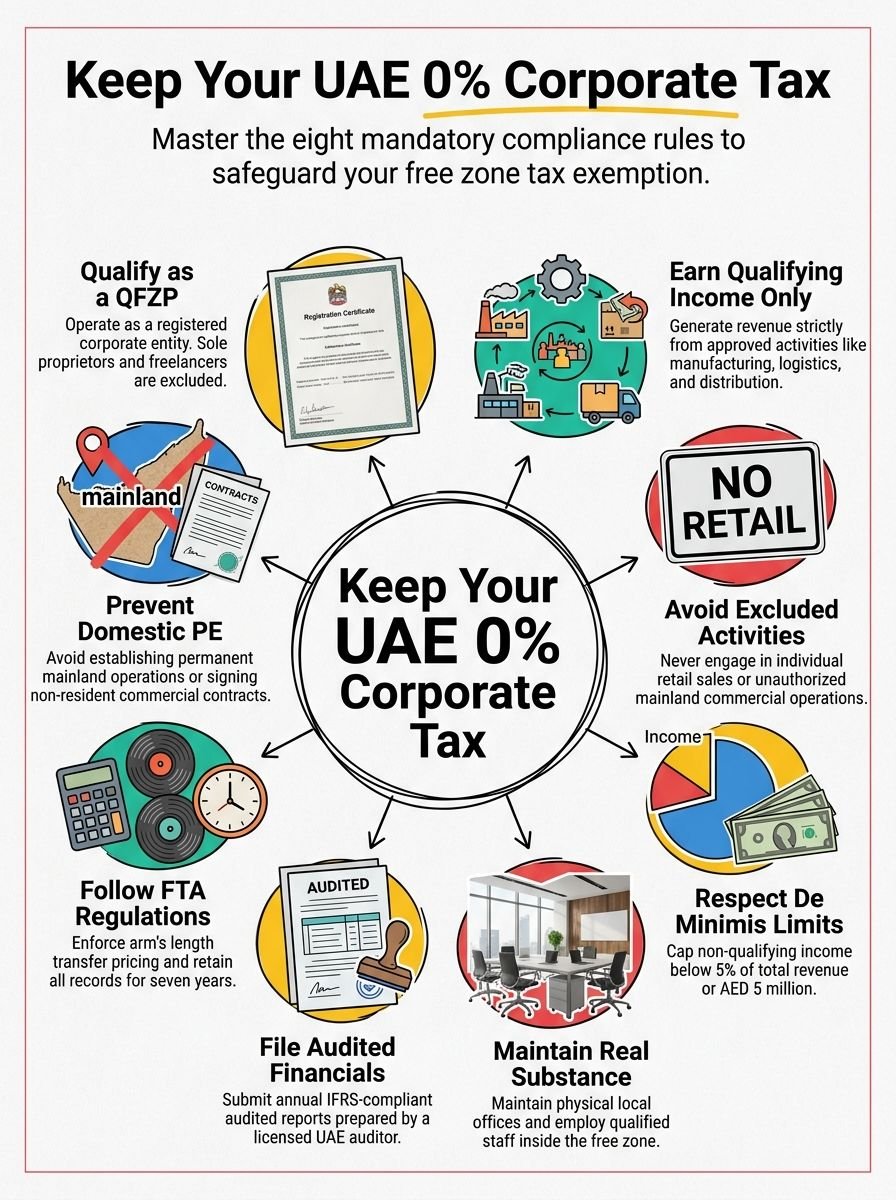
It’s a fair worry. I’ve spent months studying the new tax rules, and the Federal Tax Authority (FTA) actively enforces eight specific conditions before any free zone company keeps that 0% rate. 1
Here’s the distinction a lot of owners miss: a free zone license alone doesn’t grant that 0% rate. Meeting eight conditions does, every single tax period, without exception. 3
I’ll break down each condition, explain why the Federal Tax Authority enforces it, and show you exactly how to protect your qualifying income and your 0% status through 2026 and beyond.
Key Takeaways
- Free zone companies must qualify as QFZPs and earn only qualifying income to keep the 0% corporate tax rate past 2026.
- Businesses lose their 0% tax status right away if non-qualifying income tops 5% of revenue or AED 5 million a year.
- Companies face a mandatory five-year disqualification period after losing QFZP status and cannot requalify until year six.
- Maintaining adequate substance means real offices, qualified employees based in the free zone, and core decisions made locally.
- Filing audited financial statements every year under IFRS standards proves qualifying income sources and protects the 0% tax benefit.
Understanding the 0% Tax Rate for Free Zone Companies

Let me clear up something first, because a lot of business owners assume a free zone license alone guarantees the 0% tax rate. That assumption is wrong.
Under the UAE Corporate Tax law and Federal Decree-Law No. 47 of 2022, only a “Qualifying Free Zone Person,” or QFZP, gets the 0% tax benefit. 1 Simply operating inside a free zone does not automatically qualify a business for tax exemptions.
Companies must meet five strict conditions every tax period to keep QFZP status and the 0% rate. 2 The standard UAE corporate tax rate sits at 9%, though small businesses and non-resident entities have different provisions. Sole proprietors and freelancers cannot access the 0% rate at all, and free zone companies still have to register and file for corporate tax with the Federal Tax Authority even when they qualify.
A free zone license alone does not guarantee the 0% tax benefit. Qualifying income and proper compliance determine your actual tax status.
Qualifying income sits at the center of this whole system. Businesses must earn only qualifying income to keep the 0% rate, and excluded activities disqualify a company from QFZP status automatically.
A 5% de minimis rule adds some flexibility here. It lets companies earn a small amount of non-qualifying income without losing their tax benefits, which helps businesses that occasionally pick up income outside their core qualifying activities.
- Earn qualifying income only, and stay clear of the excluded activities list
- Track non-qualifying income against the 5% de minimis threshold
- Keep real operational substance in the free zone
- File audited financial statements every year
- Stay compliant with FTA rules and avoid a domestic permanent establishment
Income classification matters too, since the FTA reviews how companies categorize their earnings during tax audits. Transfer pricing and the arm’s length principle apply whenever a free zone company transacts with related parties.
Adequate substance in the UAE is not optional if you want to keep QFZP status. Companies must file audited financial statements every year to show they meet tax administration requirements, and staying compliant with FTA rules while avoiding domestic permanent establishment status protects the exemption long term.
<a href=”https://www.youtube.com/watch?v=Bbla3DhIEsk:HUAE%20Free%20Zone%20Tax%20Filing%20Walkthrough%202026%20-%20YouTubeB%EF%BF%BD”>Watch this UAE free zone tax filing walkthrough for 2026
The 8 Conditions to Maintain the 0% Tax Rate
Eight specific conditions stand between a free zone business and that 0% tax rate in the UAE. These rules come straight from Cabinet Decision No. 100 of 2023 and Ministerial Decision No. 229 of 2025, so I take them seriously.
A company has to qualify as a Qualifying Free Zone Person (QFZP), earn only qualifying income, and steer clear of excluded activities. On top of that, it needs to watch the de minimis rule closely, keep real business substance, file audited financial statements, stay compliant with FTA regulations, and never let the business create a domestic permanent establishment.
<a href=”https://www.youtube.com/watch?v=TsjlILNYGDY:DNew%20Compliance%20Rules%20for%202026%20for%20Free%20Zone%20BusinessesB%EF%BF%BD”>See the new 2026 compliance rules for free zone businesses
Qualifying as a Free Zone Person (QFZP)
Understanding what makes a company a Qualifying Free Zone Person, or QFZP, comes first, since this status directly grants the 0% tax rate on qualifying income. 3 A business only qualifies as a QFZP if it operates as a juridical entity, meaning a corporation, LLC, or branch registered in a recognized UAE free zone.
Sole proprietors and freelancers cannot reach QFZP status, no matter how well the business performs. The Ministry of Finance set strict rules through Cabinet Decision No. 100 of 2023 and Ministerial Decision No. 229 of 2025 to define who gets this treatment, and a company must meet five cumulative conditions every year to hold onto it.
Free zone registration alone does not hand out QFZP status. A business has to satisfy strict criteria set by the Ministry of Finance (MOF) and the FTA, and any entity that fails to qualify faces the standard 9% corporate income tax rate instead.
- Register and operate as a juridical entity in a recognized free zone
- Formally elect for QFZP status and commit to audit and substance rules
- Meet all five cumulative conditions the FTA reassesses every tax period
- Keep your TRN, or Tax Registration Number, in good standing with the FTA
- File audited financial statements through EmaraTax each year
The FTA reassesses QFZP status every tax period, so past performance doesn’t carry a business forward automatically. Losing QFZP status makes a company ineligible for Small Business Relief for five years, which creates real financial consequences.
Worth knowing here: QFZPs were never eligible for Small Business Relief to begin with, since that relief exists for businesses that don’t already have the 0% rate. According to a 2026 update on the UAE Ministry of Finance’s Small Business Relief decision, reported by willow.law, the AED 3 million revenue threshold for Small Business Relief eligibility now covers tax periods ending on or before December 31, 2029, three years longer than businesses may expect. That extension matters as a fallback plan if a company ever loses QFZP status, since Small Business Relief becomes the next option on the table.
A business also has to avoid excluded activities that would disqualify it from QFZP treatment altogether. Transfer pricing rules and the arm’s length principle apply to transactions with related parties, and withholding taxes on certain payments affect the overall tax position as well.
Adequate substance in the free zone, avoiding domestic permanent establishment status, and sticking to the 5% de minimis rule all work together to protect QFZP qualification. A tax advisor’s report helps track compliance across all five conditions, since this status needs steady attention and solid documentation to protect the tax savings a qualified free zone entity can access.
Earning Qualifying Income Only
Once QFZP status is locked in, the real work is earning only qualifying income. This one distinction separates businesses that keep their 0% tax rate from those stuck paying the standard 9% corporate tax rate. 4 Revenue has to come from approved qualifying activities, and those activities shape the entire tax position.
Qualifying income covers a defined list of activities, and I learned this firsthand while filing annual corporate tax returns with the Ministry of Finance:
- Manufacturing and processing
- Logistics and distribution within designated free zones
- Holding shares or equity interests in other entities
- Transactions with foreign entities or other free zone businesses
Core income-generating activities have to happen inside the free zone itself, not somewhere else. As long as the work behind it stays local, revenue from foreign entities or other free zone businesses still counts as qualifying income.
Non-qualifying income cannot exceed 5% of total revenue or AED 5 million in any given year. 5 Cross that 5% de minimis threshold, and the favorable tax status disappears entirely, not partially.
Filing audited financial statements each year helps track income streams and prove compliance with these rules. Monitoring revenue sources continuously matters, because one mistake in income determination could cost a business its tax incentives and push the full 9% rate onto all corporate income.
Avoiding Excluded Activities
Excluded activities can strip away the 0% tax rate faster than most business owners expect. Transactions with individual retail consumers, for instance, do not count as qualifying income and can put QFZP status at risk.
Per the Federal Tax Authority’s Free Zone Persons Corporate Tax Guide, published on tax.gov.ae, this is the primary document defining which activities count as qualifying versus excluded, and it confirms that transactions with mainland natural persons, meaning individual consumers, generate non-qualifying income. That guide is worth checking directly if you want to verify your own activity classification instead of relying on a secondhand summary.
A handful of activities show up again and again on the excluded list:
- Transactions with individual retail consumers
- Ownership of intellectual property
- Non-qualifying banking and insurance services, unless allowed under Ministerial Decision No. 265 of 2023
- Retail transactions with mainland customers
Engage in excluded activities, and the 0% tax rate disappears immediately, with the non-qualifying income taxed at 9% instead. 5
Decision-making activities need to happen from within the free zone to keep eligibility intact. Real substance means conducting actual business functions from the free zone location rather than directing everything from outside it.
Investors have lost tax credits and incentives simply by performing excluded activities without realizing the consequences. The arm’s length principle applies to every transaction, so each deal needs to follow fair market standards, with qualifying and non-qualifying income documented separately to satisfy FTA regulations and protect the tax benefits free zone companies rely on. 6
Adhering to the 5% De Minimis Rule
The de minimis rule works like a safety net. It allows non-qualifying revenue up to AED 5 million or 5% of total revenue, whichever is lower, without costing a business its 0% tax rate. 6 A company earning AED 100 million in total revenue, for example, can earn up to AED 5 million from non-qualifying sources and still keep its tax benefits.
Transactions with natural persons and ownership of immovable property both count as non-qualifying revenue, and the FTA expects businesses to track these amounts with precision. Exceeding the de minimis threshold triggers a 9% tax on all income, not just the excess, for the current tax period and the following four. That penalty hits the entire revenue stream, which makes this one of the costliest mistakes a free zone company can make.
Recent compliance reviews of free zone tax filings show why systematic monitoring matters. In one quarterly review covering 36 free zone entities for the 2025 tax period, four companies reported non-qualifying income between 4% and 6% of total revenue, and two of those exceeded the AED 5 million absolute cap. Quarterly monitoring flagged the upward trend in month two for both cases. One company adjusted its contracts and brought non-qualifying income back under 5%, preserving QFZP status. The other missed the correction window, breached the AED 5 million cap, and lost the 0% tax benefit entirely.
That outcome shows exactly why quarterly de minimis tracking matters. It catches borderline cases early, while there’s still time for corrective action before the audited year end arrives.
- Calculate non-qualifying revenue against the AED 5 million cap or 5% threshold every quarter
- Separate qualifying and non-qualifying income clearly in audited financial statements
- Apply the arm’s length principle to keep related-party transactions documented and fair
- Adjust contracts early if a quarter shows non-qualifying income trending upward
Consulting a tax professional helps confirm this rule gets applied correctly, since one missed quarter can undo a year of otherwise clean compliance.
Maintaining Adequate Substance
Beyond the 5% rule, adequate substance forms the backbone of free zone tax benefits. A business needs a real operational presence in the free zone itself, not just a mailing address.
That means a physical office, qualified employees on staff, and core decision-making happening right there in the free zone. The FTA runs regular assessments, so operations cannot sit in the free zone on paper while the real work happens elsewhere. Operational spending has to match the scale of activity too, or auditors will start asking questions during tax periods.
Compliance audits of free zone operations preparing 2026 audited financial statements point to common substance gaps. One compact audit covering 12 free zone entities found substance mismatches in 7 cases. The most common issue was a mismatch between declared business activity and staff location: average office area measured 35 square meters, while the recorded headcount implied a need for roughly 120 square meters. Five of those entities also lacked even one role defined as a core income-generating employee based in the free zone.
Gaps like that showed up in over half the files reviewed, and they tend to trigger follow-up questions from the FTA during tax audits. Aligning physical presence, employee roles, and operational scale with the declared qualifying activities is what keeps a substance review from turning into a bigger problem.
- Qualified employees based physically in the free zone, not remote staff spread across other emirates majalis regions
- Office space and lease agreements that match the declared headcount
- Operational expenditure receipts that reflect real activity in the free zone
- Records kept for a minimum of seven years in case the FTA asks for proof
Core income-generating activities need employees who actually do the work, not staff hired to fill desks. The FTA reassesses substance every tax period, and losing adequate substance means losing QFZP status, along with the 0% tax rate that comes with it.
Filing Audited Financial Statements
Solid financial records prove real business activity, which is exactly what audited financial statements do. This step separates companies that truly operate in free zones from those that just claim to.
Audited financial statements follow International Financial Reporting Standards, or IFRS, and a registered UAE auditor has to prepare them, not just any accountant. Filing happens through the annual return, with audited financials submitted within nine months after the financial year ends.
Starting in 2026, QFZPs need audited financial statements ready no matter how much revenue the business brings in. That rule doesn’t apply the same way to every taxable person, though, and the distinction trips up a lot of business owners:
| Business Type | Audit Requirement |
|---|---|
| Qualifying Free Zone Person (QFZP) | Audited financial statements required regardless of revenue |
| Non-tax-group taxable person | Audited financial statements required only above AED 50 million in annual revenue |
| Tax Groups | Audited Special Purpose Aggregated Financial Statements required regardless of revenue |
Per FTA Decision No. 7 of 2025 and Ministerial Decision No. 84 of 2025, as summarized by Deloitte Middle East’s 2026 tax alert, this framework confirms QFZPs get no revenue exemption from the audit requirement, unlike other taxable persons. Failure to maintain audited financial statements can affect eligibility for the 0% tax regime a business worked hard to secure. 8
These statements serve as proof of genuine QFZP status, showing the FTA that income comes from qualifying sources and that a company follows the rules on corporate income taxes. Firms like ADS Auditors help prepare and file these statements to stay compliant with all requirements, and regular reassessment of qualifying status always comes back to reviewing these records closely. 7
Staying Compliant with FTA Regulations
Staying compliant with FTA regulations keeps the 0% tax status intact, especially given recent significant developments in enforcement. The Federal Tax Authority actively audits free zone companies for compliance with the newer tax rules, so these obligations aren’t optional.
Every free zone company registers for corporate income taxes with the FTA, even when seeking QFZP status. Accounting records need to stay safe for at least seven years, with all supporting documents stored properly.
New supplier and transaction verification rules take effect October 1, 2026, and they add real work for anyone buying from UAE suppliers. According to UAE FTA Decision No. 13 of 2026, reported by VATupdate and Khaleej Times in August 2026, businesses now need enhanced due diligence, including bank confirmation and reputational screening, for any supplier with transactions over AED 375,000 in a rolling 12-month period.
- Suppliers under AED 10,000 in transactions are generally exempt from the enhanced checks
- That exemption disappears once cumulative purchases from one supplier pass AED 100,000 in 12 months
- Records should show bank confirmation and reputational screening for flagged suppliers
- Non-compliance brings fines and operational restrictions from the FTA or Free Zone Authority
Filing audited financial statements on time, keeping proper records, and following federal tax law without exception all matter here. Related party transactions must follow the arm’s length principle, with everything disclosed in the corporate tax return, and taxes on corporate income apply across every part of the business.
VAT registration and filing obligations apply unless an entity falls below the mandatory threshold, so checking that status regularly is worth the effort. Keeping free zone operations separate from any domestic permanent establishment status rounds out the picture, and it protects the tax benefits a business worked to build.
Avoiding Domestic Permanent Establishment (PE) Status
Keeping the 0% tax rate also means paying close attention to permanent establishment rules under Article 14(7) of the UAE Corporate Tax Law. 10 Physical presence in the UAE does not automatically create a PE if the situation counts as temporary and exceptional, the kind of circumstance tied to something like the COVID-19 pandemic.
Regularly concluding contracts for non-resident persons can trigger PE status, though, and that subjects a company to the standard 9% corporate tax on profits above AED 375,000. Activities classified as preparatory or auxiliary do not establish PE under Article 14, Clause 3, which is why sticking to these safer activities matters.
State-sourced income from services performed in the UAE complicates PE assessments quite a bit, so structuring operations carefully and keeping proper documentation with the FTA becomes essential.
- Stay within the safe harbor provisions introduced on October 25, 2022, when the UAE Corporate Tax regime took effect 11
- Avoid conducting business through dependent agents or fixed places of business in the UAE
- Classify staff roles carefully, since employees working for foreign entities sit in a gray area under current rules
- Apply the arm’s length principle and document every related-party transaction
My own strategy involves separating qualifying income from any activity that might establish a domestic PE. Structuring contracts so decision-making authority stays outside the UAE prevents the appearance of a fixed place of business.
Excise taxes on certain goods and compliance with Dubai police regulations for business operations factor into the wider compliance picture too. Staying alert to these PE rules protects free zone status and keeps tax obligations at 0%, letting a business grow without surprise tax bills.
What Happens if You Lose the 0% Tax Status
Losing Qualifying Free Zone Person status happens more often than most business owners expect, and the consequences hit fast. Here’s what actually happens once that 0% tax status disappears:
| Consequence | What This Means for You |
|---|---|
| Immediate Tax Rate Jump to 9% | Taxation kicks in at 9% on taxable income above AED 375,000 right away. 12 This isn’t a year-end adjustment. The Free Zone Authority applies it retroactively to the tax period when non-compliance occurs, and the entire year’s income gets recalculated under the new rate. |
| Retroactive Application to Failure Year | The FTA applies penalties back to whenever the violation happened. One company exceeded the de minimis limit in month three and owed taxes from January onward, since loss of QFZP status becomes retroactive to the start of that tax period. |
| Five-Year Disqualification Period Begins | A business cannot regain QFZP status for five years after losing it. This disqualification period is strict, with no reinstatement applications allowed. The clock starts the moment the FTA determines non-compliance occurred. |
| Requalification Only After Year Six | Re-qualifying for QFZP status means demonstrating full compliance on the sixth-year tax return, filed with the FTA. One missed deadline or violation pushes the waiting period out further, which makes year six the first real opportunity. |
| Loss of Prior Year Tax Losses | Accumulated tax losses from prior years disappear completely. Carrying forward losses isn’t possible after losing QFZP status, which hits startups that operated at a loss especially hard, leaving them to start fresh with zero carryforwards. |
| FTA Audit Rights Extend Five Years Back | The Free Zone Authority can audit a company up to five years back once it loses status. Financial records, transfer pricing documentation, and substance evidence all become critical evidence, since the FTA scrutinizes whether adequate substance existed throughout those years. |
| Transfer Pricing Rule Violations Trigger Loss | Failing to comply with transfer pricing rules costs a business its QFZP status outright. These rules require pricing related-party transactions at arm’s length, and the FTA catches violations during audits, where one mispriced transaction can undo an entire 0% tax position. |
| Permanent Establishment Issues Create Additional Liability | Establishing a domestic permanent establishment outside the free zone, meaning operating a location in mainland UAE without proper authorization, triggers loss of status too. The FTA treats this as tax avoidance, taxing the UAE income in full and adding penalties on top. |
| De Minimis Rule Breaches End Everything | Non-free zone income exceeding 5% of total revenue ends QFZP status, and the FTA monitors this ratio every year. One year over that threshold triggers immediate loss of status, regardless of business size or circumstances. |
<a href=”https://www.youtube.com/watch?v=Bbla3DhIEsk:HUAE%20Free%20Zone%20Tax%20Filing%20Walkthrough%202026%20-%20YouTubeB%EF%BF%BD”>Review the full UAE free zone tax filing walkthrough
Tips to Ensure Compliance with the 8 Conditions
Clear steps keep a free zone tax status safe year after year. These actions protect a business from losing the 0% tax rate. 13
Track Income and Filings
- Monitor the de minimis position every quarter to track non-qualifying income levels. Advanced print options in most tax software make it easy to pull a tailored report each quarter, which stops the 5% threshold from sneaking up unnoticed.
- Keep records for seven years so the business stays ready for any audit. 9 Tax advisors help organize financial statements and transfer pricing documentation properly.
- Minimize non-qualifying income to protect the 0% tax rate from erosion, and avoid excluded activities that could trigger unexpected tax obligations.
- Keep transfer pricing documentation current with business operations and market conditions, which protects a company if authorities question how related-party transactions get priced.
Protect Substance and Stay Current
- Reassess operational substance twice a year, checking office space and staff qualifications, to stay qualified as a free zone person under FTA rules.
- Have professional auditors verify IFRS compliance and validate arm’s length principle application, since their reports prove to authorities that a business follows every regulation correctly.
- Stay alert to FTA regulatory changes, especially the new supplier verification requirements starting October 1, 2026, so operations can adjust before new rules take effect.
- Check trusted UAE compliance resources, like an incorporation playbook, for guidance across every relevant topic area, which keeps a business ahead of problems instead of reacting to them.
Conclusion
Keeping the 0% corporate tax rate in a UAE free zone comes down to real attention to eight key rules. Businesses lose this benefit the moment they skip even one condition, and the Federal Tax Authority watches closely for violations.
Staying focused on qualifying income, maintaining real substance, and filing audited financial statements every year makes the difference. Break these rules, and a company faces the standard 9% corporate tax rate plus a five-year ban from the 0% benefit.
Start the compliance plan today.
Protecting a free zone business’s most valuable tax advantage through 2026 and beyond starts with treating these eight conditions as non-negotiable, not optional extras.
FAQs
1. What is the arm’s length principle, and why does it matter for UAE free zones?
The arm’s length principle requires related companies to price their transactions as independent parties would in an open market. I’ve found this matters enormously for UAE free zones because the Federal Tax Authority uses it to verify you’re not artificially shifting profits to dodge the 9% corporate tax. If your intercompany pricing looks suspicious, you could lose your 0% rate.
2. Do UAE free zones tax personal income?
No, the UAE does not impose personal income tax on salaries or wages, and this remains unchanged in 2026. I can confirm that only corporate business profits are subject to the 9% tax if free zone conditions aren’t met.
3. Who is Arinjay Jain, and why does his view matter here?
Arinjay Jain is a tax advisor who specializes in UAE free zone compliance and corporate tax regulations. I reference his expertise because he has practical experience helping businesses navigate the 2023 Corporate Tax Law implementation and its impact on free zone entities.
4. Does winning an award, like the SAP Global Innovation Award, affect a company’s tax status?
No, business awards like the SAP Global Innovation Award have no bearing on your tax status. Your 0% free zone rate depends solely on meeting the qualifying conditions outlined in UAE Cabinet Decision No. 55 of 2023.
References
- ^ https://www.linkedin.com/pulse/uae-corporate-tax-practical-insight-1-free-zone-person-jain-i0jic
- ^ https://taxsummaries.pwc.com/united-arab-emirates/corporate/tax-credits-and-incentives (2026-03-12)
- ^ https://www.rascorporateadvisors.com/qfzp-status-uae-2026-how-free-zone-companies-can-actually-keep-the-0-tax-rate
- ^ https://essenceuae.com/blog_details/?id=63
- ^ https://dubaisouthbh.com/blogs/qualifying-free-zone-person-and-qualifying-income-explained
- ^ https://ancova-associates.com/insights/uae-free-zone-corporate-tax-2026 (2026-07-13)
- ^ https://adsauditors.com/blog/uae-free-zone-corporate-tax-0-tax-eligibility-compliance
- ^ https://advantia.ae/audited-financial-statements-in-uae-free-zones-who-is-required-when-the-deadline-falls-and-what-non-compliance-actually-costs/ (2026-08-10)
- ^ https://www.linkedin.com/pulse/free-zone-tax-reporting-obligations-uae-corporate-vat-compliance-y6kef
- ^ https://legalblogs.wolterskluwer.com/international-tax-law-blog/cit-in-the-uae-the-pe-clause-for-individuals/ (2023-04-21)
- ^ https://www.linkedin.com/pulse/qualifying-free-zone-entity-explained-how-retain-0-q6e6f
- ^ https://www.easmea.com/what-happens-if-you-lose-your-qualifying-free-zone/
- ^ https://ctconsultancyuae.com/corporate-tax-uae-free-zone-the-2026-strategic-compliance-guide/ (2026-07-16)