

The UAE corporate tax deadline 2026 falls on September 30, and every taxable person in the country needs to know it by heart.
Ask any UAE finance team what keeps them busy every September, and you’ll hear the same story: the Federal Tax Authority offers no extensions, no grace period, and no exceptions.
That single date is really the line that separates compliant businesses from penalized ones.
I’ll walk you through the exact corporate tax filing deadline for your financial year-end, what late filing and late payment actually cost, the documents the FTA expects, and the practical steps that keep your business penalty-free.
Key Takeaways
- File your corporate tax return by September 30, 2026, with the Federal Tax Authority through EmaraTax. No extensions apply.
- Late filing costs AED 500 per month for the first year, then AED 1,000 per month after that, plus a 14% annual penalty on unpaid tax.
- You’ll need audited financial statements, an accurate taxable income calculation, and transfer pricing documentation if your business has related-party transactions.
- Businesses earning up to AED 375,000 pay zero tax. Income above that faces the 9% corporate tax rate.
- Register with the FTA within three months of launching your business, or risk a AED 10,000 late registration penalty.
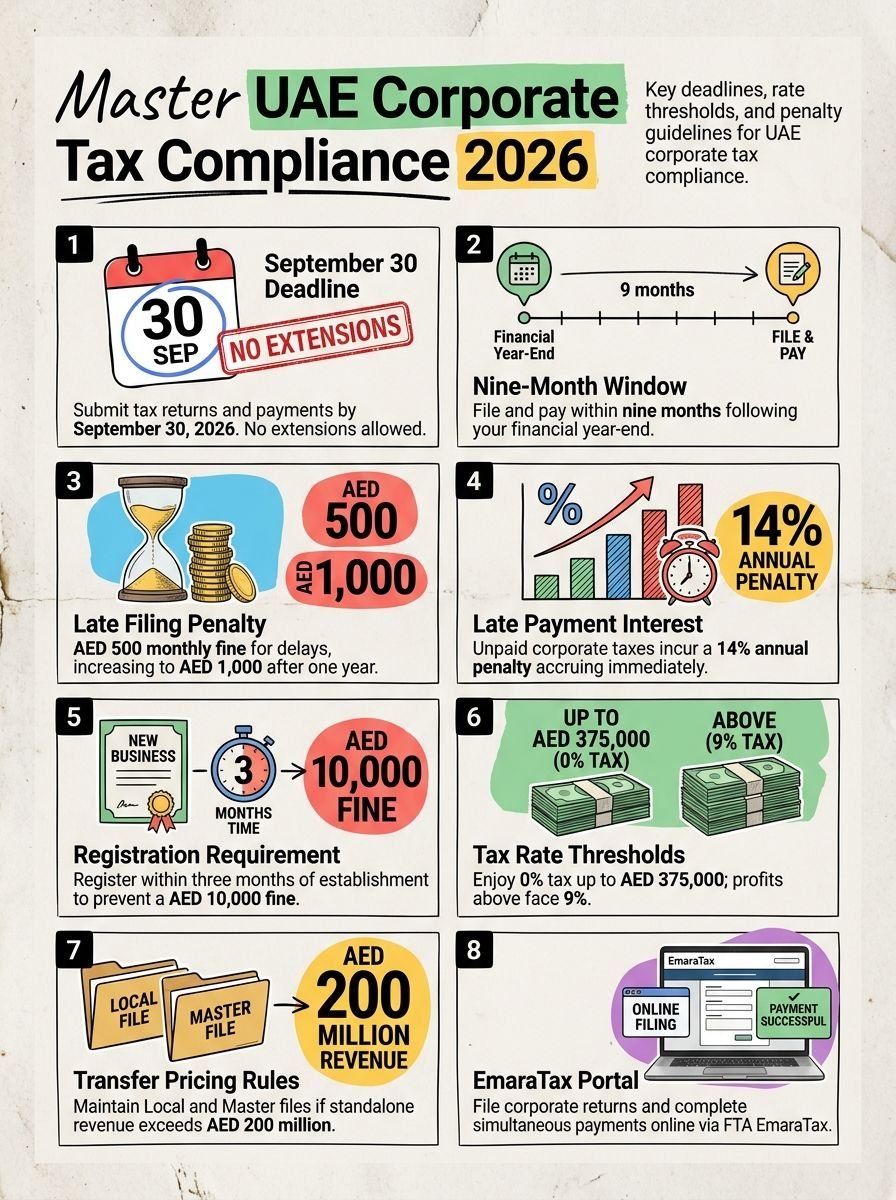
UAE Corporate Tax Deadline 2026: Key Filing Dates

Every taxable person must file their corporate tax return by September 30, 2026, through the Federal Tax Authority’s EmaraTax portal. The exact date that applies to you depends on your financial year-end, and that detail shapes your entire compliance plan.
<a href=”https://www.youtube.com/watch?v=2p2i7OQvhzU&vl=en:AUAE%20Corporate%20Tax%20Filing%202026%20%E2%96%B6%EF%B8%8FComplete%20…%20-%20YouTubeB%EF%BF%BD”>this UAE Corporate Tax Filing 2026 walkthrough
30 September 2026: Final Filing Date
September 30, 2026 is the last day to submit both your corporate tax return and your payment to the Federal Tax Authority. This deadline applies to any entity with a fiscal year ending December 31, 2025, and there’s no option to request an extension.
The nine-month rule drives this timeline. Close your accounting records by June 2026 if you want breathing room before the deadline lands.
- Filing and payment happen together. No grace period sits between the two.
- This is the first corporate tax return due under the regime set out in Cabinet Decision No. 75 of 2023.
- Audited financial statements, an accurate taxable income calculation, and transfer pricing documentation should all be ready if your business operates across multiple entities.
- Free zone businesses face this same deadline. Location inside the UAE changes nothing.
- Small business relief may reduce your tax liability, depending on your revenue.
Missing the September 30, 2026 deadline costs more than penalties. It affects your business credibility and your tax compliance record.
The consequences for missing this date are real. Late filing penalties start at AED 500 per month, and late payment penalties accrue at 14 percent per annum on any unpaid tax.
Your bookkeeping needs to be accurate and complete, since the FTA reviews accounting records during audits. I recommend working with professional CFO advisory services, such as businessheads advisory or MBG Corporate Services, to make sure your filing meets every requirement.
Preparing financial statements now, and organizing documentation early, protects your business from strain later.
Financial Year-End Adjustments and Specific Deadlines
Deadlines shift based on your financial year-end, not the calendar year. Every tax period gives you nine months from year-end to file and pay your corporate tax return with the FTA.
| Financial Year-End | Filing & Payment Deadline |
|---|---|
| December 31, 2025 | September 30, 2026 |
| March 31, 2026 | December 31, 2026 |
| June 30, 2026 | March 31, 2027 |
| September 30, 2026 | June 30, 2027 |
Mainland, free zone, and offshore companies all follow this same nine-month window. Your registration status doesn’t change your deadline.
- Short tax periods shift the standard math. Calculate your submission date from your actual period-end, not the usual dates.
- If your business stops trading, notify the FTA right away so your tax period adjusts correctly.
- Financial statements need to follow IFRS standards before you calculate taxable income.
- Transfer pricing documentation becomes due within this same nine-month window if you’re part of a tax group or run related-party transactions.
Filing through EmaraTax lets you submit your return and payment at the same time, which cuts your risk of late payment penalties at 14% per annum.
Penalties for Missing the Filing Deadline
Missing your corporate tax deadline brings real financial pain. The FTA charges late filing penalties and late payment penalties that grow larger every month you wait.
<a href=”https://www.youtube.com/watch?v=wzOQhVqhX2g&vl=es-US:HThe%20Tax%20Deadline%20That%20Quietly%20Voids%20Your%200%%20Rate%20-%20YouTubeB%EF%BF%BD”>this explainer on the tax deadline that can quietly void your 0% rate
Late Filing Penalty: AED 500/Month
The Federal Tax Authority charges a late filing penalty of AED 500 for each month, or part of a month, during the first twelve months after the September 30, 2026 deadline passes. File just one day late in October, and you owe AED 500 right away.
That structure gets steeper after year one. Penalties jump to AED 1,000 per month for any delay beyond the first twelve months.
Every registered business must file a return, whether it owes tax or not. Skipping this step triggers corporate tax penalties automatically.
- Filing three months late means AED 1,500 in penalties alone, separate from any late payment charge.
- Late filing penalties differ entirely from late payment penalties, which run at 14% per annum on unpaid tax.
- Free zone persons and standard entities face identical penalty structures. Registration status offers no protection.
Filing on time costs nothing. Filing late costs everything.
Late Payment Penalty: 14% Per Annum
Filing on time matters, but paying on time matters more. Beyond the AED 500 monthly filing penalty, a steeper cost catches many business owners off guard.
The FTA applies a 14% annual penalty on any unpaid corporate tax, and it starts accumulating the day after your payment due date passes. This penalty compounds monthly, so your debt grows every month you delay.
There’s no grace period for tax payments. Owe AED 100,000 in corporate tax and miss the September 30, 2026 deadline, and you’ll face roughly AED 1,167 in extra penalties every month until you settle the balance.
| Penalty Type | Calculation (6-month delay, AED 100,000 owed) | Total |
|---|---|---|
| Late filing | AED 500 x 6 months | AED 3,000 |
| Late payment | ~AED 1,167 x 6 months | AED 7,002 |
| Combined | ~AED 10,002 |
That figure excludes any compounding effects, and it shows how fast costs escalate once you miss a deadline. Paying and filing together through EmaraTax protects you from these steep charges.
The Federal Decree-Laws enforce these penalties without exception. Whether you run a small operation or manage a large corporation, the rules apply equally. Paying your corporate tax by September 30, 2026 keeps your finances predictable.
Filing Requirements for UAE Corporate Tax Returns
Your financial statements need to be accurate, and your taxable income calculation needs to hold up under scrutiny. The FTA also requires transfer pricing documentation if your business deals with related parties.
<a href=”https://www.youtube.com/watch?v=Wla6XC8DqMw:NUAE%20Corporate%20Tax%20Masterclass%202026%20%7C%20CT%20Return%20Filing%20LABB%EF%BF%BD”>this UAE Corporate Tax Masterclass 2026 video
Financial Statements Preparation
Financial statements show your business income and expenses clearly. They form the foundation of your corporate tax return filing with the Federal Tax Authority.
- Gather every accounting record from the fiscal period ending before September 30, 2026, so your statements reflect your true position.
- Large enterprises need audited financial statements. Hire external auditors to verify your records and confirm compliance.
- Smaller businesses aren’t required to run an audit, though accurate records still protect you from registration penalties and tax evasion questions.
- Reconcile your VAT returns against your corporate tax numbers. This step prevents inconsistencies that trigger audits.
- Keep every invoice, receipt, and bank statement on file, and bring in a tax professional, such as businessheads advisory, to review your figures before you submit.
Your statements should also include a balance sheet showing assets, liabilities, and equity, plus an income statement detailing revenue, costs, and profit across the full fiscal period.
Taxable Income Calculation
Your taxable income calculation starts with net profit from your accounting records. From there, add back non-deductible expenses and remove exempt income to reach the true taxable amount.
The FTA expects detailed financial records behind this process, so keep every supporting document ready for a potential audit. Your taxable income determines whether you pay the 9% corporate tax rate or qualify for the 0% rate on income up to AED 375,000.
Only income above AED 375,000 faces the 9% tax, so the first AED 375,000 stays tax-free. Small Business Relief adds another layer of help for businesses with revenue of AED 3 million or less.
Small Business Relief now runs through tax periods ending on or before December 31, 2029, not 2026. That’s three extra years of planning room most guides don’t mention.
Your financial statements should show each adjustment clearly, separating deductible expenses from those you can’t claim. EmaraTax lets you file your calculations directly, which keeps submission simple and reduces your chance of missing the September 30, 2026 deadline.
Proper calculation protects you from late payment penalties of 14% per annum, so verify your numbers before you file.
Transfer Pricing Documentation (if applicable)
Once you calculate taxable income, handle transfer pricing documentation if your business has related-party transactions. The FTA requires every business to follow the arm’s length principle for these dealings, and your company must comply with the OECD Transfer Pricing Guidelines to stay in good standing with the FTA.
Companies with consolidated revenue of AED 3.15 billion, or standalone revenue of AED 200 million, must maintain detailed transfer pricing documentation. Here’s the detail most guides get wrong: not every document goes to the FTA at the same time.
| Document | When It’s Due |
|---|---|
| Transfer Pricing Disclosure Form | Filed with your corporate tax return by September 30, 2026 |
| Master File | Produced within 30 days if the FTA requests it; kept on file for 7 years |
| Local File | Produced within 30 days if the FTA requests it; kept on file for 7 years |
Per Ministerial Decision No. 97 of 2023, the Master File and Local File aren’t submitted with your return at all. Treating them as something to lodge alongside your filing wastes effort you should spend keeping them audit-ready instead.
Free zone companies must also follow the arm’s length principle to keep their Qualifying Free Zone Person status and protect their tax benefits.
Non-compliance carries real consequences. The FTA increases scrutiny on companies that fail to produce proper documentation, so keep internal records ready even if your revenue sits below the mandatory thresholds.
Tips to Avoid Penalties
Staying ahead of your tax obligations comes down to two habits: register with the FTA on time, and use EmaraTax to file and pay without last-minute stress.
Ensure Timely Registration
Timely registration with the Federal Tax Authority makes all the difference for businesses in the UAE. Newly launched businesses must register for corporate tax within three months of starting operations, and that window matters more than most owners realize.
Missing it costs AED 10,000 in late registration penalties, which hits hard on your bottom line. Registration is mandatory even if your business generates no taxable income, so this step can’t be skipped.
- Standard rule: register within three months of launching your business.
- Missed the window? The FTA’s registration penalty waiver may apply if you file your first return within seven months of your tax period end.
- For a December 31, 2025 tax period, that registration penalty waiver window closes on July 31, 2026, well before the general September 30 filing deadline.
- Miss both dates, and the AED 10,000 penalty applies with no further relief.
I recently reviewed a case involving a small free zone trading business that missed its three-month registration window after launching. The company chose voluntary disclosure and filed its first return within seven months of the period end, and the FTA waived the AED 10,000 penalty because the disclosure landed inside that window.
That outcome offered relief, but don’t treat it as a guaranteed fallback. Your safest bet is registering within the original three-month window and hitting every deadline from the start.
Registering early positions your business to meet its filing obligations smoothly, protecting you from the AED 500 monthly late filing penalty and the 14% per annum late payment penalty that follow.
Use EmaraTax for Filing and Payments
EmaraTax centralizes your entire corporate tax relationship with the FTA, from registration through payment. Here’s how to stay ahead of every deadline using the portal.
- Register your company with the FTA through EmaraTax before filing anything. Registration comes first.
- File your corporate tax return directly through the portal. No office visit required.
- Pay through EmaraTax by September 30, 2026, to avoid the 14% per annum late payment penalty.
- File early. Submissions made ahead of the deadline rule out late filing penalties altogether.
- Let an authorized tax agent handle disclosures and filings on your behalf during busy periods.
- Submit your transfer pricing disclosure form through the same portal if your business has related-party transactions.
One detail is worth knowing before you send a payment. EmaraTax settles corporate tax payments through a GIBAN, a Generated IBAN tied to your company’s TRN, whether you pay by bank transfer or card through MagnatiPay. Per FTA EmaraTax payment guidance covered by UAE tax advisory firms in 2026, using the wrong reference number can misallocate your payment. It then shows as unpaid, even though you sent the funds on time.
I check the GIBAN reference every time before I confirm a transfer. That single habit keeps my compliance record clean and removes a common, avoidable source of late payment exposure.
Using the portal consistently, not just at deadline time, keeps every corporate tax obligation coordinated in one place and cuts down on errors.
Conclusion
Mark the UAE corporate tax deadline 2026 on your calendar today. Missing it costs real money: AED 500 a month in late filing penalties, and 14% a year in late payment charges.
Filing through the EmaraTax portal keeps your business safe from these fines and compliant with Federal Tax Authority rules.
Your best move is simple. Prepare financial statements early, calculate taxable income correctly, and submit everything before September 30, 2026 arrives.
Taking action today protects your business tomorrow.
FAQs
1. When is the corporate tax return deadline for 2026, and what happens if I miss it?
The UAE corporate tax deadline for 2026 is September 30. If I miss it, the FTA will charge me administrative penalties that can reach up to AED 10,000 for late filing.
2. What is the registration penalty waiver, and can I still get it?
The registration penalty waiver lets me skip fines for late tax registration if I meet the FTA’s eligibility conditions and file my return on time.
3. Who can help me file my corporate tax return before the deadline?
I work with tax consultancies like MBG Corporate Services, which guide me through the filing steps and help me check my eligibility for the registration penalty waiver.
4. What should I do if I am unsure about my tax obligations?
I contact the FTA directly, or I reach out to a trusted advisor like MBG Corporate Services. Acting early gives me room to fix errors before the UAE corporate tax deadline arrives. Waiting until the last week doesn’t give me that buffer.
References
- ^ https://www.boruconsulting.com/blog/uae-corporate-tax-close-books-june-2026 (2026-06-17)
- ^ https://www.middleeastbriefing.com/news/september-30-2026-corporate-tax-deadline-a-checklist/ (2026-06-22)
- ^ https://mgaaudits.com/uae-corporate-tax-filing-deadline-2026/
- ^ https://www.uaeexperthub.com/uae-corporate-tax-return-filing-deadlines-penalties/
- ^ https://ripplellc.ae/corporate-tax-filing-deadlines-2026/
- ^ https://abbasaccounting.com/blog/transfer-pricing-documentation-under-uae-corporate-tax/
- ^ https://ascglobal.ae/insight-details/uae-corporate-tax-deadlines-2026-avoid-late-filing-penalties
- ^ https://essenceuae.com/blog/how-to-avoid-corporate-tax-penalties-in-uae-2026-essence-accounting/ (2026-04-16)
- ^ https://globallawexperts.com/how-to-comply-with-uae-tax-procedures-2026/
- ^ https://tax.gov.ae/en/media.centre/news/federal.tax.authority.urges.submission.of.corporate.tax.returns.and.settlement.of.corporate.tax.liabilities.within.nine.months.from.the.end.of.the.tax.period.aspx (2025-09-25)