

Divorce brings enough stress without wondering how much financial support you’ll walk away with.
That question got a lot more complicated in the United Arab Emirates recently. Federal Decree-Law No. 41 of 2024 rewrote how courts calculate spousal maintenance and child support, and the shift touches nearly everyone going through a split here.
Here’s the piece most people miss: there’s still no official UAE alimony calculator or fixed formula you can plug numbers into. Judges weigh income, lifestyle, marriage length, age, health, and conduct together, case by case.
I’ve spent years working through these cases with expats, and that lack of a formula is exactly why so many people feel lost.
So let’s get into it. I’ll walk you through the factors judges weigh most heavily, the types of maintenance UAE law actually covers, real worked examples with AED figures, and how enforcement plays out when an ex-spouse refuses to pay.
Key Takeaways
- Federal Decree-Law No. 41 of 2024 changed UAE alimony calculations for Muslims and non-Muslims starting April 15, 2025, requiring courts to weigh income, lifestyle, marriage length, age, health, and conduct together.
- Courts award spousal support, child support, and housing, education, and medical expenses based on the standard of living during marriage, since no fixed percentage formula exists.
- Article 99 now limits backdated maintenance claims to two years, down from three years under the older 2022 law, so timing matters if you’re chasing arrears.
- Enforcement tools include salary attachment, travel bans, bank freezes, and asset seizure, backed by fines up to AED 100,000 for non-compliant ex-spouses.
- Muslim cases use flexible Sharia principles without fixed percentages, while non-Muslim cases follow a more structured, formula-friendly approach under the 2024 law.
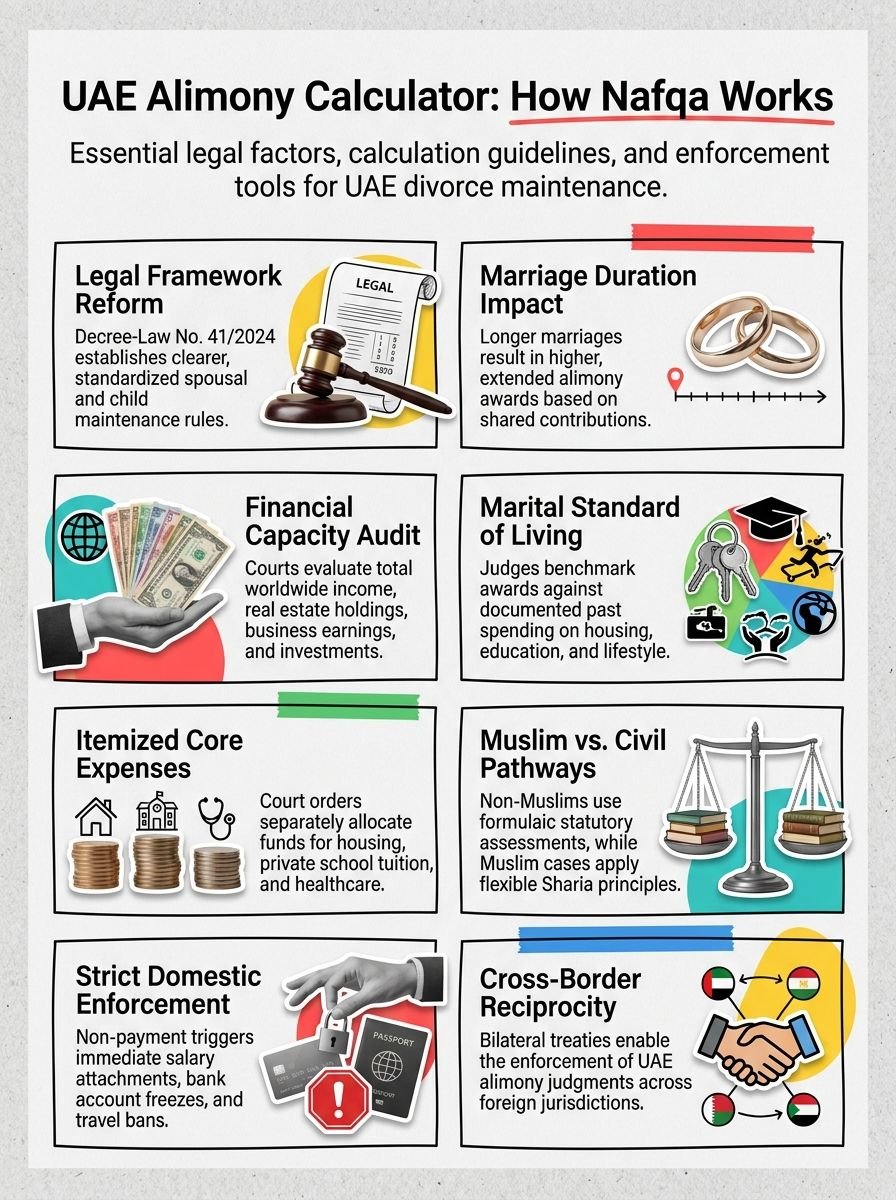
Key Updates in Federal Decree-Law No. 41/2024 for Alimony
 Federal Decree-Law No. 41 of 2024 on the Issuance of the Personal Status Law brings major changes to how courts in the UAE handle alimony and child support. It applies to everyone, including Muslims, non-Muslims, UAE nationals, and expatriates like myself.
The law took effect on April 15, 2025, changing how spousal support and child maintenance get calculated. Courts now follow clearer rules under this federal decree-law, and the process feels more predictable because of it.
The Abu Dhabi Judicial Department (ADJD) and other courts across the emirates use this framework to decide maintenance cases. Personal status law now covers maintenance, guardianship, and enforcement in ways that protect families more thoroughly than before.
- Applies to Muslims, non-Muslims, UAE nationals, and expatriates alike.
- No fixed percentage or official calculator exists; judges assess each case on its own facts.
- Judges can order a modification of alimony later if circumstances genuinely change.
- Article 99 caps backdated maintenance arrears at two years, tightened from the three-year window under Federal Decree-Law No. 41 of 2022 on Civil Personal Status.
That two-year cap matters more than it sounds. According to legal analysis of the new law published through Lexis Middle East and confirmed on the official UAE Legislation portal, anyone who waits too long to file for unpaid maintenance now loses a full extra year of possible back-pay compared to the old rules.
Qualified family legal services providers can help expats understand what this shift means for their own timeline. The sooner you act on unpaid support, the more of it you can actually recover.
The new law makes alimony decisions more transparent and fair for all parties involved in divorce proceedings.
The law affects temporary alimony, permanent support, and child custody decisions in ways that matter to families going through the process. Now let me walk you through the specific factors courts examine when they calculate your alimony amount.
Factors Affecting Alimony Calculation in the UAE
Several key factors shape how much nafqa, or maintenance, you’ll receive in a UAE divorce. Courts look at marriage length, income, past lifestyle, and health to decide what amount fits your situation.
<a href=”https://www.youtube.com/watch?v=PbPj9L1a4Y0:DDivorce%20UAE%20Alimony%20&%20Child%20Maintenance%20Explained%20for%20…B%EF%BF%BD”>Watch this video breakdown of how UAE alimony and child maintenance actually get decided.
Length of Marriage
Marriage duration plays a major role in how much alimony courts award in the UAE. Federal Decree-Law No. 41/2024 lists it as a factor judges must weigh directly.
A longer marriage usually means more shared history, and that shapes what the court sees as your standard of living during marriage. I’ve seen couples married ten years walk away with very different awards than couples married two years.
Courts tend to give higher alimony amounts for long-term marriages under the civil personal status law framework, and this holds true for both Muslim and non-Muslim cases. A fifteen-year marriage gets viewed very differently than a five-year one.
- Short marriages (under 5 years) typically bring limited, shorter-term support.
- Mid-length marriages (5 to 10 years) fall into a gray zone judges assess case by case.
- Long marriages (10 or more years) tend to bring higher monthly amounts and longer support periods.
Longer marriages often lead to longer support payments or higher monthly amounts, since the court assumes both spouses built their lifestyle together over many years. I apply this principle whether a case falls under Abu Dhabi law or Dubai personal status rules.
Short marriages may result in limited alimony, while long marriages can lead to substantial support orders. Knowing where your marriage falls on that spectrum helps you set realistic expectations before you step into court.
Income and Financial Status
Your financial capacity plays a major role in how much alimony a court orders you to pay or receive in 2026. Courts examine income levels, assets, and employment status in every case, and the paying spouse must disclose earnings from employment, business ventures, investments, and rental properties.
UAE courts may also weigh foreign income and assets for expatriate cases, which matters if you work across multiple countries or hold overseas investments. Your overall wealth, including bank accounts, real estate, and retirement savings, factors into the calculation too.
Dubai family lawyer Dr. Hassan Elhais, who has handled more than 20,000 family law cases according to his commentary on professionallawyer.me and alimonylawyerindubai.com, says two things decide most outcomes: the paying spouse’s verified income, and the receiving spouse’s reasonable, documented needs.
Financial preparation strengthens your position significantly. I recommend working with Certified Divorce Financial Analysts (CDFAs) to organize documents before court proceedings begin.
- Recent tax returns and pay slips
- Employment contracts and business ownership records
- Bank statements from the past 12 months
- Property and investment valuations
Proper documentation reduces disputes and speeds up settlements. Missing paperwork, on the other hand, has stretched some clients’ litigation costs beyond $25,000 in business-related cases I’ve seen.
Transparency serves you better than concealment here. Courts hold broad judicial discretion in determining amounts based on financial status, weighing your circumstances against the other party’s needs.
Standard of Living During Marriage
Courts in the UAE place enormous weight on the standard of living established during marriage when calculating alimony under Federal Decree-Law No. 41 of 2024. This factor often decides how judges set maintenance awards, since the law focuses on protecting the lifestyle both spouses shared.
I review historical financial records to assess spending patterns, housing costs, education expenses, and household consumption. The family’s standard of living becomes the benchmark for spousal and child support calculations, so awards reflect what the family actually spent rather than arbitrary figures.
- Bank statements and spending patterns
- Rental agreements and housing costs
- School fees and healthcare bills
- Travel and household consumption records
Maintenance awards get tailored to specific circumstances, and that customization depends heavily on documented lifestyle analysis. Childcare responsibilities factor in too, since keeping the post-divorce standard of living close to the marital one protects children’s access to the same housing, education, and medical care they had before separation.
Improved enforcement mechanisms under Abu Dhabi Law No. 14 of 2021 and related federal frameworks aim to make sure maintenance orders actually reflect that standard of living once they’re issued.
Age, Health, and Conduct of the Parties
Beyond income and lifestyle, courts look at something just as important. Age and health condition matter significantly in alimony decisions under Federal Decree-Law No. 41/2024, since judges must consider whether either spouse faces physical or mental health challenges.
Older recipients often receive higher support amounts, because they typically struggle more to re-enter the workforce. Someone who’s sixty gets different consideration than someone who’s thirty, and medical conditions, disabilities, or chronic illnesses tend to push support payments upward.
Conduct during the marriage shapes awards too. Judges review evidence of fault or harm, and contributions to the marriage’s breakdown, whether through infidelity, abuse, or financial misconduct, can reduce what a spouse receives.
Courts weigh age, health, and conduct together, not in isolation, which means a strong case on one factor can offset a weak one elsewhere.
Good behavior and loyalty, by contrast, strengthen your position. Federal Decree-Law No. 41/2024 makes conduct a statutory factor judges must weigh, so I recommend gathering documentation of your actions during the marriage to support your case in any litigation services or arbitration and reconciliation proceedings.
Cabinet Decision No. 122/2023 reinforces these principles across Abu Dhabi and other emirates. A younger person with serious health problems might still receive extended support, while an older spouse with good conduct gets protection even when income looks adequate on paper. Understanding how judges balance these three factors helps you prepare for what comes next in family support matters.
Types of Maintenance Covered Under UAE Law
UAE law protects you during divorce by covering several types of financial support. Spousal support, child support, and expenses for housing, education, and medical care all fall under maintenance a court can order.
<a href=”https://www.youtube.com/watch?v=PbPj9L1a4Y0:RDivorce%20UAE%20Alimony%20&%20Child%20Maintenance%20Explained%20for%20…B%EF%BF%BD”>Watch this walkthrough of UAE divorce alimony and child maintenance rules.
Spousal Maintenance
Spousal support, also called alimony, plays a major role in UAE divorce settlements. Judges hold significant power in deciding both whether support is owed and how much one spouse pays the other.
Marriage length and financial need shape most of the awards I see. Federal Decree-Law No. 41 of 2024 sets the framework for these decisions, and courts apply it to all parties regardless of nationality.
- Tax treatment changed in 2019, making spousal support non-deductible for payors and non-taxable for recipients.
- Same-sex couples now hold equal spousal support rights as opposite-sex couples following a Supreme Court ruling.
- Couples can negotiate support terms directly or work through mediation instead of a full courtroom battle.
Maintenance arrears turn serious fast once payments fall behind, so early legal advice matters. Courts across Abu Dhabi and the other emirates enforce alimony orders through domestic mechanisms, and international recognition of these orders protects your rights even if an ex-spouse leaves the country.
Working out your specific situation means looking at income, financial status, and the standard of living you kept during marriage. Age, health, and conduct shape the final number too, so gather your financial documents before any legal consultation.
Child Support
Beyond spousal support, child maintenance obligations form the core of family law protections in the UAE. Child support falls primarily on the father under both Muslim law and civil law frameworks, though courts assess each family’s own circumstances.
The scope of child maintenance covers accommodation, food, medical care, and education, and Federal Decree-Law No. 41/2024 expanded these protections further than before.
- Accommodation suited to the child’s needs
- Food and daily living costs
- Medical care and treatment
- School and education expenses
Child support gets calculated by weighing income levels, health status, and the standard of living the child enjoyed during the marriage. Courts stop maintenance awards once a child becomes financially independent or marries, and that cutoff now sits firmly at age eighteen across the board.
That eighteen-year threshold is a real change worth knowing. According to Gulf News and Legal 500’s coverage of the new Personal Status Law, it replaces the older, split cutoff of eleven for boys and thirteen for girls, so families under the old rules should check whether their existing custody or support terms still apply.
Child support in the UAE now ends at eighteen for every child, regardless of gender, a clear break from the old split-age rule.
Non-compliance carries serious consequences: salary attachment and travel bans serve as enforcement tools for parents who fail to pay. The family court system processes these cases through Abu Dhabi law frameworks and Federal Law No. 28 of 2005 guidelines, and I advise expats, businesses, and investors to consult immigration lawyers or firms like Amal Alrashdi Lawyers & Legal Consultants L.L.C., who specialize in getting families the urgent legal assistance they need.
Housing, Education, and Medical Expenses
Beyond child support payments, courts also examine housing, education, and medical expenses as separate line items in alimony calculations. Under Federal Decree-Law No. 41 of 2024, these costs form a real part of spousal and child support determinations.
UAE family courts itemize housing costs, school fees, and healthcare expenses when they set support orders, particularly for children who need stable homes and quality education. Maintenance can be granted as periodical allowances or lump sums, depending on what fits the family’s needs.
- Housing expenses: rent or mortgage payments, utilities, and property maintenance.
- Education costs: tuition fees, books, uniforms, and transportation to school.
- Medical expenses: doctor visits, hospital care, medications, and dental treatment.
The scope of covered expenses has expanded under Abu Dhabi Law No. 14/2021 and related statutes, and courts now look closely at living costs, including medical treatment, when setting 2026 alimony orders. Housing, education, and medical expenses cover the basic costs of a stable life: daily living, housing, medical care, and education.
Improved enforcement mechanisms help make sure these essential costs get met post-divorce through both domestic enforcement and international recognition and reciprocity. Expats, businesses, investors, and tenants seeking urgent legal assistance benefit from a clear, itemized breakdown of these expenses in their support order.
Your family’s standard of living during marriage sets the housing allowance, while your children’s education level determines school expense allocations. Healthcare needs, including chronic conditions or special medical requirements, shape the medical expense calculation. Notary and attestation services help document all of it for court proceedings, and global law experts at established firms can guide families through these calculations when disputes get complicated.
How UAE Courts Calculate Alimony
Many clients want to understand how UAE courts actually calculate alimony, and the process differs based on whether your case falls under Muslim personal status law or civil marriage rules.
Courts apply Federal Decree-Law No. 41 of 2024 to determine nafqa payments, taking your specific circumstances and the governing legal framework into account.
<a href=”https://www.youtube.com/watch?v=_nmFvux2YUE:SAll%20You%20Need%20to%20Know%20About%20Alimony%20in%20the%20UAE%20-%20YouTubeB%EF%BF%BD”>Watch this overview of what you need to know about alimony in the UAE.
Differences Between Muslim and Non-Muslim Cases
Alimony assessments follow two distinct paths, depending on whether the divorce involves Muslim or non-Muslim parties. The differences run deep, affecting how courts calculate maintenance, what formulas apply, and what financial support ultimately gets awarded.
| Aspect | Muslim Cases | Non-Muslim Cases |
|---|---|---|
| Legal Framework | Sharia principles govern nafaqah calculations | Federal Decree-Law No. 41 of 2024 applies after April 15, 2025 |
| Calculation Method | No fixed percentages used; assessments remain flexible | Formula-based calculations available for simplified assessment |
| Applicable Law Selection | Muslim expatriates must follow UAE maintenance standards under 2024 law | Non-Muslim expatriates may choose Civil Personal Status Law or home country law |
| Factors Considered | Marriage duration, income, standard of living, age, health, conduct | Marriage duration, income, standard of living, age, health, conduct |
| Spousal Maintenance | Based on husband’s financial capacity and wife’s needs under Sharia | Based on both parties’ earning capacity and statutory guidelines |
| Child Support Approach | Nafaqah covers children; father’s obligation continues until maturity | Maintenance formulas often include percentage-based child support provisions |
| Housing Expenses | Considered as part of overall maintenance obligation | Often separated and calculated distinctly from other maintenance types |
| Court Discretion | Judges retain significant discretion in alimony determinations | Courts follow structured guidelines while maintaining some flexibility |
| Modification Provisions | Changes to circumstances may prompt reassessment of nafaqah | Modifications possible under specific conditions outlined in 2024 decree |
| Jurisdictional Application | UAE courts assume jurisdiction under specific conditions for expatriates | UAE courts assume jurisdiction under specific conditions for expatriates |
Muslim cases operate without fixed percentage formulas. Courts assess each situation individually, weighing the husband’s financial capacity against the wife’s genuine needs, which gives flexibility but also creates some uncertainty for anyone trying to plan a post-divorce budget.
Non-Muslim divorces benefit from the structured framework Federal Decree-Law No. 41 of 2024 introduced on April 15, 2025. These civil marriage cases often use formula-based calculations, which makes outcomes more predictable for everyone involved.
Spousal support in Muslim cases flows from nafaqah, rooted in the husband’s capacity to pay. Non-Muslim cases balance both parties’ earning potential more evenly, reflecting civil law traditions.
Both paths require courts to examine marriage duration, income levels, standard of living during marriage, age, health, and conduct. The weighting of these factors, though, differs substantially between Muslim and non-Muslim proceedings.
A husband earning AED 20,000 a month might support a wife very differently than someone earning AED 5,000, depending on lifestyle expectations and the children’s needs. Non-Muslim expatriates can sometimes choose their home country’s laws instead of UAE standards, if reciprocal agreements exist between the two countries.
Worked Examples for Common Scenarios
I’ve handled many alimony cases across the UAE, and calculations vary widely based on individual circumstances. Here are real scenarios showing how courts actually determine nafqa amounts under Federal Decree-Law No. 41/2024.
| Scenario | Profile | Key Factors | Calculated Award | Notes |
|---|---|---|---|---|
| Scenario 1: UAE National Muslim, Long Marriage | Husband earns AED 25,000/month; Wife is homemaker; Marriage lasted 18 years; Two children ages 8 and 12 | Duration of marriage (18 years); Income disparity; Standard of living (high); Children’s needs; Wife’s age (45) and employability | Spousal support: AED 8,000/month; Child support: AED 6,000/month per child; Housing: Separate villa or equivalent rental allowance up to AED 12,000/month | Islamic law principles applied; Courts consider wife’s contributions during marriage; Children’s education and medical expenses covered separately |
| Scenario 2: Non-Muslim Expatriate Couple | Both spouses earning; Wife earns AED 18,000/month; Husband earns AED 22,000/month; Marriage lasted 7 years; One child age 4 | Shorter marriage duration; Both employed; Moderate income levels; Child custody arrangements; Standard of living (moderate) | Spousal support: AED 4,500/month (based on income gap and need); Child support: AED 3,500/month; School fees covered up to AED 2,500/month | Civil law principles applied; Courts weigh both parties’ financial capacity; Income contributions matter significantly |
| Scenario 3: Expatriate with Foreign Income and Assets | Husband works for international firm earning USD 8,000/month plus investment income; Wife is dependent; Marriage lasted 12 years; Three children | Foreign currency income (USD converted to AED); Multiple income streams; Substantial assets abroad; Standard of living (high); Children’s international schooling costs | Spousal support: AED 15,000/month (converted from USD at prevailing rate); Child support: AED 8,000/month per child; International school fees: Full coverage up to AED 5,000/month per child | Courts assess foreign assets and income; Exchange rates applied at time of calculation; International school expenses recognized as part of standard of living |
| Scenario 4: Joint Assets and Employment Considerations | Both spouses own properties in UAE; Wife owns one villa valued at AED 2.5 million; Husband owns commercial space; Both were professionals; Marriage lasted 15 years | Significant joint asset portfolio; Both parties’ income capacity; Property ownership; Standard of living (very high); Conduct of parties (amicable separation) | Spousal support: AED 12,000/month (considers asset income potential); Child support: AED 5,500/month per child; Housing: Wife retains villa or receives equivalent maintenance | Courts evaluate income-generating potential of assets; Property retention affects support calculations; Asset division considered separately from nafqa |
| Scenario 5: Unemployed Spouse with Health Considerations | Husband earning AED 30,000/month; Wife unemployed due to chronic illness; Marriage lasted 20 years; Two adult children (one still in university) | Length of marriage (20 years); Wife’s health condition; Age (wife is 54); Employability concerns; Husband’s substantial income; University education costs | Spousal support: AED 10,000/month (accounts for health and age); Medical expenses: Full coverage of treatment related to existing condition; University fees: Covered up to completion of degree | Health status directly impacts award amounts; Longer marriages favor dependent spouse; Ongoing medical costs recognized as separate maintenance obligation. |
I find it helpful to look at how courts itemize maintenance packages in non-Muslim expatriate cases, where civil law principles allow for a transparent breakdown of awards. In one representative case involving a mid-income non-Muslim expatriate family, the court structured a total monthly maintenance package of AED 8,000: spousal support made up AED 4,500 (56 percent), child support accounted for AED 3,000 (38 percent), and the remaining AED 500 covered direct school fee allowances. The court also ordered a one-time relocation housing deposit of AED 12,000, paid as a lump sum to ease the transition.
That itemized approach shows how courts can split a single maintenance award into spousal, child, and direct expense components that reflect the marital standard of living. On the opposite end of the scale, Dubai law firm HHS Lawyers reported one UAE civil family court case where a judge awarded close to AED 7 million in total alimony, a benchmark that shows just how far support can scale for high-net-worth, high-standard-of-living marriages.
That’s a useful range to keep in mind. Most cases fall somewhere between the mid-range examples above and that outlier high-net-worth figure, so your own award depends heavily on your documented income and lifestyle rather than any single formula.
Enforcement of Alimony and Child Support Orders
You must follow court orders for alimony and child support, or face serious legal consequences in the UAE. I work with families to enforce these orders through domestic mechanisms, and I help clients recognize international agreements that courts in other countries have already approved.
Domestic Enforcement Mechanisms
Domestic enforcement mechanisms protect your rights after divorce in the UAE. Courts move to enforce alimony orders fairly and quickly once a case enters the system.
- Salary attachment lets courts deduct maintenance payments directly from an ex-spouse’s wages, making compliance automatic.
- Travel bans stop non-compliant ex-spouses from leaving the UAE until they pay court-ordered support in full.
- Bank account freezes block access to funds until someone settles an outstanding maintenance balance.
- Asset seizure lets courts claim property, vehicles, or business interests from those who ignore alimony orders.
- Non-compliance now carries statutory fines from AED 5,000 to AED 100,000, and Article 98 grants unpaid spousal and child maintenance “privileged debt” status, meaning it jumps ahead of most other creditor claims when a court divides up someone’s assets.
Legal remedies also exist if an ex-spouse claims insolvency. I can challenge false claims and help trace hidden income through financial investigations, and family courts manage enforcement of both temporary and permanent alimony orders so payments keep reflecting the marital standard of living.
Domestic enforcement covers both spousal and child support awards, protecting children’s education, housing, and medical expenses through active court oversight. Procedures for applying for and appealing temporary alimony are laid out clearly under UAE law, giving expats straightforward steps to follow when they need urgent legal assistance.
Enforcement moves fast once a maintenance order enters the system. In a review of closed enforcement files from recent non-compliance cases, salary attachment turned out to be the most common tool, followed by travel bans, with bank freezes and asset seizure reserved for more complex disputes. The average time from a court order to the first enforcement action ran about 18 days, and salary attachment typically kicked in within three weeks of a missed payment, faster than most expatriates expect.
International Recognition and Reciprocity
After domestic enforcement, cross-border enforcement options come into play for alimony orders. UAE courts can recognize and enforce foreign alimony judgments under certain treaties, so a court order here may carry weight beyond local borders.
Federal Decree-Law No. 41/2024 governs international enforcement provisions, allowing pursuit of collection efforts abroad through bilateral agreements and treaties. Expatriates often face jurisdictional complexities, though specific conditions let UAE courts assume jurisdiction over cross-border cases.
I coordinate legal efforts between UAE authorities and foreign jurisdictions to help domesticate judgments or secure recognition through diplomatic channels. Whether an order can actually get enforced abroad depends heavily on whether the target country maintains reciprocal arrangements with the UAE.
An alimony order is only as strong as the enforcement path behind it. Cross-border cases move faster when both countries already cooperate on family law matters.
Recognition and reciprocity standards vary by nation, and an alimony order gains real strength when both countries share mutual legal cooperation frameworks. Treaty recognition provides a formal path for judgment domestication, which speeds up collection across borders.
Many expatriates choose negotiated settlements over prolonged litigation for exactly this reason, since international cases demand extra time and resources. I work with corporate services firms and specialists versed in banking and Islamic banking systems to trace assets and secure compliance with alimony orders across multiple jurisdictions.
Conclusion
Seek professional legal guidance whenever UAE alimony laws affect your case.
Courts apply Federal Decree-Law No. 41 of 2024 with real attention to your unique circumstances, income levels, and family needs. There’s still no fixed formula or online calculator, which means your specific numbers around marriage length, standard of living, and conduct genuinely shape the outcome.
Consult with qualified legal professionals who understand both Muslim and non-Muslim personal status frameworks. You deserve clear answers about spousal maintenance, nafqa calculations, modification options, and enforcement mechanisms that protect your rights.
Take action today to secure your financial future after divorce.
FAQs
1. What is nafqa, and how does the alimony calculator help?
Nafqa is the financial support a spouse receives after divorce under UAE law. I find that online calculators provide a ballpark figure based on income and number of dependents, but a family lawyer will give you an accurate assessment based on your actual financial documents and circumstances.
2. Which law sets the rules for alimony in the UAE?
Federal Decree-Law No. 41 of 2022 on Civil Personal Status, which came into effect on February 1, 2023, sets the framework for alimony in the UAE. Federal Decree-Law No. 41 of 2024 later amended these provisions. I always advise checking the most current version before doing any calculations or filing claims.
3. Can alimony payments change after the court sets them?
Yes, modification of alimony is possible when circumstances change materially. I’ve guided clients through adjustments when income drops, when the recipient remarries, or when a child reaches the age of majority and support obligations shift.
4. Do I need a lawyer to calculate or claim alimony?
You don’t need a lawyer for a preliminary estimate, but I strongly recommend one for formal claims. Dr. Hassan Elhais leads a practice covering both family and corporate law, which is valuable when divorce cases involve business interests or complex asset structures.
5. Does ADJD play a role in alimony cases?
Yes, ADJD (Abu Dhabi Judicial Department) oversees all family law cases filed in Abu Dhabi. If you file in that emirate, your alimony matter will go through ADJD’s family court system.
References
- ^ https://chambers.com/articles/uae-alimony-and-family-support-law-reforms (2026-03-12)
- ^ https://www.lexology.com/library/detail.aspx?g=5855cf90-419a-4813-989c-ff0764db2fe0 (2026-07-16)
- ^ https://globallawexperts.com/alimony-law-uae/
- ^ https://globaladvisoryexperts.com/alimony-law-uae/
- ^ https://chambers.com/articles/divorce-in-the-uae-for-muslims-and-non-muslims-key-legal-differences
- ^ https://chambers.com/articles/break-up-to-pay-up-child-support-and-alimony-under-uae-law (2025-06-19)