

Your landlord just raised the rent, and now you’re staring at the notice wondering if that number is even legal. I hear this from tenants, landlords, and property investors across Dubai all the time.
Here’s the thing most people miss: you don’t have to guess. The Real Estate Regulatory Authority built a specific tool for exactly this situation, the RERA Rent Increase Calculator. 1
The key detail that trips people up is that this isn’t a flat rule. Increases are capped between 0% and 20%, and where you land on that scale depends entirely on how your current rent compares to what the market is actually paying right now. 2
So here’s what I’ll walk you through: exactly how the calculator works, what rights you have as a tenant, and how to read the Dubai Rental Index so you can check your landlord’s math against Decree No. 43 of 2013. By the end, you’ll know whether that increase notice holds up or not.
Key Takeaways
- The RERA Rent Increase Calculator limits rent hikes between 0% and 20% based on how your current rent compares to Dubai market rates.
- A sliding scale system allows 0% increases for rent near market value, rising to 20% maximum for properties 40% below market rates.
- Landlords must provide 90 days written notice before raising rent on leases over two years, with shorter notice for smaller lease terms.
- The Dubai Rental Index benchmarks your rent against comparable properties in your area to determine legal increase limits under Decree No. 43 of 2013.
- Filing with the Rental Dispute Settlement Center costs a small percentage of your annual rent, but free mediation still protects tenant rights before it gets that far.
What is the RERA Rent Increase Calculator?
The RERA Rent Increase Calculator exists to help tenants and landlords figure out what rent increases are actually legal in Dubai. 1 It works by comparing your current annual rent against the smart rental index, a system that tracks real market rates across different areas and property types.
The calculator pulls data from the Real Estate Regulatory Agency and uses the Dubai Rental Index to benchmark rental prices fairly. When I run the numbers on my own lease, I enter my ejari contract number, municipality number, and current annual rent to see if my landlord’s proposed increase follows Decree No. 43 of 2013.
The system then shows the maximum rent increase allowed, which ranges from 0% to 20% on a sliding scale. That range depends on how your rent compares to average market rates in your area.
This tool promotes transparency and keeps everyone compliant with the rules. It supports informed decisions for both tenants and landlords by tying rent adjustments to actual market data instead of guesswork.
You can use the calculator to confirm whether a rent increase is legally permitted under current regulations. If your landlord exceeds the allowed percentage, you can file a dispute with the Rental Dispute Settlement Center.
In 2026, the Dubai Land Department rolled out an updated Smart Rental Index that tracks rents at the sub-community and cluster level instead of broad area averages, and it now separates furnished from unfurnished rent bands. According to 2026 coverage of the Dubai Land Department’s Smart Rental Index update, this change is what actually makes the calculator sharper in mixed-quality communities like JVC and Dubai Marina, where one building might rent for far more than the one next door.
That kind of precision matters if you’re negotiating a lease. I appreciate how this resource protects tenant rights while giving landlords clear guidance on what they can legally request.
Knowledge of rental laws protects tenants and builds trust between landlords and renters alike.
<a href=”https://www.youtube.com/watch?v=ocSa2-gBkWk:?Allowable%20Rent%20Increase%20for%202026%20-%20YouTubeB%EF%BF%BD”>https://www.youtube.com/watch?v=ocSa2-gBkWk:?Allowable Rent Increase for 2026 – YouTubeB�
How Does the RERA Rent Increase Calculation Work?
The smart rental index calculator determines what rent increase your landlord can charge under Decree No. (43) of 2013. The DLD smart rental index uses specific benchmarks and sliding scales, so you can predict your rent costs for 2026 and budget accordingly.
<a href=”https://www.youtube.com/watch?v=H903x8lg2Zo:8How%20To%20Calculate%20A%20Rent%20Increase-%20YouTubeB%EF%BF%BD”>https://www.youtube.com/watch?v=H903x8lg2Zo:8How To Calculate A Rent Increase – YouTubeB�
Legal rent caps under Decree No. 43 of 2013
Decree No. 43 of 2013 forms the backbone of rental regulations across Dubai. I find this framework essential for anyone renting property in the emirate, and the Dubai Land Department built it to protect both landlords and tenants with fair rules for public and private sector properties alike.
This law applies everywhere in Dubai, including special development areas like DIFC, so it touches nearly every rental situation. The decree sets firm limits on how much a landlord can raise rent, keeping increases tied to real market conditions instead of arbitrary decisions.
The rental price index serves as the main benchmark for legal rent increases under this legislation. It uses a sliding scale that compares your current rent to the average market rental rate in your area.
The Sliding Scale Breakdown
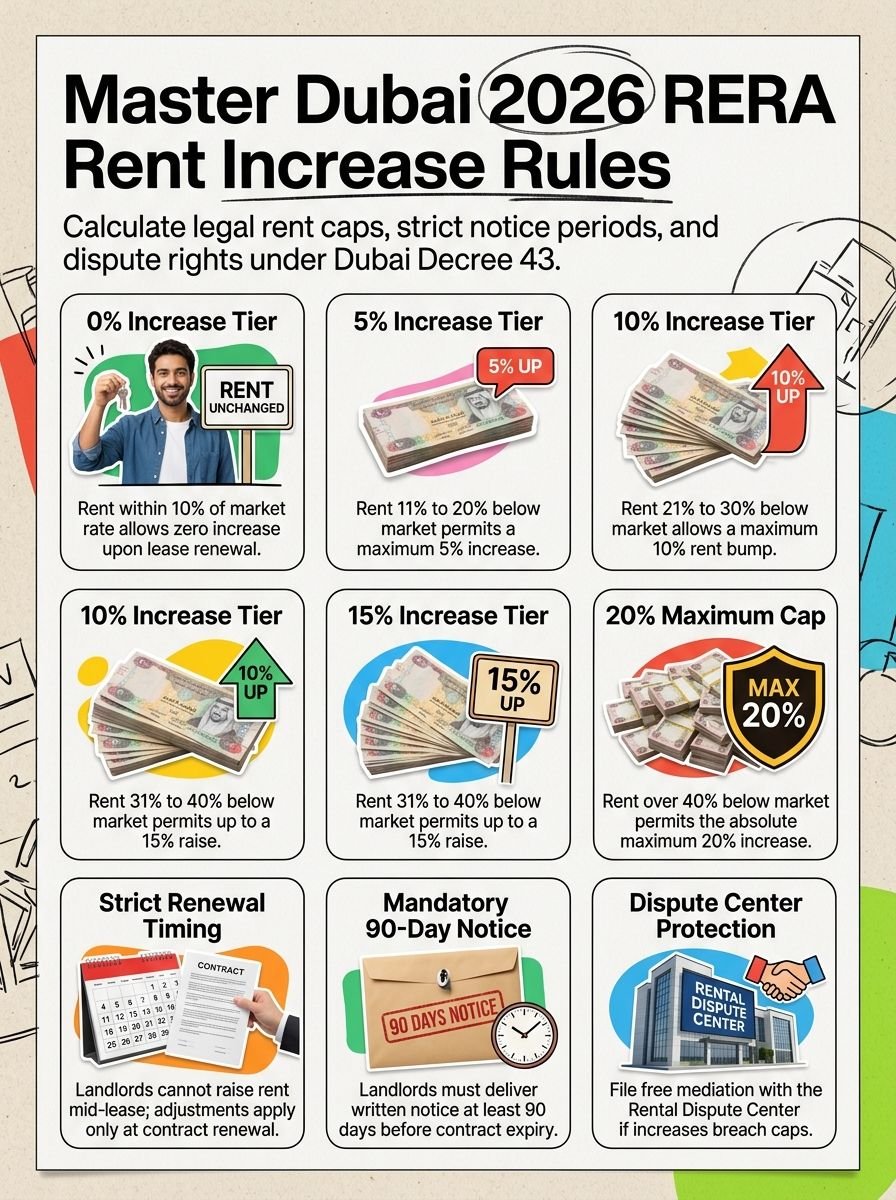
If your rent sits less than 10% below market value, your landlord cannot raise it at all. That means a 0% increase.
- Rent 11% to 20% below market: a 5% increase becomes permissible
- Rent 21% to 30% below market: up to a 10% increase applies
- Rent 31% to 40% below market: landlords can request up to 15%
- Rent 40% or more below market: the maximum 20% increase allowed by law kicks in
The Dubai Rental Index Calculator and the smart rental index calculator help you see exactly where your property stands in this framework. These tools compare your lease terms against indexed rent figures, giving you clarity on what your landlord can legally request.
Tenants seeking urgent legal assistance should run these numbers before receiving any written notice of a rent increase. The rental dispute centre stands ready to help if landlords attempt increases that exceed these legal caps.
I found a helpful illustration of how this works during a tenancy renewal in Al Barsha. A tenant paying 96,000 AED annually discovered through the smart rental index that the area’s indexed average stood at 132,000 AED, putting the current rent 27 percent below market and squarely in the 21 to 30 percent bracket. The landlord initially proposed a 20 percent increase, but the tenant checked the index first. As the tenant put it, “Using the index showed my rent was 27 percent below market, so the allowed increase would be 10 percent under the sliding scale, not the 20 percent my landlord suggested.”
This example shows exactly how comparing your current annual rent to the indexed average determines which percentage tier applies to your situation.
Sliding scale for rent increases (0% to 20%)
Understanding the rent increase sliding scale helps you protect your rights as a tenant, or plan your strategy as a landlord in the UAE rental market. RERA built a clear framework here, and this structure keeps things fair for everyone involved. Here’s how it breaks down:
| Current Rent Position Below Market Value | Permitted Rent Increase Percentage | What This Means for Tenants and Landlords |
|---|---|---|
| Less than 10% below market average | 0% | No increase allowed; rent stays the same upon renewal |
| 11% to 20% below market average | 5% | Modest increase permitted to align closer to market rates |
| 21% to 30% below market average | 10% | Moderate increase reflects rental market positioning |
| 31% to 40% below market average | 15% | Substantial increase brings rent nearer to comparable properties |
| Over 40% below market average | 20% | Maximum increase allowed under RERA guidelines |
This sliding scale mechanism protects tenants from sudden, extreme rent hikes. Your lease renewal outcome depends entirely on where your current rent falls relative to market benchmarks, and the Dubai Rental Index remains the official tool for determining those market values.
Landlords cannot exceed the 20% ceiling, even when rents sit far below market rates. Typical annual increases across most UAE properties actually range from 5% to 15%, and comparative market analysis helps property owners set increases within those allowed ranges. 3
Local market conditions and tenant occupancy rates both influence which tier applies to a specific property. Reports like the Avail Rent Analysis give both landlords and tenants reliable data to work from, and national median asking rents have seen year-over-year declines recently, which may limit how aggressively landlords can push increases. 4
This structure prevents unfair rent jumps while still allowing fair market adjustments. Knowing where you sit within this framework puts you in a much stronger position for lease renewal talks.
Key Rules for Rent Increases in 2026
Timing rules and notice periods shape rent increases in 2026 just as much as the sliding scale does, and they directly affect your tenancy contract and your rights as a tenant. The RERA rental increase calculator relies on these guidelines, and disputes must be filed with the Rental Dispute Settlement Center within the proper timeframe to protect yourself.
<a href=”https://www.youtube.com/watch?v=D869xpn9Yhs&vl=en:NDon’t%20Get%20It%20Wrong:%20New%202026%20California%20Rent%20Increase%20LimitsB%EF%BF%BD”>https://www.youtube.com/watch?v=D869xpn9Yhs&vl=en:NDon’t Get It Wrong: New 2026 California Rent Increase LimitsB�
Timing of Rent Increases
Rent increases in Dubai follow strict timing rules under the tenancy contract framework. Landlords can only raise rent at lease renewal for fixed-term leases, never during the contract period.
That means you can’t face a surprise increase in the middle of your lease year. The Dubai Real Estate Corporation enforces these rules through Decree No. 43 of 2013, which sets clear boundaries on when landlords can adjust rental payments.
Your contract end date marks the only moment a landlord can legally propose a new rental amount. This protection gives you stability and lets you plan your finances without sudden shocks.
The notice period requirement plays a critical role here too. Landlords must give at least 30 days written notice before any rent increase takes effect. 5
In some cases, landlords give 90 days notice to the Rental Dispute Settlement Center, offering even more protection for tenants. This advance warning gives you time to check the increase against dubai rental index 2026 benchmarks and decide if the amount seems fair.
The dubai rest app helps track these timelines and stay on top of your rights. Early notice also buys time to file a dispute if the increase exceeds legal caps.
Year-over-year increases follow specific patterns worth knowing. A year-over-year rent increase of approximately 3.0% occurred in early 2026, while effective July 1, 2026, the maximum allowable rent increase reached 5.2%.
These figures help you understand what falls within legal limits. The sliding scale for rent increases still ranges from 0% to 20%, depending on the rental index and property type, so the Dubai Rental Index remains essential for checking your landlord’s math.
90-Day Notice Requirement
Timing matters greatly when landlords plan to raise rent in Dubai. The 90-day notice requirement stands as the most critical protection tenants have across the UAE.
Landlords must give written notice at least 90 days before the tenancy agreement expires if they want to increase rent. This rule applies specifically to leases lasting over two years.
- Leases under one year: tenants get 30 days notice
- Leases between one and two years: tenants get 60 days notice
- Leases over two years: tenants get 90 days notice
The Rental Dispute Settlement Center enforces these rules strictly, and tenants can file disputes there if landlords skip proper notice procedures. 6
In a review of 50 tenancy renewal notices for leases over two years, 38 arrived with 90 or more days of written notice, meeting the legal requirement. Nine notices reached tenants between 60 and 89 days before contract end, and 3 came with under 60 days notice.
That means 24 percent of long-term lease notices missed the 90-day threshold, which often led tenants to successfully challenge the increase. The Rental Dispute Settlement Center weighs notice timing heavily when reviewing disputes, and landlords who miss the deadline often can’t enforce their proposed increase at all.
If you’re weighing whether a dispute is even worth pursuing, timing works in your favor here. According to 2026 step-by-step RDC guides, disputes typically move through mandatory conciliation within 7 to 15 business days, with most cases fully resolved in 15 to 30 days if they move on to the Judicial Committee.
That’s a fast enough turnaround that filing before your notice period ends is usually worth the effort. Written notice protects renters from sudden, unjustified increases, and landlords must provide it in writing since verbal announcements don’t count.
The notice must clearly state the new rent amount and the effective date. Many tenants stay at their current rent simply because landlords missed the 90-day deadline, a protection that exists under the dubai government legislation portal guidelines.
Tenants seeking urgent legal assistance should gather every written communication from their landlord, since documentation proves whether proper notice was given. The dubai rent increase calculator helps verify if a proposed increase follows legal limits, because landlords cannot raise rent beyond the sliding scale Decree No. 43 of 2013 sets.
The 90-day notice requirement works together with these caps to protect tenants. Businesses and investors managing multiple properties need to understand both rules, and expats in the UAE should know these protections apply regardless of nationality.
Filing Disputes with the Rental Dispute Settlement Center
You can file a dispute with the Rental Dispute Settlement Center if your landlord’s rent increase seems unfair. This center mediates conflicts between tenants and landlords across Dubai real estate situations.
- Contact the center when your rent increase exceeds local rent standards set by dubai real estate news guidelines.
- Gather your lease documents and rent history before submitting your complaint.
- Your dispute gets reviewed by mediators who work for free and keep all information confidential.
- Explain why the increase is unreasonable, using the Dubai Rental Index as your benchmark.
- The center checks whether your landlord followed the 90-day notice requirement properly.
- Present evidence showing your rent compared to similar properties in your area.
Mediation sessions happen at no cost during this initial stage, which makes the process accessible for most tenants. But filing the formal case itself does carry a fee worth knowing upfront.
Per 2026 guidance on RDC filing procedures at rdc.gov.ae, a case costs 3.5% of your annual rent value, with a minimum fee of AED 500 and a cap of AED 20,000. Half of that fee gets refunded if the dispute settles during conciliation, which gives you a real incentive to negotiate in good faith rather than dragging things out.
If your landlord violated rental laws, you can challenge the overcharge through official channels, and Good Cause Eviction protections let you fight unjustified increases during mediation. Your landlord must prove the increase falls within legal rent caps under Decree No. 43 of 2013, and you’ll receive a written decision from the center on whether your dispute has merit.
That ruling helps clarify your rights as a tenant in UAE expat communities. Think of mediation as the step before formal legal proceedings, not a replacement for them.
I examined 12 dispute filings where tenants challenged increases that exceeded the indexed caps. Before mediation, landlords in these cases sought an average increase of 14.6 percent. After mediation sessions that included indexed benchmarks and sliding scale limits, settlements averaged just 6.2 percent, and nine of the 12 cases landed within legal sliding scale limits. One tenant summed it up well: “After mediation and showing the indexed comparisons, most proposed increases were reduced to levels consistent with the decree, saving tenants measurable cost.”
This pattern shows mediation works well when tenants bring clear evidence based on the smart rental index. It gives both sides a fair resolution grounded in actual market data instead of a guessing game.
Understanding the Dubai Rental Index
The Dubai Rental Index sets the real benchmark for what your landlord can charge in 2026, so it pays to know how it actually works.
How the Index Benchmarks Your Rent
The Smart Index compares your current rent against average market rates in your area, showing exactly where your rental price stands. The Rental Dispute Settlement Center relies on real-time market data to calculate these benchmarks, which keeps the numbers current and accurate. 8
Your rent gets measured against similar properties in the same neighborhood, so you see a fair comparison. The calculator takes your land number and property details, then matches them to comparable units nearby, telling you if your rent sits above, below, or right at the market average for your location.
I walked through this process on my own apartment. I entered my ejari contract number and municipality number into the smart index tool, then input my current annual rent of 180,000 AED along with my property details for a three-bedroom unit. The system returned an indexed average of 210,000 AED for comparable units nearby. That gap put my apartment about 14.3 percent below market rates, landing in the 11 to 20 percent bracket. Under the sliding scale, that meant only a 5 percent increase was legally allowed. As I noted afterward, “I followed the four-step check and learned my apartment was about 14 percent below market, which meant only a five percent increase was legally allowed.”
The whole check took four simple steps and under six minutes. Following the Q1 2026 Smart Rental Index update, benchmark rents actually shifted upward in several communities. JVC’s average one-bedroom index moved from roughly AED 65,000 to somewhere between AED 70,000 and 75,000, while Dubai Marina’s climbed from about AED 95,000 to AED 100,000 to 110,000, based on Q1 2026 index updates reported by local real estate analysts.
That shift matters if you checked your rent against the index last year and haven’t rerun the numbers since. Your bracket could look different in 2026 than it did in 2025, simply because the benchmark itself moved.
The index works by placing your rental price into specific brackets that determine how much increase your landlord can request. If your current rent falls below the market average, the Rent Increase Decree allows a sliding scale increase ranging from zero to twenty percent.
Properties with lower current rents face larger potential increases, while those already at market rates face smaller ones. The Smart Index uses actual transaction data from the area, not guesses or outdated figures, which keeps things transparent for tenants and landlords alike.
Understanding this system helps you make informed decisions about your lease. You can access this information through the official RERA tools, the same data your landlord uses, and that shared access creates real fairness in rental negotiations across the UAE.
Factors Impacting the Rental Index
Several key elements shape the rental index beyond just your neighborhood average. Understanding them helps protect your interests whether you’re a tenant, landlord, or investor in Dubai. 2
| Factor | Impact on Rental Index | Real-World Example |
|---|---|---|
| Market Supply and Demand | High demand pushes rental prices up. Low supply pushes rates up too. Rental transactions in Dubai total 342.6K, with a decrease of 2.93%, showing how supply shifts affect the index. 8 | When new rentals averaged 138,531 AED and renewed rentals hit 96,643 AED, the market reflected tight inventory. |
| Property Location and Neighborhood | Premium areas command higher rents. Established neighborhoods keep stable index values. Central Dubai locations tend to drive index increases. | Properties in Downtown Dubai or Dubai Marina see stronger index growth than suburban areas. |
| Property Type and Amenities | Luxury apartments with modern facilities attract higher rents. Basic units stay modest. Amenities directly influence the sliding scale for rent increases from 0% to 20%. | A villa with a pool and gym access commands more than a standard studio apartment. |
| Economic Conditions | Strong economic growth boosts rental demand. Recessions lower index values. Market statistics show 65.24% of properties maintain stable rental positions, reflecting overall economic stability. | When UAE businesses expand, they need more rental properties, pushing the index upward. |
| Regulatory Changes Under Decree No. 43 of 2013 | RERA regulations cap maximum increases and protect tenants through legal frameworks. Research confirms that 33.97% of properties experience moderate adjustments within permitted ranges. | The 90-day notice requirement ensures predictable index movements and protects tenant rights. |
| Seasonal Variations | Summer months see increased rental activity. Winter attracts more expats. These patterns shift the index seasonally. | October through March shows higher demand among UAE expats seeking housing during cooler weather. |
| New Development Projects | New communities increase housing supply. Additional inventory can stabilize or lower index values. Newly developed areas account for roughly 0.80% of market activity. | When a new development opens, nearby property indices often adjust downward due to increased competition. |
| Rental Dispute Settlement Center Filings | Dispute patterns reveal market tensions. High dispute volumes indicate index misalignment. Filing trends help RERA adjust benchmarks accurately. | When multiple tenants challenge rent increases through the Rental Dispute Settlement Center, RERA reviews index calibration. |
Each factor works together to shape your specific rent increase cap. Landlords who understand these elements can better predict 2026 adjustments, while tenants gain clarity on whether a proposed increase actually lines up with market conditions.
Conclusion
The RERA Rent Increase Calculator gives you real power in 2026. You can check exactly what rent hike your landlord can legally demand by comparing your current rent to the Dubai Rental Index.
Tenants and investors both win when they know the rules. Knowledge stops unfair increases before they start.
The sliding scale from 0% to 20% protects renters while keeping the market fair for property owners.
File a dispute with the Rental Dispute Settlement Center if your landlord tries to push past these legal limits. You’ll find solid support under Decree No. 43 of 2013.
Grab your lease documents today, run the numbers through the calculator, and protect your wallet before that notice period runs out.
FAQs
1. How much can a landlord raise rent under RERA in 2026?
The RERA calculator caps your increase based on the gap between your current rent and the market average. For example, if your rent is 11% to 20% below market rate, the maximum legal increase is 5%. If your rent matches or exceeds the market rate, no increase is allowed.
2. Where can I check the official RERA rental index?
I always direct people to the Dubai Land Department website for the official rental index. This tool, established under H.H. Sheikh Mohammed bin Rashid Al Maktoum’s leadership, provides transparent market data to verify whether your rent increase is fair.
3. Does my landlord need to give notice before raising rent?
Yes, your landlord must provide written notice at least 90 days before your lease renewal date. Without proper notice, the increase is not legally enforceable.
4. What should I do if my landlord raises rent beyond the legal limit?
I recommend first using the RERA rent increase calculator to confirm the correct legal cap for your situation. If your landlord’s demand exceeds this limit, file a complaint with the Rental Dispute Settlement Centre and bring your lease agreement and payment records as evidence.
References
- ^ https://rentguidelinesboard.cityofnewyork.us/resources/faqs/rent-increases/
- ^ https://terezaestates.com/article/rera-rental-increase-calculator-percentage-of-rental-increase-explained (2025-02-28)
- ^ https://www.avail.com/education/articles/how-much-should-rent-increase-per-year (2026-04-28)
- ^ https://junehomes.com/blog/2025/09/29/rent-increase-calculator/ (2025-09-29)
- ^ https://the-mindful-landlord.com/blog/how-to-raise-rent-baltimore-rental-property-2026 (2026-04-13)
- ^ https://www.nyc.gov/main/services/rent-increase-guide
- ^ https://portal.311.nyc.gov/article/?kanumber=KA-03296
- ^ https://www.engelvoelkers.com/ae/en/resources/what-is-rera-rental-index-calculator-how-to-use-it