

Getting fired or laid off in the UAE hits hard. The stress gets worse fast when your final paycheck doesn’t show up on time. I hear from expats, business owners, and tenants every week who face this exact worry, wondering how they’ll cover rent and bills.
Here’s what most people miss when they first read Federal Decree Law No. 33 of 2021: your employer owes you every dirham of your final settlement money within 14 days of your last working day, not the day your visa gets cancelled or your paperwork clears.
That distinction matters more than it seems.
I’ve spent time digging through this law, and the 14-day clock starting from your last working day is the detail that trips up both workers and employers. So let’s break down exactly what employers owe you, which deductions are actually legal, and what to do the moment payment gets delayed.
Keep reading, because knowing these rules puts the power back in your hands.
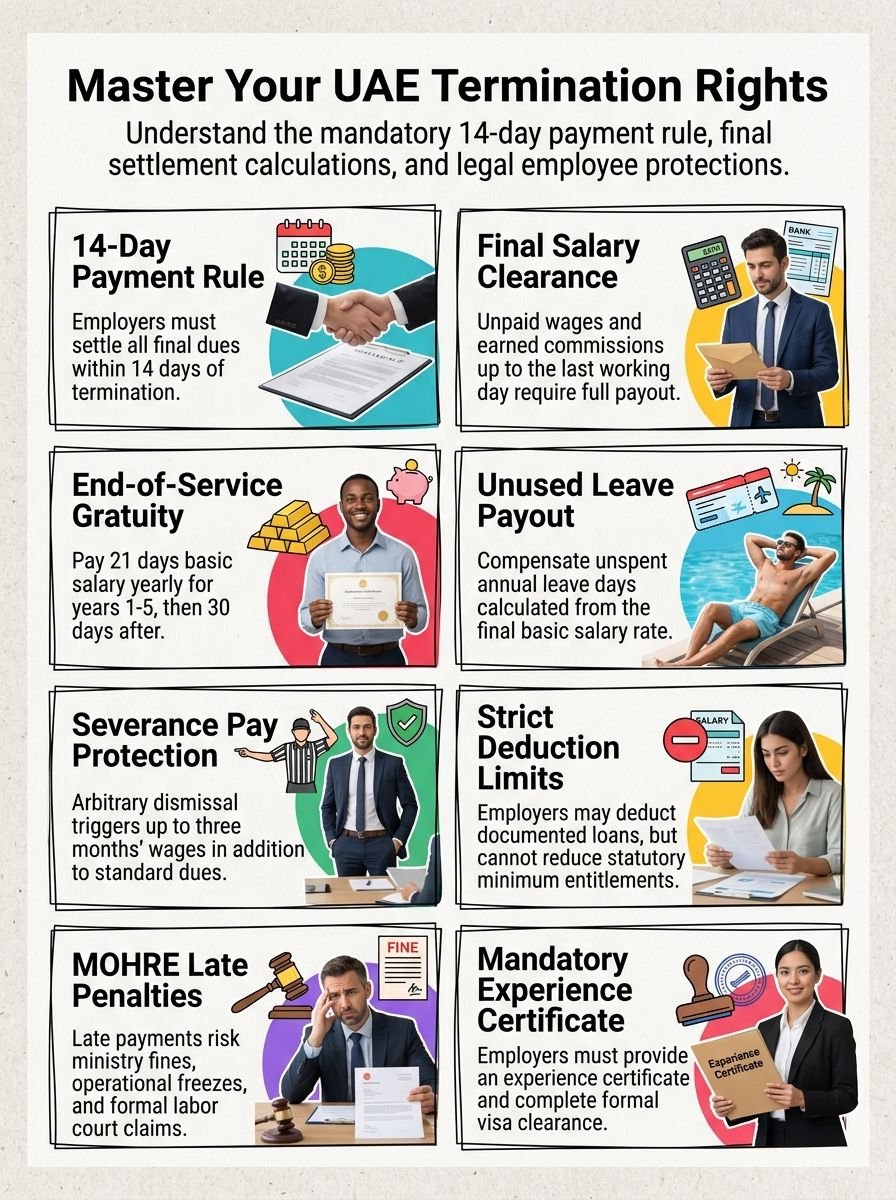
Types of Termination in the UAE

Your job ends in the UAE in one of a few distinct ways, whether your employer makes the call or you do. Understanding which type applies to you determines exactly what your employer owes you under Federal Decree-Law No. 33 of 2021.
<a href=”https://www.youtube.com/watch?v=d0NsJ7Duaco:MExplained:%20UAE%20Labour%20Law%20termination%20benefits%20-%20YouTubeB%EF%BF%BD”>https://www.youtube.com/watch?v=d0NsJ7Duaco:MExplained: UAE Labour Law termination benefits – YouTubeB�
Voluntary resignation
Deciding to leave a job in the UAE comes with specific rules to follow. You must give at least 30 days’ written notice to your employer before your last day. This notice period gives the company time to find someone new for the role.
You can resign immediately if you and your employer agree to end things early through mutual agreement. Leaving right away also works if your contract has already reached its end date. During probation, you still owe 30 days’ notice, or you pay 30 days’ salary instead.
Quitting improperly during probation can trigger a one-year labor ban that stops you from working in the UAE, but this isn’t as automatic as it sounds. Under Article 9(6) of Federal Decree-Law No. 33 of 2021, the ban only applies in two specific scenarios: leaving the UAE during probation without giving the required 14 days’ written notice, or joining a new UAE employer during probation when that new employer refuses to compensate your original employer for recruitment costs. Golden Visa holders and family-sponsored visa holders can sometimes get exempted from the ban, decided case by case by MOHRE under Cabinet Resolution No. 1 of 2022.
That’s a meaningful distinction. It means a straightforward probation exit, done properly and on time, usually doesn’t carry this risk at all.
Leaving early from a limited contract also comes with a penalty: you lose 50% of the money still owed to you under that contract. This penalty kicks in when you break the agreement before its end date.
You can take unpaid leave to search for a new job after resigning. The UAE Ministry of Human Resources and Emiratisation enforces these employment termination rules. Your employer must give you a relieving letter and an experience certificate when you leave, which prove your work history and help with future job hunting.
You’ll also collect your unused annual leave and end-of-service gratuity when you resign. Your employer calculates this gratuity based on your basic salary and years of service, and all final salary payments must arrive within the required timeframe.
- Your employment contract spells out exactly which benefits apply to your case.
- The federal decree-law no. 33 of 2021 protects your employee rights throughout this process.
- Reading through these termination laws before you hand in your notice saves you from costly surprises later.
Termination with notice
Unlike voluntary resignation, termination with notice gives employers a formal path to end employment relationships. This approach requires employers to follow strict legal procedures under UAE labour law, and the notice periods vary based on contract terms.
During probation, employers give 14 days of written notice. After probation ends, notice periods stretch from 30 to 90 days, depending on what the employment contract states. Valid grounds for termination with notice include redundancy, poor performance, misconduct, or breach of contract terms, and employers must document these reasons clearly in writing before ending the job.
Post-probation dismissals demand documented warnings before termination occurs. Employers cannot skip this step without facing legal trouble. This applies the same way across the private sector, free zones, and other business areas.
Severance pay calculations become important here. Employers must pay 21 days of basic salary per year for the first five years, then 30 days per year for each year after that, protecting workers from sudden job loss.
Termination with notice protects both employers and workers by creating clear, legal pathways for ending employment.
Employers must also settle all outstanding dues, including unpaid wages and accrued leave, when terminating with notice. The labour court enforces these requirements strictly across the UAE.
Dismissals may count as unfair if employers act in discriminatory or retaliatory ways. Legal compliance matters greatly for businesses operating in the UAE, and termination must stay documented in writing at all times.
Employers who skip these procedures face compensation claims and labour court disputes. Proper notice periods and fair treatment prevent costly legal battles for everyone involved.
Summary dismissal under Article 44
Article 44 of the UAE Labour Law gives employers the power to terminate employees without notice for serious misconduct. This type of termination, called summary dismissal, applies to specific offenses that the law defines clearly.
Employers can dismiss workers immediately, even during the probationary period, which cannot exceed six months. The law reserves summary dismissal for gross misconduct only, not for minor issues or performance problems.
Employers must document the termination process carefully and keep investigation records to support their decision. Courts may find the dismissal arbitrary and order additional compensation under Article 123 if businesses skip proper procedures.
End-of-service gratuity remains payable after summary dismissal if the worker completed one year of service. Employees dismissed for gross misconduct, however, may have their end-of-service benefits withheld entirely.
Employers can also deduct proven amounts owed to them from the final settlement in summary dismissal cases. If a worker caused damage or owes money to the company, the employer can reduce the payment accordingly, but only with documentation to back it up.
I always advise businesses to work with legal professionals, like those at Beyond Borders HR or the Dubai International Financial Centre, to stay compliant with employment contracts and Cabinet Resolution No. 1 of 2022. Proper documentation protects employers and keeps the process fair for everyone involved.
Mutual termination agreement
Mutual termination agreements give both employers and employees a way to end employment contracts without conflict or legal battles. This approach works well for many UAE expats and businesses looking to part ways amicably.
Both parties must agree in writing on all terms, and the notice period must fall between 30 and 90 days. Either side can start this process for any legitimate reason, which makes it flexible for anyone navigating the emirates labour market award requirements.
This documented agreement avoids the penalties that come with unilateral early termination, protecting both the employer and the worker. Contract expiry can also serve as a basis for mutual termination, giving everyone clarity about next steps. Organizations that use this method tend to see far fewer disputes and keep better professional relationships intact.
A Real Settlement, Start to Finish
A recent mutual termination negotiated through Beyond Borders HR shows how a compliant settlement actually plays out. The Dubai-based case wrapped up at month end, with full payment delivered on day 12, two days ahead of the legal deadline.
| Settlement Component | Amount (AED) |
|---|---|
| Final salary (one month) | 9,000 |
| Accrued leave payout | 1,200 |
| Prorated end-of-service gratuity | 2,500 |
| Unpaid commission | 800 |
| Total settlement | 13,500 |
No deductions applied in this case, and written confirmation arrived well ahead of the 14-day deadline. That timing alone prevented any risk of escalation or complaint.
Final entitlements stay mandatory even under mutual termination agreements, so employers must pay all compensation within 14 days of the termination date. I recommend that businesses prepare detailed settlement calculations covering final salary, end-of-service gratuity, unused leave payouts, and any severance pay owed, before the conversation even starts.
The tasheel system and gdrfa processes help streamline visa cancellation and work permits after a mutual termination goes through. Employees should ask for written confirmation of all amounts due before signing anything, so they walk away with proper documentation for their records.
This approach protects workers seeking urgent legal assistance while helping investors and tenants understand their obligations under UAE labour law. Clear communication and solid paperwork make the whole separation process smoother for everyone.
The 14-Day Payment Rule
Your employer must pay you within fourteen days after your job ends. Here’s exactly what that rule means for your wallet and your rights.
<a href=”https://www.youtube.com/watch?v=J-AQZHkXBEw:BUAE%20mandates%201st-of-month%20salary%20rule%20from%20June%202026B%EF%BF%BD”>https://www.youtube.com/watch?v=J-AQZHkXBEw:BUAE mandates 1st-of-month salary rule from June 2026B�
Employer obligations for final settlement
Employers in the United Arab Emirates must settle all employee payments quickly and fairly. Here are the core obligations every employer must meet.
- Employers must pay all final settlement dues within 14 days of the contract termination date without delay.
- Unpaid salary forms the foundation of final settlement and requires immediate payment to the departing employee.
- Accrued leave payouts must be calculated accurately and included in the final settlement amount owed.
- End-of-service gratuity calculations follow a clear formula: 21 days per year for the first five years, then 30 days for each subsequent year.
- Notice-period compensation applies when employers terminate contracts with advance notice rather than summary dismissal under Article 44.
- Bonuses and commissions that employees earned but did not receive must be paid as part of the final settlement.
A few more obligations round out the list. Employers must verify the minimum service period of one year has been met before calculating gratuity eligibility, and all outstanding payments require processing before the 14-day deadline to avoid legal penalties.
- Employers must issue an experience certificate upon the employee’s departure to support future job prospects.
- Social security contributions and residency visa-related obligations must be settled according to applicable regulations.
- Severance pay applies in cases of arbitrary dismissal or when fixed-term contracts end without renewal by the employer.
- Compensation for dismissal becomes due when termination occurs without valid cause under UAE employment law standards.
Every employee benefit accrued during service needs proper valuation in the final settlement calculation. Skipping this step is one of the fastest ways employers end up in a MOHRE dispute.
Consequences of delayed payments
Missing the 14-day window brings serious trouble, and these consequences hit hard. Any payment made after this deadline counts as delayed under UAE rules, and the Ministry of Human Resources and Emiratisation (MOHRE) treats this violation seriously.
Penalties may not exceed the employee’s daily wage for six months, and that financial hit can sting a business badly. Warnings, fines, and potential work shutdowns often follow, disrupting daily operations.
Here’s the part that’s changing the game for 2026. Starting 1 June 2026, MOHRE’s overhauled Wage Protection System sets the 1st of each month as the unified salary due date for private-sector workers, and it comes with an escalating enforcement timeline. According to 2026 Gulf News and Khaleej Times coverage of this new resolution, warning notices can go out from day 2 of a delay, work-permit issuance restrictions can start by day 5, and administrative fines under Cabinet Resolution No. 21 of 2020 can apply from day 11. If wages remain unpaid by day 16, MOHRE automatically registers a labour dispute on the employee’s behalf, no complaint filing required. Repeat offenders risk getting downgraded to Category Three under Resolution No. 209 of 2022.
That timeline matters just as much for final settlements. It shows regulators are moving faster than ever to catch late payments before they spiral.
| Day of Delay | What Happens |
|---|---|
| Day 2 | Warning notices can be issued |
| Day 5 | Work-permit issuance restrictions may begin |
| Day 11 | Administrative fines can apply under Cabinet Resolution No. 21 of 2020 |
| Day 16 | MOHRE automatically registers a labour dispute |
Filing a complaint with MOHRE triggers an investigation into the employer’s practices. Delayed payments may also lead to compensatory damages awarded to the employee, adding extra cost on top of the original settlement amount.
Business reputation takes a hit too, and that damage spreads fast through the wider Middle East business community. Investors and tenants seeking urgent legal assistance often find that delayed wage payments are one of the first red flags of poor management.
Serious or repeated payment failures bring further administrative action, and these escalate quickly. A company can face work shutdowns that halt all operations until the violation gets resolved.
Timely wage payments keep a workplace fair, and skipping that responsibility destroys employee trust fast. Unemployment insurance scheme contributions and staff residency visas can also run into complications once a pattern of late payments builds up.
MOHRE enforcement teams move quickly to protect worker rights across Abu Dhabi Global Market and other business zones. Acting fast is the only way to avoid these penalties and keep a business running smoothly.
What Employers Must Pay After Termination
Here’s exactly what your employer owes you after termination, from your final salary to end-of-service gratuity and unused leave payouts. These termination benefits protect your rights across the UAE.
<a href=”https://www.youtube.com/watch?v=bPKPJW3GAOw:L2026%20UAE%20Labour%20Law:%2010%20Things%20Every%20Employer%20Must%20KnowB%EF%BF%BD”>https://www.youtube.com/watch?v=bPKPJW3GAOw:L2026 UAE Labour Law: 10 Things Every Employer Must KnowB�
Final salary
Final salary stands as the most straightforward part of your termination benefits in the UAE. Your employer must pay all unpaid wages earned up to your last working day, calculated based on your agreed salary structure.
This amount includes any regular monthly compensation, hourly wages, or daily rates you worked during that final period. Payment arrives in official UAE currency within 14 days of contract termination, as set out under UAE Labour Law Article 53. Your employer cannot delay this settlement or hold back funds without legal justification.
Calculating final salary requires careful attention to your specific employment terms. Your contract outlines exactly what counts toward this payment, whether you earned a fixed monthly amount, commission-based income, or a bonus structure.
All unpaid salary components from your last pay period must be included in the final settlement. Even partial days or hours worked before termination still belong to you.
- Gather your employment contract, Emirates ID, and salary records before meeting your employer.
- Cross-check every figure against your contract terms before signing anything.
- File a MOHRE complaint if payment doesn’t land within the 14-day window.
Disputes over final salary calculations happen often, so having your paperwork ready puts you in a stronger position. Your final salary forms the foundation of your complete termination settlement, which makes verifying every figure well worth the extra ten minutes.
End-of-service gratuity
End-of-service gratuity confuses many expats in the UAE, so let me clear it up. Your employer calculates this payment using your last basic salary, excluding any additional allowances.
Countless workers miss out on proper gratuity payments simply because they don’t understand the calculation method. The law sets clear rules: you get 21 days of basic salary per year for your first five years of work, then 30 days per year for any years beyond that. In my experience helping expats through termination for cause situations, gratuity caps at two years of basic salary maximum. You must complete at least one year of continuous service to qualify, and unpaid leave doesn’t count toward that service period.
Here’s something worth clearing up, since a lot of guides still get this wrong. Since Federal Decree-Law No. 33 of 2021 took effect on 2 February 2022, the old penalty for resigning early no longer applies.
Under the previous law, employees who resigned before five years of service only got one-third or two-thirds of their calculated gratuity. That rule is gone now. Per Federal Decree-Law No. 33 of 2021, and confirmed by legal analysis from UAE employment law firms, anyone who resigns after completing at least one year of continuous service now receives their full accrued gratuity, calculated the exact same way as termination gratuity: 21 days’ basic salary per year for the first five years, then 30 days per year after that, capped at two years’ basic salary. Proration today only applies to fractional years of service, not to whether you resigned or got let go.
That correction matters. Believing the old one-third or two-thirds rule could mean walking away thinking you’re owed far less than the law actually guarantees you.
Employees dismissed for gross misconduct lose their gratuity entirely, which I’ve seen happen to workers at major employment hubs like City Centre Mirdif. I always tell my clients to request their gratuity calculation in writing before signing off on any final settlement.
Gratuity forms a mandatory part of your final settlement under UAE law, and your employer must include it within the 14-day payment rule window. Companies that delay gratuity payments create real financial hardship for departing workers, so pushing back on delays early is worth it.
Your notice pay, accrued vacation pay, and repatriation expenses all come together with gratuity to form your complete termination package. Verify every number in your settlement letter, since calculation errors happen more often than most people realize.
Unused leave payouts
Confusion over unused leave payouts comes up constantly among UAE expats, so here’s how it actually works. Your employer must pay you for any annual leave you didn’t take when your employment ends, whether you resign or get dismissed.
This payment comes from your last drawn basic salary, calculated proportionally based on your total service period. Documenting every leave day you’ve used throughout your employment protects you when it comes time for final settlement. Your unused leave payout isn’t optional. It’s a statutory obligation under UAE labor law that employers cannot skip or reduce.
I’ve handled cases where employees lost money simply because they never tracked their leave balances before accepting a final settlement. The math works like this: if you earned 30 days of annual leave but used only 20, you get paid for those remaining 10 days at your regular daily rate.
This unused leave compensation must appear in your final settlement within 14 days of termination, right alongside your final salary and end-of-service gratuity. Reviewing your leave records carefully before signing any settlement documents saves headaches later, since corrections become difficult once you’ve signed.
Your documentation of accrued and used leave serves as proof if disputes come up down the line, so keep these records throughout your employment. Next, let’s look at the other payments your employer might owe you.
Severance pay (if applicable)
Beyond unused leave payouts, severance pay applies in specific termination situations. Severance pay differs from end-of-service gratuity, and this distinction matters a lot for UAE expats seeking urgent legal assistance.
Employers must calculate severance at 21 days of basic salary per year for the first five years, then 30 days per year for any additional service beyond that. If your fixed-term contract ends early without cause, you receive compensation equal to three months’ wages or the remaining contract value, whichever amount is shorter. Unfair dismissal claims can add up to three months’ wages on top of standard benefits, which matters significantly for your total settlement.
| Scenario | Compensation Owed |
|---|---|
| Fixed-term contract ends early, no cause | Three months’ wages or remaining contract value, whichever is shorter |
| Unfair dismissal claim | Up to three months’ wages, on top of standard benefits |
| Standard severance (per year of service) | 21 days’ basic salary per year (first 5 years), 30 days per year after |
Misclassifying employees as independent contractors can affect severance obligations entirely, and I’ve seen this trip up more than one employer. Severance provisions must follow UAE statutory labor laws precisely, since any deviation creates legal exposure for businesses and investors.
Employers cannot skip severance pay when termination happens without proper cause, and delayed payments trigger serious consequences under the 14-day rule. I recommend consulting with legal professionals like Dalal Alshehhi if your employer fails to pay severance within the required timeframe. These statutory requirements protect you, and understanding them helps you claim what you rightfully earned during your time in the UAE.
Permissible Deductions from Final Payment
Employers in the UAE can only make specific deductions from your final settlement, and these deductions must follow strict legal guidelines under UAE labor law.
| Type of Deduction | Permissibility | Key Requirements |
|---|---|---|
| Proven Employee Loans | Permitted | Employer must document the loan amount. Written agreement must exist. Employee acknowledgment is required. Deduction cannot reduce settlement below statutory minimums. |
| Salary Advances | Permitted | Documented proof of advance must be available. Employee must have received the funds. Justification for the advance must be clear. Communication to employee before deduction is mandatory. |
| Outstanding Employee Debts | Permitted | Debt must be verified and proven. Records supporting the debt amount must be maintained. Employee notification is essential. Deductions cannot fall below legal minimums. |
| Gross Misconduct Cases | Limited | End-of-service gratuity may be withheld. Final salary must still be paid. Employer must prove the misconduct. Documentation of the offense is required. |
| Arbitrary or Unjustified Deductions | Not Permitted | Employers face penalties for unauthorized deductions. Standard entitlements cannot be reduced. Such deductions violate UAE labor law. Employees can pursue legal action. |
| Deductions After Unfair Dismissal | Not Permitted | Standard entitlements must remain intact. Deduction of benefits is illegal. Employee retains all statutory rights. Employer liability increases significantly. |
| Undocumented Deductions | Not Permitted | All deductions require supporting documentation. Records must be retained for legal compliance. Employee must receive justification. Absence of proof makes deduction invalid. |
| Deductions Below Statutory Minimums | Not Permitted | Final settlement cannot fall below legal amounts. Statutory minimums protect worker rights. Employer cannot reduce these amounts. Violations result in enforcement action. |
A compliance review of 18 settlements found three recurring deduction errors that drive most disputes. Undocumented salary advances, recorded without employee acknowledgement, showed up in 9 of the 18 cases reviewed.
Five cases had overdrafts deducted without proper loan agreements in place, and seven contained leave calculation errors caused by incorrect service start dates. Every one of these error types needed a follow-up correction.
The pattern is clear: simple paperwork gaps drive most settlement disputes. Proper loan agreements with signed acknowledgements would have prevented the majority of contested deductions in this review.
Always request supporting documentation for any deduction claimed before accepting your final settlement.
Your final payment settlement must include all legally earned compensation, and employers cannot make arbitrary reductions to this amount. You retain the right to challenge any deduction that lacks proper documentation or legal justification.
- Request written proof for any deduction your employer claims.
- Employers must retain documentation supporting deductions for legal compliance.
- Gross misconduct may lead to withheld gratuity, but your final salary stays protected.
- Unfair dismissal rulings block all standard entitlement deductions from your final payment.
Employers who make unauthorized deductions face real penalties under UAE labor law, and you can pursue legal action against anyone who tries it. Proven amounts you genuinely owe, like loans or advances, can only be deducted with proper records behind them.
Conclusion
Knowing your rights matters when employment ends in the UAE.
My goal here was to show you exactly what employers must pay within those critical 14 days, from final salary to end-of-service gratuity and unused leave.
You deserve every dirham owed to you, and UAE labour law backs that up fully. If your employer delays payment or withholds funds, reporting to MOHRE protects your interests and holds them accountable.
Take action today. Keep your documents safe, and understanding these payment rules gives you real power over your financial future.
FAQs
1. What is the 14-day payment rule for employee termination in the UAE?
Under UAE Federal Decree-Law No. 33 of 2021, employers must settle all final dues within 14 days of your last working day. This covers your salary, allowances, and any other amounts owed. The rule exists specifically to protect workers from financial hardship after job loss.
2. What must employers pay after an employee termination?
From what I’ve seen in practice, your final settlement must include salary, unused annual leave pay, end-of-service gratuity if eligible, and any outstanding bonuses or commissions. Many workers now use services like tabby to manage expenses during this transition.
3. What happens if an employer misses the 14-day deadline?
The employer faces penalties from the UAE Ministry of Human Resources and Emiratisation. I recommend filing a complaint with MoHRE immediately if your payment is delayed.
4. Can a terminated employee dispute the final payment amount?
Yes, you can dispute any payment you believe is incorrect. I always advise keeping all pay slips and contract documents, then escalating to MoHRE if direct discussion with your employer fails.
References
- ^ https://www.kayrouzandassociates.com/insights/uae-labor-law-resignation-rules-2026 (2025-08-15)
- ^ https://u.ae/en/information-and-services/jobs/Sector-of-employment/employment-in-the-private-sector/terminating-employment-contracts (2026-08-12)
- ^ https://boundlesshq.com/guides/united-arab-emirates/end-of-employment/
- ^ https://www.linkedin.com/pulse/practical-hr-guide-employee-termination-uae-beyondbordershr-ocpqf
- ^ https://www.usemultiplier.com/united-arab-emirates/termination-laws
- ^ https://www.facebook.com/groups/304563929742414/posts/2317416598457127/
- ^ https://www.fatmaalmoosa.com/blog/legal-insights-1/uae-labour-law-final-settlement-14-days-8 (2026-05-28)
- ^ https://www.globalworkplaceinsider.com/2013/09/end-of-service-gratuity-in-the-uae-explained/
- ^ https://chambers.com/articles/what-does-the-company-owe-you-when-you-lose-your-job
- ^ https://paismo.com/blog/termination-benefits-in-uae/