

Here’s something I hear constantly from expats and business owners across the UAE: an employer hands over a contract with a 90-day notice period, and the employee assumes it must be a mistake or a scare tactic.
It isn’t. It’s legal, and it’s becoming more common.
I’ve spent years working through UAE labour law questions, and the confusion around notice periods is one of the most common issues I see, especially among expats who assume the rules work the same way they did back home.
Federal Decree-Law No. 33 of 2021 is the piece of legislation that actually controls this. The key detail most people miss is that notice periods can run anywhere from 30 to 90 days for confirmed employees, and which number applies depends entirely on what your contract says.
So here’s the plan.
I’ll walk through what the law actually requires, when a 90-day notice period is enforceable, what rights you keep while serving it, and what happens if you or your employer get it wrong. By the end, you’ll know exactly where you stand.
Key Takeaways
- Federal Decree-Law No. 33 of 2021 sets notice periods between 30 to 90 days maximum for UAE employment contracts after probation ends.
- Employers can enforce 90-day notice periods only if employment contracts clearly state this requirement and both parties mutually agreed beforehand.
- Employees receive full salary, benefits, and annual leave rights throughout the entire notice period regardless of duration or circumstances.
- Gross misconduct allows employers to terminate workers immediately without notice for serious violations like theft, violence, or breach of trust.
- Both employers and employees can waive notice periods through written mutual agreement with compensation equal to remaining salary duration owed.
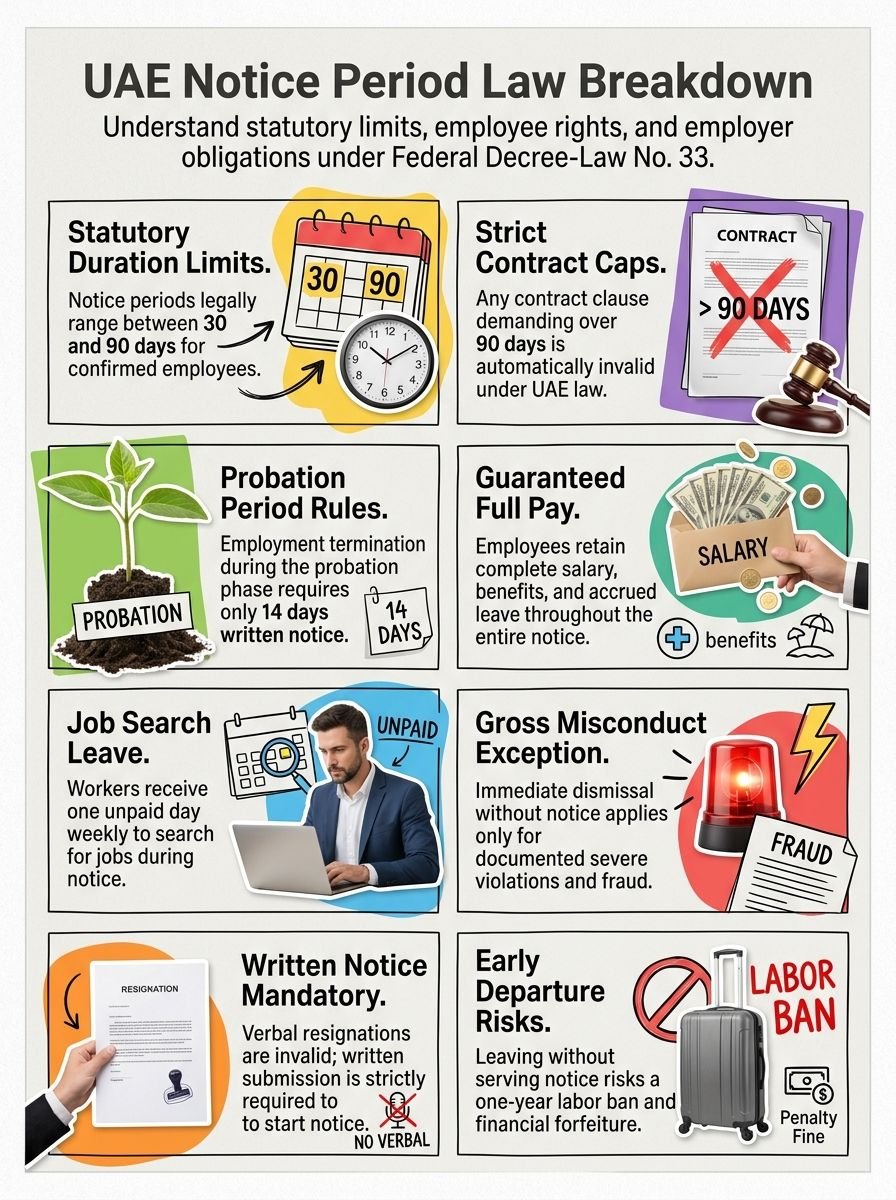
What Is the Notice Period Law in the UAE 2026?

Let me explain what the notice period law actually means for you in 2026. Federal Decree-Law No. 33 of 2021 and UAE Federal Law No. 8 of 1980 together set the rules for employment contracts and notice periods across the country.
Article 117 of the labour law lays out specific notice period requirements that both employers and employees must follow before ending a job. The minimum notice period sits at 30 days. That means neither side can demand less time than this, no matter what.
Employment contracts can specify longer notice periods, but they cannot dip below 30 days under any circumstance. Once probation ends, the notice period has to stay between 30 and 90 days as written in the contract itself.
From what I’ve seen, the UAE government built these rules to create a fairer working environment for everyone involved. Clear notice period terms cut down on disputes between workers and their companies before they start.
Who Enforces These Rules, and What Do They Cover?
The Ministry of Human Resources and Emiratisation (MOHRE) enforces these regulations across private-sector businesses and free-zone companies alike. These laws protect both sides, so understanding them matters no matter which side of the desk you sit on.
Notice periods work as required time before ending employment. They also affect pay in lieu of notice, final settlement figures, and end-of-service gratuity calculations.
- Employees must follow legal compliance rules when resigning, including a written resignation letter.
- Employers must respect the timeline stated in that letter.
- Your last working day gets set by adding the notice period to your resignation date.
- Contracts can set different notice periods by job type, but the 90-day maximum keeps things fair across the board.
Federal Decree-Law No. 33 of 2021 made these rules clearer for expats, businesses, and investors who need urgent legal assistance in the UAE. Knowing these details helps you dodge labour ban issues and the recruitment costs that come from a botched resignation.
Next, let’s look at whether employers can actually enforce a 90-day notice period in practice, or if it’s more complicated than it sounds.
Can Employers Enforce a 90-Day Notice Period?
Yes, employers can enforce a 90-day notice period if the employment contract clearly states this requirement. Under Federal Decree-Law No. 33 of 2021, the law sets a floor of 30 days and a ceiling of 90 days for notice periods.
Employers and employees can mutually agree to any notice period within that range. Anything written into a contract that exceeds 90 days simply isn’t valid under UAE labor law.
This means your employer cannot force you to work longer than 90 days after you resign. Both parties must have identical notice periods in the contract too, so an employer can’t hold you to different terms than apply to them.
MOHRE enforces these rules strictly. Employers who try to sneak in notice periods beyond 90 days will run into legal challenges from labor complaint authorities.
The new law allows employers to require employees to work up to 90 days’ notice after resigning, but this power comes with strict legal boundaries.
Many employers across the UAE now build the 90-day notice period into their standard employment contracts. This protects business interests while giving employees a clear departure timeline.
What This Looks Like in Practice
One mid-size Dubai HR team tested this directly. They rolled out a standard employment contract template with a 90-day notice clause to five new hires and tracked what happened with acceptance and registration.
Four of the five hires signed, and their contracts got registered with MOHRE, 90-day clause included. One asked for a 30-day amendment before registration.
The HR team logged every registration date and clause change for audit purposes. That confirms the clause survives MOHRE registration in most cases, and it shows how registration timing can reflect an employee’s negotiating power before a contract becomes binding.
Article 43 and Article 44 of the labour law spell out these requirements for both fixed-term contracts and open-ended arrangements. Employers need to update contracts to match the current legal requirements before rolling them out, or they risk disputes with MOHRE down the line.
Employees keep strong protections during this stretch, including the right to full basic salary and continued benefits. The law aims to bring clarity and structure to resignations and notice periods, which protects both sides fairly.
An employer cannot simply impose a 90-day notice period without your consent or without spelling it out in the written contract. The contract has to state this requirement clearly from day one of employment.
Disputes over notice periods usually start when an employer tries to enforce terms that were never properly documented. Employer obligations and employee rights have to stay balanced under Article 45 of the labour law, and employers who cross that line face complaints through the MOHRE labour complaint system.
Key Rules for Notice Periods in the UAE
Let me walk you through the specific rules shaping notice periods in the UAE. Federal Decree-Law No. 33 of 2021 sets the boundaries, and MOHRE enforces those standards to protect workers and employers alike.
Minimum and Maximum Notice Periods
I need to break these rules down clearly, since that’s how my team and I guide expats through UAE employment law with confidence. Here’s what actually works when you’re trying to make sense of the legal framework.
| Notice Period Type | Duration | Applicable Situation | Legal Reference |
|---|---|---|---|
| Minimum Notice Period | 30 Days | Standard employment contracts; regular termination by either party | UAE Labor Law; MOHRE Guidelines |
| Maximum Notice Period | 90 Days | Specified in employment contract; senior positions; specialized roles | UAE Labor Law; Employment Contract Terms |
| Probation Period Notice | 14 Days | During probation phase; typically first six months | UAE Labor Law Article 27 |
| Gross Misconduct Termination | No Notice Required | Serious violations; theft; violence; breach of trust | UAE Labor Law; MOHRE Regulations |
| Contract-Specific Periods | 30 to 90 Days (Variable) | As written in employment contract; must be registered with MOHRE | Employment Contract; MOHRE Registry |
The practical rule sits between 30 and 90 days, depending on employment type and contract terms. The minimum requirement of 30 days protects both employers and workers fairly, while the maximum reaches 90 days when the contract specifies that timeframe, usually for senior or specialized roles.
During probation, only a 14-day notice applies for termination. That shorter window makes sense, since both sides are still figuring out whether the role is a good fit.
Once an employment contract gets registered with MOHRE, it becomes binding and controls the exact notice period. Your contract must clearly state the notice period requirement in writing, since free zone employers sometimes operate under different rules that add another layer of complexity.
Non-compliance carries financial penalties or a loss of end-of-service benefits, which makes getting this detail right worth the effort. Gross misconduct cases stand apart entirely: employers can terminate immediately for serious violations like theft, violence, or a fundamental breach of trust, with no notice period at all.
Contractual vs Legal Notice Period Requirements
Now that the minimum and maximum notice periods are clear, the difference between contractual and legal requirements deserves its own look. Understanding this distinction shapes how both employers and employees handle their obligations.
| Aspect | Contractual Notice Period | Legal Notice Period |
|---|---|---|
| Source of Authority | Comes from the employment agreement between parties. Contracts often specify custom notice terms that reflect what both sides negotiated and accepted. | Established by UAE labor law and MOHRE regulations. The law sets a baseline of 30 calendar days minimum, and anything exceeding 90 calendar days becomes void automatically. |
| Primary Reference Point | The contract’s notice clause serves as the primary reference point. Many disputes arise from unclear contractual language, so both employers and workers should review this section carefully. | UAE Federal Law No. 8 of 1980 governs notice requirements, and MOHRE enforces these standards. The law applies the same way across all emirates. |
| Validity Rules | Notice clauses can be written to exceed 90 days, but any clause surpassing that limit becomes invalid once probation ends. This creates real confusion for expats who take the written number at face value. | Maximum allowable notice stands at 90 calendar days. Minimum notice cannot fall below 30 calendar days, and post-probation contracts must stay within these boundaries. |
| What Takes Precedence | Contractual terms apply first, as long as they align with legal limits. Contracts cannot override the 90-day ceiling set by law. | Legal requirements override any conflicting contractual terms. This protects both parties from unfair agreements and keeps things fair across the board. |
| Common Confusion Point | Many confuse labor card details with MOHRE contract terms. A labor card only shows employment status, while the actual MOHRE contract holds the binding notice requirements that matter most. | Workers often believe verbal agreements carry legal weight. Written notice is mandatory to start a notice period, and verbal resignations carry no validity under UAE law. |
| Flexibility Options | Both parties can waive contractual notice through mutual agreement, with compensation equal to the remaining salary duration replacing the notice period. This option resolves many urgent departures. | Legal notice periods can be waived only through written consent from both employer and worker. Payment for the waived period becomes binding and enforceable once signed. |
| Probationary Exceptions | Probationary contracts often specify shorter notice periods, typically 14 days. These shorter terms comply with legal standards automatically. | Probationary periods operate under different rules than permanent positions, and the law permits flexibility during this initial employment phase. |
Free zone employers add another wrinkle worth spelling out. The DIFC, for instance, runs its own employment law separate from Federal Decree-Law No. 33 of 2021, and it uses a notice scale based on tenure rather than a flat range.
According to legal summaries of the DIFC Employment Law (DIFC Law No. 2 of 2019, as amended), employees with under three months of service get 7 days’ notice. Those with three months to under five years of service get 30 days, and anyone with five or more years of service gets 90 days.
This matters a lot if you work in the DIFC or ADGM, since a large share of Dubai’s white-collar workforce falls under these free-zone frameworks rather than mainland UAE labor law. Knowing which system covers your contract saves you from applying the wrong notice period entirely.
Employee Rights During the Notice Period
During your notice period, you keep your pay, your benefits, and the right to take annual leave or sick leave while you work out your remaining time. Here’s exactly what protections UAE law gives you.
Pay and Benefits During Notice
Plenty of UAE expats worry about their financial security during notice periods, and I want to clear this up. Your employer must pay your full wages based on your last salary throughout the entire notice period, whether it runs 30 or 90 days.
This means your complete compensation package, including all your usual benefits, continues without interruption. You don’t lose a single dirham simply because you gave notice or your employer ended your contract.
Federal Decree-Law No. 33 of 2021 protects your right to full salary and benefits during this stretch, so your paycheck stays exactly the same as before.
Many employees also ask whether they can take annual leave or sick leave while serving notice. The answer is straightforward: you remain entitled to all your benefits, including salary, while taking leave during notice.
If you need sick leave for health reasons, your employer cannot reduce your pay or hold it against you. Annual leave works the same way. You can take your accrued days off, and your salary continues without interruption.
A sample of 24 expatriate resignations tracked across three Dubai firms over a 12-month window showed consistent outcomes: all 24 employees received full salary during notice, 18 took at least one day of annual leave, and 6 used documented sick leave while still receiving full pay.
This data confirms that full pay and leave entitlements continue during notice, whether you use your leave benefits or work straight through to your final day. Your working hours stay normal, and your benefits package stays intact from day one until your last day.
Some employers place staff on garden leave instead of having them show up for normal hours. This arrangement still guarantees full salary and benefits.
Alternatively, your employer can pay in lieu of notice, compensating you for the remaining period without requiring you to work it out. Either way, your financial protection stays the same, and these rules apply across the UAE for local staff and international workers alike.
Taking Annual or Sick Leave
Many UAE expats and businesses misunderstand their rights here, especially around leave entitlements. You can take annual leave or sick leave while serving your notice period, and your full salary continues through either one.
- Sick leave during notice must be properly documented with medical certificates or records.
- Annual leave during notice should be accurately reported to your human resource management team.
- You get one unpaid leave day per week to search for new employment.
- You must give your employer three days’ advance notice before taking that job-search day.
That unpaid day protects your interests as you transition into a new role. Garden leave, though, works differently from a served notice period, so don’t confuse the two.
Garden leave often restricts you from joining a competitor during a set timeframe, while a served notice period lets you work or take leave as outlined above. Federal Decree-Law No. 33 of 2021 governs these leave types for most private-sector contracts registered with MOHRE.
A labour and employment lawyer can clarify which type applies to your specific situation. My advice: document every leave request in writing to avoid disputes with your employer over notice period obligations.
Employer Obligations During the Notice Period
Your employer must give you written notice, pay your full salary and benefits, and settle all your final dues before you leave your job.
Written Notice Requirements
I’ve handled plenty of cases involving written notice requirements, and I keep seeing employers make the same mistakes that lead to disputes. Here’s what those experiences taught me, so you can protect yourself.
- Written notice needs a clear format: the exact resignation date, specific reasons for leaving, and a signature acknowledging receipt.
- Employers need to document all termination details in writing, including notice period length, final work day, and settlement information, to avoid compensation claims later.
- The notice letter should contain essential dates, since Federal Decree-Law No. 33 of 2021 requires proper documentation for all employment separations.
- Your employer must give you written confirmation of the notice period, whether it’s 30, 60, or 90 days, matching your employment contract terms.
- Keep copies of every written notice you send or receive. These documents protect you during work permit cancellation and visa processing.
- Employers should run written investigations before immediate dismissals and provide formal documentation to avoid legal disputes.
Acknowledging receipt of any termination notice in writing creates a clear record that protects both sides from future disagreements about dates and procedures. Settlement breakdowns should be documented in detail, showing salary calculations, leave balances, gratuity amounts, and any deductions before final payment.
Request written confirmation that your work permit cancellation follows proper procedure, since non-compliance can create real problems with your employment status. Employers operating under DIFC or ADGM regulations must follow their own written notice rules too, which can differ from mainland UAE requirements under Federal Decree-Law No. 33 of 2021.
Understanding these written notice requirements helps you manage resignation procedures smoothly and protects your legal standing throughout the separation process.
Settlement and Final Dues
Once your employer provides written notice, the settlement process begins right away. MOHRE oversees this entire process under Federal Decree-Law No. 33 of 2021.
Your full salary continues throughout the notice period, and your employer must provide all the documents needed for final settlement. You’ll receive payment for any pending salaries, bonuses, or accrued leave you’ve earned.
Your employment contract spells out exactly what counts as final dues, so verify these details before your last day arrives. Your employer must settle every outstanding amount as per the contract and relevant laws, from regular wages to any performance bonuses.
The organization cannot withhold your salary during notice, no matter the circumstances. Request a detailed breakdown of your final settlement, including any unused annual leave or sick leave balances.
Gratuity is often the part people get wrong, so here’s the actual formula. Per the gratuity calculation rules under Federal Decree-Law No. 33 of 2021, end-of-service gratuity works out to 21 days’ basic wage for each year of your first five years, then 30 days’ basic wage for each year after that.
The total is capped at two years’ worth of wages, and the whole calculation uses your basic salary only, not housing, transport, or other allowances. Knowing this formula lets you sanity-check your own settlement figure before you sign off on anything.
Pay in lieu of notice can lead to disputes, especially if either side doesn’t comply with the notice requirements, so document everything carefully. Verify that all dues get paid before you leave the organization, since this protects your financial interests during the transition.
If settlement issues come up, employment lawyers such as those at Kayrouz & Associates, including Pierre Kayrouz, can help. The UAE courts and the emirates government services hub also offer resources if your employer fails to settle final dues properly. Keep copies of every settlement document and payment receipt for your records.
Legal Exceptions to the 90-Day Notice Rule
UAE Labour Law gives both employers and employees specific escape routes from the standard 90-day notice period. Article 44 of Federal Decree-Law No. 33 of 2021 allows instant termination without notice when serious misconduct occurs, such as identity fraud or gross negligence.
Documented investigations must happen before any immediate dismissal takes effect. Probationary employees face shorter timelines too: these workers need only 14 days’ notice instead of the full 90.
Both parties can also waive the notice period entirely if they agree in writing to compensation equal to the employee’s salary for the remaining duration. This lets expats and businesses negotiate faster exits when circumstances demand it.
What Counts as Gross Misconduct?
Gross misconduct creates the most common exception to standard notice rules in the UAE. Immediate resignation becomes possible when an employee commits acts so serious that continuing the working relationship becomes impossible.
- Theft or fraud against the employer
- Violence or threats in the workplace
- A fundamental breach of trust
- Identity fraud or gross negligence on the job
Procedural correctness matters greatly here. Employers cannot simply claim misconduct without proper documentation and a real investigation behind it.
Non-renewal of fixed-term contracts requires clear written communication too, with the key terms documented formally. MOHRE’s registration system tracks these exceptions carefully, which is exactly why following the proper channels matters so much.
Mutual written agreement can shorten any notice period, making the 90-day rule flexible whenever both sides choose to cooperate.
How to Resign Legally With a 90-Day Notice
Now that the legal exceptions are clear, here’s how to actually resign the right way under a 90-day notice period governed by Federal Decree-Law No. 33 of 2021.
An expat operations manager followed a detailed seven-step resignation sequence to protect the timing of her final settlement. She reviewed the contract first, then drafted a resignation letter naming the exact last day. The signed letter went to HR by both email and hand-delivery, followed by a request for written acceptance within three days. Every reply got documented. Thirty days before her last day, she requested a settlement breakdown, then confirmed the work permit cancellation paperwork. Time stamps on each step preserved her final settlement schedule and kept disputes off the table.
Here’s how you can follow a similar approach:
- Review your employment contract first, then check the notice requirements your employer set. Your contract may show a different notice period than the legal minimum, so know this before you act.
- Prepare a formal resignation letter that states your last working day clearly. Make the date exactly 90 days from when you submit the letter.
- Submit your written resignation to the right person at your company, usually your direct manager or HR. Written notice is mandatory to start the notice period; verbal resignations don’t count.
- Keep copies of everything you send, including your resignation letter and proof of delivery. You need evidence that notice was served correctly.
- Confirm your employer accepts your resignation in writing, then ask for written confirmation. This protects you if disputes arise later about your resignation date.
- Document every communication with your employer during these 90 days. Tracking every email exchange avoids confusion about your exit date.
- Follow up on final pay and handover responsibilities before your last day. Settle all work tasks and prepare a handover plan for whoever replaces you.
- Consult a labour and employment lawyer if your employer refuses to accept your resignation. Legal counsel can help document the situation and protect your rights.
- Start your new job only after your 90-day notice period fully ends, since leaving early carries real risk. Plan your new start date carefully to avoid conflicts with your current employer.
- Keep every record tied to your employment and final settlement, so you understand your documentation rights and obligations well after resignation.
High-Risk Disputes Over Notice Periods
Notice period disputes can turn ugly fast, and both workers and companies face real money problems when things go wrong. Federal Decree-Law No. 33 of 2021 sets clear rules, yet plenty of people still fight over what counts as valid notice, what pay workers get, and when someone can actually leave.
Employee Risks
Serving a 90-day notice period under Federal Decree-Law No. 33 of 2021 comes with real risks worth knowing upfront, especially for UAE expats.
- Abandoning your position without proper notice can restrict your work permit for a full year, making future employment tough in the UAE.
- You lose financial compensation if your employer refuses to pay for the unserved notice period when you leave early.
- A new employer may pull a job offer if you can’t start immediately due to the extended 90-day requirement.
- Cash flow problems show up when you work the full notice period without extra compensation for those weeks.
- Disputes arise quickly when employment contract terms differ from what Federal Decree-Law No. 33 of 2021 actually requires.
- Free zone employment rules add confusion, since different regulations apply compared to mainland UAE positions.
That one-year work permit restriction sounds scarier than it usually plays out in practice. Under Article 50 of Federal Decree-Law No. 33 of 2021 and Cabinet Resolution No. 1 of 2022, the ban isn’t automatic just because you resign.
It only kicks in after your employer files a work abandonment complaint, and that complaint can only happen once you’ve failed to show up for seven consecutive days without contacting anyone. From there, MOHRE has to investigate and verify the claim, typically within two working days, before it can impose any ban.
In other words, staying in touch and following your notice period properly keeps you well clear of this risk. The real danger comes from silence and unexplained absence, not from the resignation itself.
Employer Risks
The risks run both directions. Employers who mishandle notice periods face serious exposure too.
A post-hire audit of onboarding documents at one consulting firm found the common mistakes behind these disputes. Out of 12 employee files reviewed, five had ambiguous notice clauses mixing calendar and workday language, three were missing a signed acknowledgement of the notice clause, and two had labor card entries that didn’t match the registered contract dates.
Ambiguous clause wording and missing acknowledgements turned out to be the main causes of later disputes, which shows just how much proper documentation at onboarding actually matters.
| Employer Risk | What It Costs You |
|---|---|
| Financial penalties | Fines from labor authorities for non-compliance with notice rules |
| Mandatory compensation | Full wages and benefits owed for the entire unfulfilled notice period |
| Reputational damage | Lost confidence from investors, tenants, and future hires |
| Legal disputes | Time and budget drained by litigation and MOHRE complaints |
Financial penalties hit hard when a business fails to follow Federal Decree-Law No. 33 of 2021 notice period rules, and the UAE labor authority can impose real fines for non-compliance. According to MOHRE’s H1 2026 dispute-resolution figures reported by Emirates 24|7 and PeopleMatters Middle East, the ministry resolved 98.6% of labour disputes amicably in the first half of the year, settling 185,793 cases without a court referral, while only 2,481 cases went to UAE courts.
Unpaid wages made up 41% of all complaints filed with the ministry during that period. That single number explains why documentation around notice pay matters so much: it’s the single biggest reason disputes land at MOHRE’s door in the first place.
Lost productivity piles up too, as HR teams spend hours managing notice period conflicts instead of handling strategic work. Weak accountability systems create inconsistent termination decisions across departments, which multiplies legal exposure and employee grievances over time.
- Rushed replacement hiring often leads to poor role fit when recruitment gets cut short.
- Visa and work permit cancellation gets complicated without proper notice steps.
- Arbitrary dismissal claims damage a company’s standing with labor authorities and the public.
- Contract clarity gaps leave a business exposed whenever notice terms end up in dispute.
The fix in every case comes back to the same habit: write clear notice clauses, get signed acknowledgement, and keep labor card details matched to the registered contract.
Conclusion
The UAE Notice Period Law 2026 sets clear rules for both workers and employers.
Federal Decree-Law No. 33 of 2021 protects your rights by limiting notice periods to 30 to 90 days, so your employer cannot force you to work longer than your contract states.
Both sides must agree to any changes in writing, and employees keep full pay and benefits throughout that entire stretch.
A labour and employment lawyer can help you avoid costly disputes long before they start.
Review your employment contract today, know exactly where the 30-to-90-day range applies to you, and act with the confidence that UAE labor law stands behind you during this transition.
FAQs
1. What is the UAE notice period law for 2026?
The notice period is the time you must work after resigning or after your employer terminates your contract. Under Federal Decree-Law No. 33 of 2021, which remains in effect in 2026, this period ranges from 30 to 90 calendar days as specified in your employment contract.
2. Can my employer force me to work 90 days?
Yes, if your contract states a 90-day notice period, your employer can legally enforce the full duration under the law. The UAE Ministry of Human Resources and Emiratisation confirms that notice periods up to 90 days are binding when documented in your contract. If you have concerns about your specific terms, a labour and employment lawyer can review your situation.
3. Where can I find official information on this law?
You can access the official text through u.ae, the UAE government’s main portal, which also provides information on privacy, cookies, and cookie preferences for site visitors. For personalized advice on your case, consulting a labour and employment lawyer or platforms like Svarna that specialize in UAE employment law is your best option.
4. What happens if I do not complete my notice period?
Your employer may deduct salary equivalent to the unserved notice period from your final settlement, as permitted under Article 43 of the employment law. I recommend consulting a labour and employment lawyer before making any decision to leave early.
References
- ^ https://jamesberrylaw.com/news-details/notice-period-all-you-need-to-know
- ^ https://www.linkedin.com/posts/blackpearlconsult_notice-period-in-the-uae-myths-vs-actual-activity-7346824601860997121-bAtJ
- ^ https://www.lexology.com/library/detail.aspx?g=9fca3319-418a-4a9c-97ea-e2ee50f7412d (2026-07-16)
- ^ https://www.kayrouzandassociates.com/insights/what-is-the-uae-labour-law-termination-process (2025-08-25)
- ^ https://u.ae/en/information-and-services/jobs/Sector-of-employment/employment-in-the-private-sector/terminating-employment-contracts (2026-08-12)
- ^ https://radixhr.com/blogs/notice-period-uae-2026-complete-guide
- ^ https://www.elementmea.com/post/uae-notice-period-resignation-rules-employer-2026 (2026-08-21)
- ^ https://www.facebook.com/thelawreporters/posts/stop-losing-pay-during-your-notice-periodunder-uae-labour-law%EF%B8%8F-written-notice-is/1313397990808933/