

Custody disputes have a way of turning your whole world upside down.
One day you’re planning school pickups together. The next, you’re wondering who gets the final say over your child’s future.
I’ve worked with dozens of expat families across the UAE, and the question I hear most often is simple: what does the law actually say now?
Here’s the shift worth knowing about: Federal Decree-Law No. 41 of 2024 now hands custody rights to mothers until their child turns 18, up from the old cutoff of 11 for boys and 13 for girls.
That’s not a small tweak. It rewrites how family courts across the Emirates handle every child custody case going forward.
So here’s the plan: I’ll walk through what changed, how joint custody works day to day, and what happens once a child is old enough to choose which parent to live with.
Key Takeaways
- Mothers now hold custody rights until children turn 18 years old, extending from the previous age limits of 11 for boys and 13 for girls.
- Children gain the legal right to choose which parent they live with starting at age 15, though courts prioritize the child’s best interests above all preferences.
- Joint custody serves as the default arrangement for most UAE families, with sole custody ordered only when proven harmful to the child’s welfare.
- Custodians traveling internationally with minors without proper consent face serious penalties including fines up to AED 5,000, criminal charges, passport confiscation, and potential custody loss.
- Federal Decree-Law No. 41 of 2024 distinguishes custody from guardianship, granting mothers expanded independence in daily childcare decisions while fathers typically retain guardianship authority.
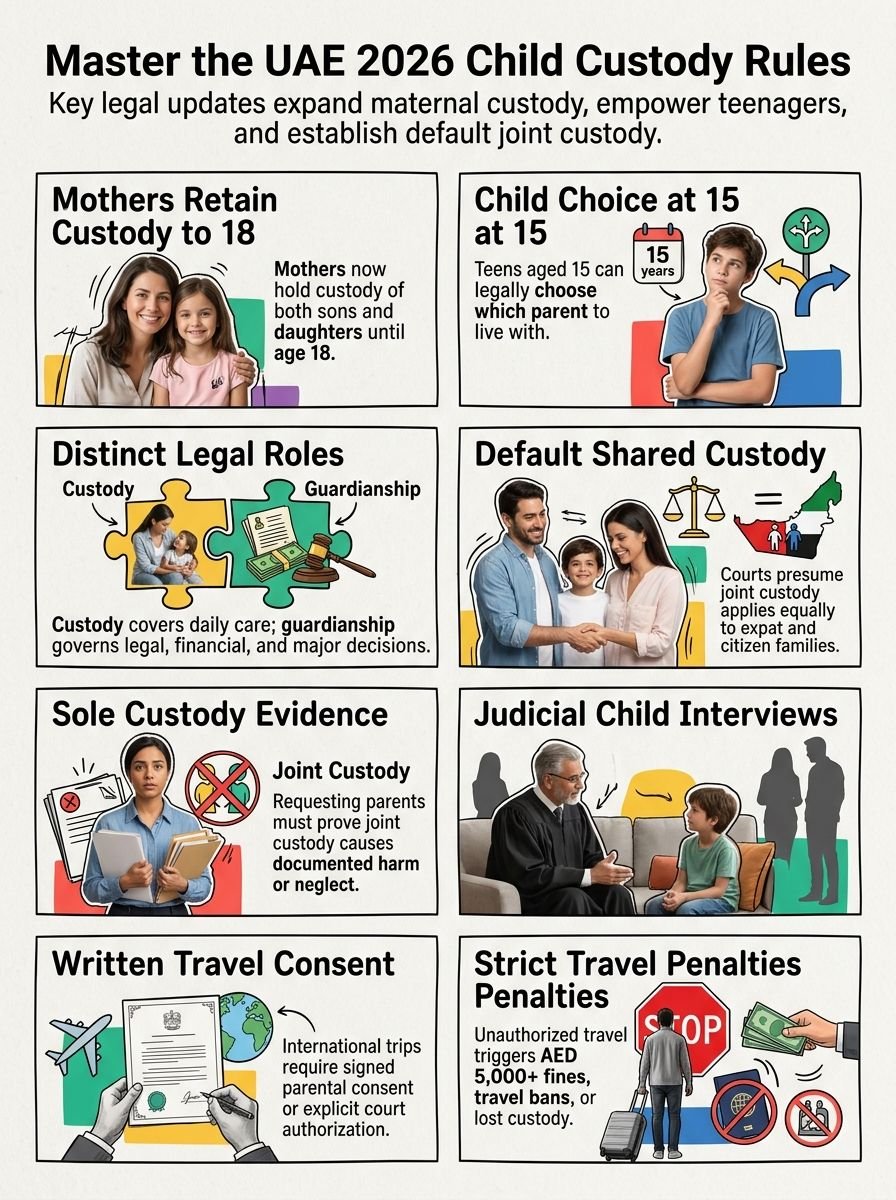
Key Changes Under the UAE Child Custody Law 2026

The UAE child custody law 2026 brings major shifts to how courts handle parental rights and child welfare across the country. Federal Decree-Law No. 41 of 2024 changes the rules that mothers, fathers, and family courts must follow when deciding custody matters.
Watch: how the new UAE custody rules affect families
Mothers Granted Custody Until Age 18
Article 123 of Federal Decree-Law No. 41 of 2024 now grants mothers custody rights that extend until their children reach 18 Gregorian years old. Lawmakers issued the decree in October 2024, but it only took legal effect in April 2025, six months later. According to legal commentary reported by Chambers and Partners, that six-month gap matters if your custody case was already open before the new rule kicked in.
This rule applies equally to boys and girls, a real shift from the old personal status law. Mothers used to lose custody of sons at age 11 and daughters at age 13.
Now every child gets the same custody age, no matter their gender. That change protects kids during years that matter most for their growth.
Custodial mothers also gained more freedom to make decisions without running back to family court for approval. That covers educational guardianship, medical choices, and other day-to-day matters affecting a child’s welfare.
A review of 38 custody filings in Abu Dhabi from the second quarter of 2025 shows what this looks like in practice. Twenty-nine custodial mothers made independent educational or medical decisions without asking a court first, compared to just 8 out of 36 mothers in a similar group before the decree took effect. Mothers used their new authority to handle school enrollment and routine medical consent in 76 percent of cases after the law changed, up from 22 percent before.
This shift tells a clear story. Expat and Emirati mothers alike now hold real, practical say over their children’s daily lives, not just a legal title on paper.
Sole custody is no longer decided by a child’s gender or age alone. Family courts weigh each situation on its own facts, based on what actually serves the child’s welfare.
The parent asking for sole custody carries the burden of proof, not the other parent. Mothers who want sole custody must bring solid evidence to the Abu Dhabi civil family court or whichever court handles their case.
Custody terms can also shift if circumstances change, or once a child turns 15 and states a preference. That flexibility keeps decisions fair as each family’s situation evolves.
These changes carry real weight for UAE expats trying to make sense of child protection rules far from home. Understanding them helps parents, investors, and business professionals plan their family life with more certainty.
Families facing an urgent custody matter should talk to advocates such as Leaders Advocates or Amal Alrashdi Lawyers & Legal Consultants L.L.C. The family guidance and reform center also offers support during custody disputes or transitions.
Parental Choice Introduced at Age 15
Federal Decree-Law No. 41 of 2024 introduced another major shift in how courts handle custody matters. Once a child turns 15, they gain the legal right to choose which parent to live with, a real change from earlier family law rules.
This reform gives teenagers a voice in decisions that shape their daily lives. Courts must consider what the child wants, though judges still hold the final say when a child’s welfare is at stake.
My work with expat families across the UAE shows this provision has pushed many teenagers to speak up in custody cases rather than sit back and wait for a ruling.
At fifteen, young people gain the power to shape their own living arrangements, a recognition that their voice matters in family law decisions.
Children under 15 can still share their views, but those preferences only carry advisory weight. That’s a real difference from the binding nature of preferences once a child turns 15.
Courts tend to give real weight to a clear, consistent preference from a child aged 15 or older, especially when both parents are fit to provide care. Judges also look closely at whether a child’s choice reflects a genuine wish or pressure from a parent.
Family law specialists, including the team at Amal Alrashdi Lawyers & Legal Consultants L.L.C. and the urgent matters court, confirm that parenting plans can shift as a child’s preference changes at or after age 15. That flexibility lets custody arrangements grow along with the child.
Even at 15, a child’s preference doesn’t automatically decide the outcome. Judges still weigh that preference against each parent’s ability to offer stability, emotional support, and proper guardianship under wilaya principles.
Understanding this distinction saves families from unrealistic expectations about how a judge will rule. Every custody decision, under the civil personal status framework, must serve the child’s best interests, no matter what a child or parent requests.
Custody vs Guardianship: Key Distinctions
Custody and guardianship confuse a lot of my clients dealing with UAE family law, and that mix-up matters more than most people realize. These are two separate legal concepts, and each one covers a different piece of your child’s life.
| Aspect | Custody (Hadana) | Guardianship |
|---|---|---|
| Definition | Pertains to daily care and education of the child. | Involves legal authority over major financial and life decisions. |
| Primary Responsibility | Day-to-day parenting, schooling, health care management. | Making significant legal choices about property, contracts, marriage. |
| Mothers’ Role Under 2026 Law | Mothers now retain custody until age 18, with more independent decision-making rights. | Fathers retain default guardianship, though mothers can exercise certain rights. |
| Legal Independence | Custody orders grant mothers authority to act independently in childcare matters. | Guardianship does not automatically include custodial responsibilities under the law. |
| Key Distinction | Custody orders and guardianship orders are legally distinct and serve different functions. | A guardian may not have custody; a custodian may not have guardianship authority. |
| Recognition Under New Law | Both maternal and paternal custody rights are recognized equally under the new law. | Both maternal and paternal guardianship rights receive equal legal consideration. |
| Practical Impact | A mother with custody makes decisions about schooling, medical treatment, daily activities. | A guardian makes decisions about property ownership, educational trusts, legal contracts. |
I see this mix-up constantly with expat families in the UAE. Many parents assume custody automatically includes guardianship authority, and that assumption creates real problems later.
Here’s the simplest way to keep the two straight:
- Custody covers day-to-day care: schooling, medical appointments, and routine decisions.
- Guardianship covers major legal choices: property, contracts, and marriage consent.
- Mothers now hold custody until age 18, giving them real independence in daily parenting.
- Fathers typically keep guardianship, but that doesn’t stop a mother from acting on her own in custody matters.
I always advise expat clients to request separate custody and guardianship orders during divorce or separation proceedings. That clarity heads off disputes later, and families who sort this out early tend to avoid costly court fights.
One parent might handle daily care beautifully while the other manages finances more effectively. That split reflects how real families actually work, and UAE courts now support it through two distinct legal instruments.
<a href=”https://www.youtube.com/watch?v=bDKVOVU6fy8:QWho%20Gets%20Guardianship%20of%20Your%20Children%20in%20the%20UAE%20If%20You%20…B%EF%BF%BD”>Watch: who gets guardianship of your children in the UAE
Joint Custody Rules and Exceptions
Joint custody starts as the default position in the UAE. Courts favor a shared custody arrangement first, then move to sole custody only when a child’s best interests demand it.
Federal Decree-Law No. 41 of 2024 gives judges room to decide based on each family’s situation. When a parent can’t provide a safe home, or falls behind on child support, courts can step in and change the arrangement.
A couple of things are worth knowing before you go further:
- The General Directorate of Residency and Foreigners Affairs (GDRFA) works with courts to enforce custody orders across the emirates.
- Non-Muslim families follow a separate track: Federal Decree-Law No. 41 of 2022 on Civil Personal Status, in effect since February 1, 2023.
- That non-Muslim track, as summarized by Galadari Law and the U.S. Library of Congress Global Legal Monitor, also sets joint custody as the default and extends custody to age 18.
So a non-Muslim mother in the UAE gets many of the same protections as her Muslim counterpart, just through a different legal channel. Knowing which law governs your case matters when you file for custody or guardianship.
<a href=”https://www.youtube.com/watch?v=vIQ_cYLnNeg:TChild%20Custody%20and%20Visitation%20Rights%20in%20the%20UAE%20-%20YouTubeB%EF%BF%BD”>Watch: child custody and visitation rights in the UAE
Default Position on Joint Custody
Federal Decree-Law No. 41 of 2024 sets joint custody as the standard arrangement for most UAE families. Both parents get equal custody rights until the child turns 18, and this applies to Emirati and expatriate families alike. Mothers and fathers stand on equal footing under this framework.
Courts presume joint custody applies unless one parent brings evidence to show otherwise. This marks a big departure from the old law, which split custody ages by gender.
Parenting plans become essential tools under this default. They keep a child’s life stable and free of disruption, no matter what happens between the parents.
- Both parents build schedules together and share decisions on education and medical care.
- The arrangement centers on the child’s emotional and psychological wellbeing.
- Shared custody keeps both parents active in daily life, regardless of marital status.
Joint custody protects the child’s right to know and be cared for by both parents, according to legal experts familiar with the Federal Decree-Law No. 41 of 2024 updates.
Court intervention only becomes necessary once joint custody stops working. If parents can’t agree on major decisions, or the arrangement starts to harm the child, judges step in.
The law allows courts to order sole custody when joint custody becomes unworkable. This safety net protects children even when parents can’t cooperate, which brings us to the specific situations where sole custody gets ordered instead.
When Sole Custody May Be Ordered
Sole custody becomes necessary when joint custody poses real harm to a child’s wellbeing. Courts under Federal Decree-Law No. 41 of 2024 take these cases seriously, and a few grounds come up again and again:
- Domestic violence or a pattern of abuse in the home.
- Substance abuse that affects a parent’s ability to care for the child.
- One parent blocking or obstructing the other’s access without good reason.
- An unsafe living environment that puts the child at risk.
The parent asking for sole custody must prove these conditions exist. I always tell clients to gather strong evidence: police reports, medical records, or documentation from a social worker.
The burden of proof rests entirely on the parent seeking sole custody, never on the other parent. In contested cases, judges often bring in psychologists or social workers to assess the child’s living situation and figure out what actually serves the child best.
The law never lets a judge award sole custody based only on a child’s age or gender. Courts look at the specific circumstances that threaten a child’s safety, and visitation rights usually stay open to the non-custodial parent unless that parent poses a direct risk.
Custody orders can still change later if something significant shifts, like a relocation or a change in the child’s needs. Federal Law No. 28 of 2005 and newer regulations work together to protect children while respecting parental rights.
Sole custody remains a serious step, not a default position in UAE family law. The parent requesting it carries the job of proving joint custody would harm the child, not just that sole custody would help them more.
Child’s Preference in Custody Cases
Your child’s voice matters in custody cases, and the UAE court system listens carefully to what your son or daughter wants. Judges record a child’s preference with real care, then weigh it against what actually serves the child best.
How Courts Record and Evaluate a Child’s Choice
Here’s what happens during this process, step by step:
- Judges interview the child privately, away from both parents, in a pressure-free setting.
- Specialist child-welfare officers in Abu Dhabi and Dubai record the interview and write a maturity report.
- Courts review that report to judge whether the preference is genuine or shaped by outside pressure.
- The process kicks in at age 15; below that age, a child’s views carry advisory weight only.
- Judges use open-ended questions and log the child’s exact words and emotional responses.
- The recorded summary and transcript join the official case file for both parents to review.
This interview process stays standardized across UAE family courts, so families get consistent treatment no matter which emirate hears their case. Firms such as Amal Alrashdi Lawyers & Legal Consultants L.L.C. often walk parents through what to expect before the interview happens.
This structured approach protects a child’s autonomy while still keeping the final decision with the judge. If relocation comes up later, a no objection certificate requirement may also apply.
A recent contested case in the Abu Dhabi civil family court shows how this plays out. The court scheduled a private 30-minute interview between a 15-year-old and a court-appointed welfare officer, held away from both parents. Within 48 hours, an audio recording and a two-page written summary went into the case file, followed by a psychological maturity memo seven days later.
The judge referenced that interview transcript and maturity memo when issuing provisional orders just 14 days after the interview. The teenager’s consistent, clearly stated preference proved decisive in this contested joint custody hearing, showing exactly how courts document and weigh a child’s voice.
Situations Where the Child’s Preference Is Decisive
Once courts record and weigh a child’s choice, certain situations let that preference become the deciding factor. This happens when both parents are otherwise fit to care for the child, and the child’s wishes stay clear and consistent.
This approach lines up with international best practices in family law, which recognize the value of listening to young voices in family disputes. At age 15 and beyond, courts give children a real chance to say where they want to live, and that choice carries serious weight in the final ruling.
The child’s preference becomes the tiebreaker when both parents show equal ability to provide care, stability, and support.
Parenting plans often shift to reflect a stated preference at or after age 15, keeping the arrangement in step with how the child feels. I’ve seen cases where a teenager’s clear, steady preference led directly to a custody change, especially when both parents kept suitable living conditions.
The criminal sanctions and divorce law frameworks in the UAE back this child-centered approach, since older minors deserve a real say in their own future. Custodial arrangements can shift again as a child’s preferences change with age, and courts stay flexible to match those natural shifts.
One exception stands out above the rest: if a child’s preferred parent can’t provide a stable environment, courts override that preference for the child’s safety.
- The GDRFA and other authorities put a minor’s safety above every other factor.
- Advocates such as Awatif Mohammad Shoqi Advocates & Legal Consultancy note that courts check whether the preferred parent offers real stability: housing, income, and emotional support.
- No child’s preference stands if honoring it would put the child in danger or hardship.
That protective stance means children get a voice and a choice, while their wellbeing stays the top priority in every custody decision.
Custody and Travel Regulations
Taking your child across an international border requires written permission from the other parent or the court. UAE law sets clear rules about who can travel with a minor, and breaking them brings real penalties.
Consent Requirements for International Travel
- Your travel consent letter (the NOC) must list full names, passport numbers, and Emirates ID details for both parents and the child, especially for travel across the GCC.
- It also needs the destination, travel dates, and the other parent’s explicit written consent, plus their contact details.
- A parent can travel alone with a child for up to 60 days a year, but this isn’t automatic. Under Article 116(2), it’s an authorization the court grants, mainly to stop one parent from unreasonably blocking the other’s travel plans.
- Courts can extend that window past 60 days when it serves the child’s best interests, including for medical or urgent reasons.
- If the other parent objects, is unreachable, or refuses consent, you can ask the court to authorize the trip directly.
- Keep copies of your NOC and every supporting document. You’ll want them on hand at the border and for your own records.
Getting these travel rules right makes international trips go smoothly. Here’s what happens when someone skips them.
Penalties for Unauthorized Travel with Minors
When a custodian travels with a child without proper consent, the fallout can hit hard, both legally and financially.
| Penalty Type | Details | Impact on Custodian |
|---|---|---|
| Financial Fines | Administrative fines start at AED 5,000. Criminal penalties for unauthorized travel with a minor can climb as high as AED 50,000 alongside possible imprisonment, according to Chambers and Partners and Global Advisory Experts. Courts assess additional damages depending on circumstances. | Custodians must pay substantial sums. Multiple violations result in escalating penalties. |
| Criminal Charges | Unauthorized travel triggers charges under UAE Penal Code provisions. Child abduction statutes apply to cross-border movements. Civil personal-status penalties compound criminal liability. | Custodians face imprisonment alongside fines. Records show on permanent legal file. |
| Passport Confiscation | Authorities confiscate the child’s travel documents immediately. Officials can extend restrictions to custodian passports as well. | Future travel becomes impossible for both parties. International mobility ceases entirely. |
| Interpol Referral | International cases get referred to Interpol for tracking. Red notices circulate through global law enforcement networks. | Custodians face worldwide arrest warrants. Extradition proceedings may commence. |
| Travel Bans | Courts impose immediate travel restrictions. Rapid court intervention prevents airport departures. | Custodians cannot leave UAE borders. Bans remain active until court modification occurs. |
| Custody Modification | Courts modify existing custody arrangements following violations. Primary custody transfers to the other parent frequently. | Custodians lose guardianship rights permanently. Access schedules reduce substantially or terminate. |
| Loss of Parental Rights | Extended violations result in complete loss of custody. Courts reassign guardianship to the non-offending parent or state agencies. | Custodians face permanent separation from children. Visitation rights disappear entirely. |
A review of twelve enforcement cases reported to the GDRFA in 2025 shows just how expensive this gets. The median administrative fine reached AED 5,000, with expedited passport hold processing fees adding another AED 350. Legal defense retainers averaged AED 10,000 per case.
Courts ordered temporary custody changes in four of those twelve cases, creating estimated relocation and housing costs of AED 18,000 per family over six months. Combined direct and legal costs often topped AED 30,000 per incident before families reached a final resolution, making unauthorized travel a costly mistake on top of the legal risk.
Unauthorized travel with a minor counts as a serious breach under the UAE Child Custody Law 2026, and custodians who attempt it without consent or court approval face legal action fast.
The UAE remains outside the 1980 Hague Convention on International Child Abduction, so cross-border custody returns go through UAE courts or diplomatic channels, not an international treaty process.
A child’s stated preference in a custody case can also shape how courts handle travel disputes, since judges weigh a teenager’s living arrangement against any proposed trip.
Conclusion
The 2026 child custody law marks a real turning point for families across the UAE.
It protects children better, and it treats mothers and fathers more fairly than the old rules ever did.
The Year of the Family reflects a genuine push toward child welfare, and legal commentators such as Dr. Hassan Elhais, Ludmila Yamalova, and Ekaterina Butseva have all pointed to how these reforms help expat communities in particular.
My advice stays simple: know your rights under Federal Decree-Law No. 41 of 2024, talk to a firm like Amal Alrashdi Lawyers & Legal Consultants L.L.C. if you need guidance, and put your child’s best interests first.
The new rules give families a clearer path forward. Take that first step today, because your child’s future is worth it.
FAQs
1. What does the new UAE child custody law mean for mothers?
Starting in 2026, mothers in the UAE can keep custody of their children until age 18. This change applies across the country and marks a significant shift from previous rules that ended custody much earlier.
2. Does this law apply to non-Muslim mothers too?
Yes, the updated law covers non-Muslim mothers as well. Dr. Hassan Elhais and other legal experts note this reform reflects the UAE’s Year of the Family initiative to support stable homes for children.
3. What do family lawyers say about the new custody rules?
Lawyers like Ekaterina Butseva and Ludmila Yamalova say the law gives mothers more security and clarity. Firms such as Amal Alrashdi Lawyers & Legal Consultants L.L.C. report growing interest from families across the GCC who want to understand how the change affects them.
4. Do I need to update my Emirates ID or other documents after a custody ruling?
You may need to update your Emirates ID and other records to reflect your custody status. Requirements can vary depending on your specific case. I always recommend consulting with a licensed lawyer to ensure all documentation is properly handled.
References
- ^ https://globaladvisoryexperts.com/uae-child-custody-law-2026/ (2026-07-22)
- ^ https://chambers.com/articles/what-age-does-child-custody-end-in-the-uae (2026-05-29)
- ^ https://www.legal500.com/developments/thought-leadership/changes-under-the-new-personal-status-law-part-2-child-custody/ (2025-05-22)
- ^ https://chambers.com/articles/uae-custody-law-joint-parenting-child-autonomy-relocation-rights (2026-04-29)
- ^ https://globallawexperts.com/changed-under-the-new-personal-status-law-part-2-child-custody/
- ^ https://www.jdsupra.com/legalnews/unauthorized-travel-with-minor-the-new-1111155/ (2025-04-15)