

Divorce hits differently when you’re far from home. I’ve talked to enough expats in Dubai and Abu Dhabi to know the fear that comes with it: strange courts, an unfamiliar language, and no idea where to even start.
Here’s the good news. Federal Decree-Law No. 41 of 2022 changed the rules for expats by opening up a no-fault civil divorce system. 1
That one shift matters more than most people realize. You no longer have to prove harm, like adultery or abuse, to end your marriage. That single change removed the biggest barrier expats used to face in UAE courts.
So here’s what I’ll walk you through: the actual costs, the real timelines, and the practical steps for filing in Dubai or Abu Dhabi. 3
You’ll get clear answers, not confusion or wasted legal fees. Keep reading to see exactly what happens next.
Key Takeaways
- Federal Decree-Law No. 41 of 2022 allows expats to file no-fault divorce without proving wrongdoing in UAE civil courts.
- Divorce costs range from AED 2,000 for simple cases to AED 50,000 for complex disputes involving significant assets.
- No-fault divorces typically complete in one to six months, while mutual-consent cases finish within weeks when both parties agree.
- Expats can file through Dubai Courts, Abu Dhabi Civil Family Court for Non-Muslims, or DIFC Courts based on eligibility.
- Essential documents include passports, residence visas, marriage certificates, bank statements, and translated foreign documents for court acceptance.
Recent data tracking expat no-fault filings across Dubai Courts, Abu Dhabi Civil Family Court for Non-Muslims, and DIFC Courts shows that most straightforward cases close quickly. In a review of 30 no-fault filings, 12 completed within one month, 10 took one to three months, 6 required three to six months, and only 2 extended beyond six months.
Out-of-pocket totals ranged from AED 1,900 to AED 48,500, with a median client spend of AED 7,200. This pattern confirms one thing: most uncontested no-fault filings finish inside three months when both parties cooperate and keep their documents in order.
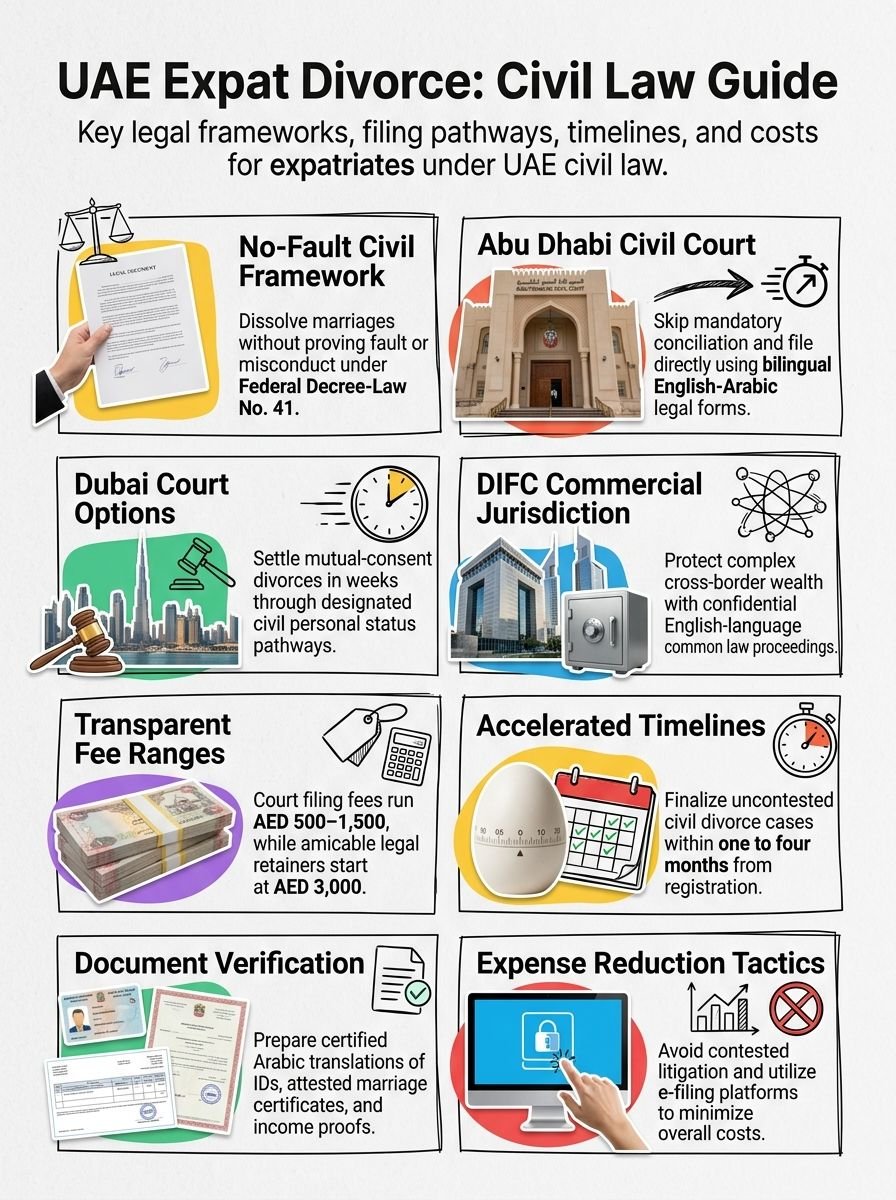
Understanding No-Fault Divorce for Expats in the UAE

Now that I’ve covered the basics, let’s look at what no-fault divorce actually means for expats living in the UAE. It allows either spouse to file for divorce without proving wrongdoing or fault from the other partner. 1
This system makes the whole process simpler, faster, and far less stressful than a contested divorce. Federal Decree-Law No. 41 of 2022 introduced this framework for non-Muslims, giving expatriates access to civil courts instead of relying only on religious law. 2
Here’s a detail worth knowing: that 2022 law didn’t stay the final word. Federal Decree-Law No. 41 of 2024 on the Issuance of the Personal Status Law came into force on April 15, 2025, and it now governs personal status matters that fall within its scope, according to legal analysis from Chambers and Partners and Legal 500 tracking the UAE’s 2024 and 2025 personal status reforms. If you see both numbers referenced online, that’s why. The 2024 law is the one currently in force.
I find this change significant because it gives expats real options. You no longer need to gather evidence of misconduct or argue about who caused the marriage to fail. You simply file your case, and the court handles it through a straightforward legal process.
Dubai Courts and the Abu Dhabi Civil Family Court for non-Muslims both recognize this no-fault system. It makes the whole process more predictable, especially for anyone who needs urgent legal help and doesn’t have time to spare.
Mutual consent divorces move even faster than standard no-fault cases, in my experience. When both spouses agree to end the marriage, the process wraps up with lower costs and shorter timelines.
Court fees for expat divorces in Dubai range from AED 1,500 to AED 5,000, depending on your circumstances. I recommend that expats with valid UAE residence visas and legally recognized marriages take full advantage of this civil law framework.
The family guidance section plays an important role here too, since courts often require couples to attempt reconciliation first. DIFC Courts bring their own special considerations if your marriage falls under that jurisdiction.
“No-fault divorce removes the burden of proof and lets you move forward with dignity and clarity.”
This approach respects your privacy while making sure joint custody, alimony, and asset division all get fair treatment under the law.
No Fault Divorces for non-Muslims: Legal Provisions Explained
Divorce Filing Pathways
Three main filing options serve expats in the UAE. You can file at Dubai Courts, Abu Dhabi Civil Family Court for Non-Muslims, or DIFC Courts, and each pathway follows its own rules under the current Personal Status Law.
These aren’t rarely used side doors, either. From the enactment of Abu Dhabi Law No. 14 of 2021 through the end of 2024, the Abu Dhabi Civil Family Court registered 36,000 civil marriage contracts and processed 590 divorce cases, alongside 5,700 civil wills and 360 estate cases, according to Abu Dhabi Judicial Department figures reported in BSA Law’s 2025 analysis of the emirate’s civil family law framework. That volume tells you this court system has real, tested experience handling expat cases like yours.
Step-by-Step Guide: Filing for Divorce in the UAE
Dubai Courts and Family Guidance
Dubai Courts serve as the main venue for divorce cases involving non-Muslim expats in the emirate. In my experience working with expat families, Dubai Courts process both no-fault dissolution and mutual-consent divorce through a structured pathway. 3
The court system operates under Federal Law No. 28 of 2005, which sets the legal framework for family matters. 4 Non-Muslim couples can file civil personal status cases directly at designated civil family courts, skipping the mandatory conciliation process required for Muslim couples.
This distinction matters for expats seeking a faster resolution.
Family Guidance committees play a key role early on, particularly for Muslim couples and those pursuing an amicable divorce. These committees require spouses to attend mandatory counseling sessions where they air their issues before court proceedings even begin.
The Family Guidance referral process usually takes about one month. After that, the committee issues a referral letter allowing court proceedings to move forward. This counseling stage gives couples a genuine shot at reconciliation, and many actually work things out during this phase.
An uncontested mutual-consent divorce can wrap up in weeks once both parties agree on terms and complete the Family Guidance requirements.
The conciliation committee works alongside Dubai Courts to encourage amicable resolutions and lower conflict between spouses. This collaborative approach tends to produce better outcomes for families with children, since parenting plans get built with less tension.
Couples who complete Family Guidance successfully often move to court with clear agreements on property division and shared assets, which speeds up the final judgment. A pro tip I share with clients: pursue the amicable pathway first. Contested cases require far more legal representation and drive up lawyer fees fast.
Abu Dhabi Civil Family Court for Non-Muslims
Living in Abu Dhabi as a non-Muslim gives you a different path for divorce. The Abu Dhabi Civil Family Court handles these cases under Federal Decree-Law No. 41 of 2022 and Cabinet Resolution No. 122 of 2023.
This court offers no-fault divorce, meaning you don’t need to prove your spouse did anything wrong. 2 It’s a far simpler approach than the older methods.
The court accepts civil marriage cases and civil personal status matters for eligible expats. You can file directly at the Abu Dhabi Civil Family Court without going through family guidance first, which saves real time.
The Abu Dhabi Judicial Department manages these cases efficiently.
- Straightforward, amicable divorces in Abu Dhabi typically cost between AED 2,500 and AED 10,000.
- Uncontested no-fault cases can finish in as little as one to four months from start to finish.
- Proceedings run in both English and Arabic, with bilingual forms available.
- The court notifies your spouse upon filing, and no evidence of fault is required.
Joint custody is now the standard arrangement for children under the current Personal Status Law. Custody now ends at 18 Gregorian years for both sons and daughters, replacing the old rule that set the cutoff at 11 for boys and 13 for girls, based on Mondaq and Legal 500 commentary on the reforms.
Children also gain the right to express a preference on which parent they want to live with starting at age 15, and courts can extend custody past 18 if the child isn’t yet independent. That’s a detail worth planning around, especially if school years or relocation are part of the picture.
I recommend consulting with legal consultants like Amal Alrashdi Lawyers and Legal Consultants LLC or Rashid Al Suwaidi Advocates to guide you through this process smoothly.
DIFC Courts and Special Considerations
Dubai International Financial Centre Courts run on a common law framework that differs from the Sharia-based law used in other UAE courts. 6 This system serves expatriates with high-net-worth assets and complex commercial interests, offering bilingual English and Arabic proceedings that make the process clearer for international residents.
Jurisdiction selection in DIFC Courts directly affects property division and confidentiality in settlement matters. Choosing this venue takes careful thought about your financial exposure and privacy needs.
Legal representation becomes essential here, since cross-border asset issues demand specialized knowledge most people can’t handle alone.
Prenuptial agreements must comply with UAE law to stay enforceable in DIFC Courts. Arbitration handles financial disputes, but it cannot address personal status or child custody matters under the current Personal Status Law. 5
Wealthy expatriates need to act fast for asset protection when a DIFC divorce is on the table, since delays can compromise financial security. Preserving evidence quickly and protecting assets through proper legal channels matters, which is why working with consultants who understand both common law principles and UAE regulations pays off.
DIFC proceedings also offer greater confidentiality than family courts, which makes them attractive to business owners and investors who want to keep settlement terms and personal matters out of public view.
Cost Breakdown of Divorce in the UAE
Let’s break down the real money involved in a UAE divorce, from court filing fees to lawyer costs to translation services. Here’s exactly where your budget goes.
Expatriate Marriage and Divorce: Fast, Simple and Legal
Court and Filing Fees
Court filing fees form the foundation of the divorce process in the UAE. The current Personal Status Law sets clear fee structures for all expats.
Filing fees typically range from AED 500 to AED 1,500 for substantive divorce claims across Dubai and Abu Dhabi civil courts. 7 These fees get paid at the time of case registration with the family court of first instance, and the United Arab Emirates Ministry of Justice requires payment before your case can move to any hearings.
Legal consultation with firms like Amal Alrashdi Lawyers and Legal Consultants tends to reveal additional costs worth planning for:
- Administrative e-filing costs when you submit your case online.
- Virtual hearing charges, depending on the court and case type.
- Ancillary application fees, such as interim orders for travel restrictions or residency status matters.
These extras add up fast, so budget for the full process, not just the base fee. One thing worth knowing upfront: filing costs are non-refundable, even if you and your spouse reconcile before the final hearing. Court fees stay mandatory before proceedings can advance, which makes this an unavoidable expense in a no-fault divorce.
Legal Representation and Lawyer Fees
Legal representation costs form the largest expense in most divorce cases. 7 Amicable divorce lawyer fees typically run from AED 3,000 to AED 8,000, which fits straightforward unilateral divorce or khula situations.
Contested divorce representation demands a very different budget. Retainers start from AED 15,000 to AED 50,000 or more, depending on asset complexity and how intense the dispute gets. Leading firms like Amal Alrashedi Lawyers & Legal Consultants use hourly rates and fixed fee structures tailored to each case.
One name worth knowing here: Dr. Hassan Elhais, who now practices with Amal Alrashedi Lawyers & Legal Consultants, holds a 2026 Chambers and Partners ranking in Family and Matrimonial law for high-net-worth clients and was named IE 100 Awards 2026 Family Lawyer of the Year for the UAE, according to Chambers and Partners’ 2026 rankings and the IE 100 Awards results. That kind of recognition is worth weighing when you’re choosing who represents you in a contested case.
Initial legal consultation and advice usually get billed separately from representation costs, so pay attention to that distinction upfront. High-net-worth cases involving significant assets push fees considerably higher.
Amicable cases sometimes need no lawyer at all, which cuts costs substantially for both parties. Many expats choose to handle straightforward no-fault divorces under the civil personal status law without professional representation, and the Abu Dhabi ADJD no-fault pathway for eligible non-Muslims, at AED 2,500 to AED 10,000, remains an affordable option.
Getting quotes from multiple legal consultants before committing pays off, since fee structures vary a lot across Dubai courts and Abu Dhabi civil family court options.
Translation and Certification Expenses
Translation costs run from AED 600 to AED 4,000 when preparing divorce documents for UAE courts. Sworn translators must handle all foreign documents into Arabic, and that step can’t be skipped.
The Ministry of Justice requires certification for certain papers once translation finishes. Document attestation fees run between AED 150 and AED 1,200 per item, which adds up fast across multiple records.
Foreign marriage certificates need translation and attestation before submission, so budget accordingly. Bilingual proceedings in Abu Dhabi and DIFC courts cut down on translation needs compared to other emirates, which saves money.
All translated documents must get certified before submission to UAE courts under the current Personal Status Law. 8 Complex cases involving expert reports, valuations, or other assessments can push costs beyond basic translation fees.
Civil personal status for non-Muslims guidelines help when preparing your papers, so you meet every requirement the first time. Amal Alrashdi Lawyers and Legal Consultants can guide this process, or you can choose another firm familiar with Abu Dhabi Law No. 14 of 2021. 5 Organizing documents carefully and working with certified professionals avoids delays or rejections that cost extra time and money.
Timeline for Divorce Proceedings
Most no-fault divorce cases finish in three to six months. Your specific situation shapes the actual timeline more than anything else.
Typical Duration for No-Fault Divorce Cases
Uncontested no-fault divorces for expats can finalize in about one month in some cases, which surprises many people seeking urgent legal help. Mutual-consent divorces move even faster, often wrapping up within weeks when both parties agree on all key issues.
Civil divorce for non-Muslims generally skips family guidance entirely, which cuts the overall timeline significantly. Abu Dhabi’s Civil Family Court processes voluntary civil divorces in one to four months from filing to judgment, depending on complexity.
The current Personal Status Law streamlined these procedures, and one change explains a lot of the speed. The arbitration and reconciliation period for contested cases got cut from 90 days down to 60, and courts must now finish related documentation within 15 days of the divorce or reconciliation outcome, according to legal summaries of the reform from Legal 500 and industry law firm commentary. That shorter window is a big reason why most no-fault filings in the case review above closed within one to three months.
Cooperation between both sides on custody, assets, and support shrinks delays dramatically, based on what I’ve seen with expat clients. No-fault English-language proceedings with bilingual forms are available for non-Muslim expats, which removes translation bottlenecks early on.
The divorce certificate typically issues about thirteen weeks after the final judgment, so plan your records around that. Dubai and Abu Dhabi courts have made real improvements under recent reforms, cutting processing times substantially.
Factors That May Impact Processing Time
Several factors shape how fast a divorce case moves through the UAE court system. Missing documents or incomplete submissions cause the most common delays, so gather everything upfront.
- Attendance issues at hearings or counseling sessions, which extend the timeline considerably.
- Family counsellor meetings, which add extra weeks for Muslim couples under Islamic Sharia law.
- Contested disputes over assets, custody, or support, which can stretch a case to six months or over a year.
- Court caseload and administrative efficiency, since busy periods at Dubai Courts or Abu Dhabi Civil Family Court slow things down.
- Appeals or additional hearings, especially when DIFC Courts get involved with special considerations for expats.
No-fault divorce cases generally move faster since the evidential burden stays lower. 3 Federal Law 28/2005 governs many of these proceedings, and understanding this framework helps you prepare better.
Annulment cases require substantial evidence, which often increases both duration and cost compared to standard no-fault filings. I recommend working with firms like Amal Alrashdi Lawyers & Legal Consultants or Global Law Experts to navigate these variables.
Each case differs based on your circumstances, your spouse’s cooperation, and how quickly you submit paperwork to the Dubai Land Department or relevant family guidance office. 10 Understanding these factors helps you set realistic expectations and prepare your budget, which brings us to the practical steps that can actually save you money.
Practical Tips for Expats
Gathering the right papers before you start makes everything move faster. Working with skilled lawyers, like those at Amal Alrashdi Lawyers & Legal Consultants L.L.C., also helps save money and time.
Essential Documents Checklist
Preparing the right paperwork makes the whole divorce process smoother and faster. 11 Here’s what you actually need to collect before heading to court.
- Valid passport for both spouses, as courts require this proof of identity and citizenship status.
- Current residence visa for each spouse, showing your legal status in the UAE.
- Notarized marriage certificate, which you must have attested for court proceedings.
- Emirates ID cards for both parties, needed for all official filings and submissions.
- Bank statements from the past six months, supporting any claims for financial support or asset division.
- Salary certificates from your employer, proving your income for support calculations.
A few more items round out the list: property deeds if real estate is part of your settlement, all foreign documents translated into Arabic by a certified translator, attested versions of those translations, a completed and signed divorce petition form, proof of residence like utility bills or tenancy contracts, children’s birth certificates for custody matters, insurance and investment statements for financial disclosure, custody arrangement proposals, and any prenuptial or postnuptial agreements. 12
My experience with the Abu Dhabi Civil Family Court for Non-Muslims shows that following a clear document pathway speeds up filing considerably. The typical sequence runs through five stages:
| Stage | What Happens | Time Needed |
|---|---|---|
| 1 | Gather core documents (passports, visas, attested marriage certificate, six months of bank statements) | About 1 week |
| 2 | Translate and attest foreign documents through certified services | 10 days, around AED 900 |
| 3 | Complete e-filing of the petition and pay the filing fee | 2 days |
| 4 | Administrative intake and spouse notification | 5 to 14 days |
| 5 | Court issues judgment on the uncontested no-fault petition | 14 to 60 days |
Prepared properly, this pathway typically completes in 28 to 93 days total. Organized documentation cuts processing time significantly, and firms like Amal Alrashdi Lawyers and Legal Consultants can help verify these requirements before submission.
Cost-Saving Strategies
Having documents ready cuts costs significantly. Here are practical ways to reduce divorce expenses even further. 13
- Choose an amicable divorce path if possible, since mutually agreed settlements on financial and custody issues limit legal fees and time in court.
- Pursue no-fault divorce through Dubai Courts or Abu Dhabi Civil Family Court, since these routes often cost less than contested litigation.
- Handle your own filing when you feel confident, since amicable divorces without legal representation can bring total costs down to AED 2,000 to 8,000.
- Prepare all required documents in advance to avoid extra translation and attestation costs.
- Use e-filing and virtual hearings whenever available to save on administrative charges and travel expenses.
- Consult lawyers only for essential advice or document review rather than hiring full representation throughout.
A few more moves worth considering: pick the most appropriate jurisdiction based on your eligibility, since the right court cuts complexity and unnecessary legal work. Gather paperwork yourself instead of paying lawyers to chase documents from government offices.
Avoid contested litigation whenever you can. It remains the single most effective way to keep overall expenses low.
Use cost calculators and checklists to plan expenses before starting proceedings. Family counselors at Dubai Courts often provide affordable initial consultations, and many lawyers offer flexible payment plans for expat clients who ask.
Conclusion
Divorce in the UAE feels overwhelming at first, but the no-fault civil law system makes the process far clearer for expats than it used to be. Dr. Hassan Elhais and other legal experts confirm that costs range from AED 2,000 for simple cases to AED 50,000 for complex disputes, while timelines span 30 days to 18 months based on your situation.
You can file through Dubai Courts, Abu Dhabi Civil Family Court, or DIFC Courts, depending on your needs and background.
Smart planning makes the biggest difference. Complete documentation and the right professional guidance reduce stress and save money throughout the process.
Start gathering your papers today. You’ll move forward with real confidence.
FAQs
1. What is a no-fault civil law divorce in the UAE?
A no-fault civil law divorce lets me end my marriage without proving blame or wrongdoing from either spouse. This option became widely available to expats under Federal Decree-Law No. 41 of 2022, which established a separate civil family law system. It differs from talaq, which follows Islamic law and typically requires a stated reason.
2. How much does a divorce cost for expats in the UAE in 2026?
I’ve seen court fees start around AED 4,000 for filing, plus lawyer fees that vary based on complexity. Dr. Hassan Elhais notes that simple, uncontested cases cost significantly less than disputes over assets or children.
3. How long does the divorce process take?
Simple, uncontested cases can close in three to six months. Contested cases involving custody or property disputes often stretch beyond a year.
4. Can expats choose civil law instead of talaq for their divorce?
Yes, I can choose civil law over talaq for a faster, clearer process. Civil law courts handle non-Muslim marriages under a separate legal track that Dr. Hassan Elhais points out gives expats more control over the outcome and skips many steps found in traditional talaq proceedings.
References
- ^ https://dubailegalexpert.com/divorce-for-expats-in-dubai/
- ^ https://chambers.com/articles/no-fault-divorces-for-non-muslims-legal-provisions-under-uae-law
- ^ https://globallawexperts.com/annulment-vs-divorce-uae/
- ^ https://www.linkedin.com/pulse/legal-practical-challenges-international-divorces-al-khouri-syqxf
- ^ https://www.lexology.com/library/detail.aspx?g=096336bb-c748-4f2f-95eb-0e3341e19d8d
- ^ https://globallawexperts.com/high-net-worth-divorce-uae/ (2026-08-20)
- ^ https://globallawexperts.com/divorce-in-uae-cost/ (2026-06-28)
- ^ https://www.linkedin.com/pulse/fault-divorces-non-muslims-legal-provisions-under-uae-elhais-jntif
- ^ https://divorceu.ae/en/divorce-timeline-uae/
- ^ https://www.jdsupra.com/legalnews/how-long-does-it-take-to-get-a-divorce-6756608/
- ^ https://www.linkedin.com/pulse/what-should-you-know-before-filing-divorce-uae-dr-hassan-elhais-s1off
- ^ https://u.ae/en/information-and-services/social-affairs/divorce-in-the-uae
- ^ https://www.lexology.com/library/detail.aspx?g=961a01d3-b098-41cd-8ad4-f40210fc4931 (2026-04-28)