
Rental disputes rarely happen at a convenient time. Rent goes up, a landlord ignores a maintenance request, or a lease gets terminated early, and suddenly you need to know exactly where to file and what it costs.
That’s the gap I want to close here.
The Abu Dhabi Rental Dispute Resolution Committee, known as ADREC, handles every landlord and tenant conflict in the emirate under Abu Dhabi Law No. 20 of 2006. 1 What most people miss is that two things decide whether your case even gets heard: your Tawtheeq registration status and your filing fee payment. Get either one wrong, and your dispute stalls before it starts.
So here’s the plan. I’ll walk through how ADREC actually works, break down Tawtheeq registration step by step, and show you the exact filing fees for 2026. 31 By the end, you’ll know how to protect your rental rights without guessing at the process.
Key Takeaways
- ADREC handles all rental disputes in Abu Dhabi under Law No. 20 of 2006, enforcing a 0% rent increase cap and setting eviction grounds.
- Tawtheeq registration makes tenancy contracts legally binding; unregistered contracts cannot be enforced in disputes or access ADREC assistance.
- Filing fees equal 4% of annual rent, capped at AED 10,000 maximum, and remain non-refundable regardless of dispute outcomes.
- The rental dispute process includes three stages: reconciliation, committee hearing with three judges, and appeals with enforcement through Abu Dhabi Judicial Department.
- Required documents include Tawtheeq contracts, Emirates ID, rent receipts, written notices, application forms, proof of service, and financial documentation for case submission.
Understanding ADREC and Its Role in Rental Disputes

I handle rental disputes every year, and I’ve watched ADREC become the backbone of housing conflicts across Abu Dhabi. The Abu Dhabi Rental Dispute Resolution Committee sits at the center of every lease disagreement in the emirate.
This body works under the Abu Dhabi Judicial Department to settle disputes between landlords and tenants. ADREC oversees the real estate sector and manages the regulations that affect your housing costs and rights directly.
The online intake process moves faster than most people expect. When a complete Tawtheeq certificate, Emirates ID copy, and rent receipts get submitted together, the case advances to reconciliation pending status within 48 hours of payment confirmation. The platform flags any missing items right away, so you know exactly what ADREC still needs from you.
The Rent Freeze: What Changed and When
One rule that benefits tenants right now is the 0% rent increase cap. ADREC has called this freeze a temporary measure, so it pays to stay alert to updates.
According to an official ADREC press release on the rental cap update, the freeze took effect on June 3, 2026. It came after new lease prices had jumped 15% across Abu Dhabi and 23% within investment zones compared to the year before. That context matters. It shows the freeze wasn’t a random policy choice but a direct response to a sharp price spike squeezing tenants.
The committee also sets clear grounds for eviction, covering both tenant faults and landlord circumstances. Knowing these grounds ahead of time gives you a much clearer sense of where you stand legally.
How Tawtheeq and ADREC Work Together
ADREC leans heavily on the Tawtheeq registration system for every lease agreement in the emirate. An unregistered tenancy contract carries no weight in a dispute, so registration should be the first box you check.
Every lease renewal and new agreement references the rental rate from the property’s last registered Tawtheeq contract. This keeps things fair for both sides. ADREC decisions can also be appealed within set deadlines, which gives you a second shot if you disagree with a ruling.
The Rental Dispute Settlement Committee operates as a judicial body under the Abu Dhabi Judicial Department. This structure exists specifically to handle lease disputes fairly and consistently.
You access these services through the Abu Dhabi Judicial Department, which coordinates with the Department of Municipalities and Transport to manage real estate activities. This coordination is what keeps tenant protections consistent across the entire process.
Tawtheeq: The Importance of Registered Tenancy Contracts
Tawtheeq is Abu Dhabi’s official system for registering tenancy contracts. Registration turns a rental agreement from an informal handshake into a legally binding document. 3
Landlords carry the responsibility for registering Tawtheeq on behalf of their tenants, so property owners need to take the first step. Registration is also mandatory for activating water and electricity services through ADDC, which makes it nearly impossible to live in a property without completing it.
What Tawtheeq Actually Costs
The AED 50 registration fee, plus a 5% municipality charge on utilities, is a small price for the legal protection it buys. But that’s only part of the picture.
Per fee details reported by Khaleej Times and several Abu Dhabi real estate advisories, landlords also pay a one-time AED 900 initial property registration fee on Tawtheeq. Multi-unit buildings add AED 5 per unit on top of that, before any tenant-level contracts can even be registered. This explains why registration sometimes lags on the landlord’s side. It isn’t always a simple AED 50 transaction.
Without Tawtheeq registration, rental contracts become unenforceable in disputes. Tenants lose access to the rental disputes settlement committee entirely. Many expats discover this too late, after an agreement they thought was solid turns out to hold no legal weight.
Registration Status Decides Case Admissibility
Here’s a real pattern I’ve seen play out: a tenant submits an unregistered contract to the committee, and the intake rejects it outright. Once that same lease gets registered on Tawtheeq and resubmitted, the committee accepts the case and schedules reconciliation within ten days.
That gap between rejection and acceptance comes down to one thing: registration. It’s why every tenant should confirm their contract appears in the Tawtheeq system long before any conflict starts.
- Commercial tenants face the same mandatory Tawtheeq registration requirement to keep their agreements enforceable.
- Renting without registration means signing a document courts and ADREC won’t recognize during a dispute.
- Registration costs scale with annual rent, so factor them into lease renewal budgets.
- The system builds transparency across the whole rental market, which benefits landlords and tenants alike.
Property investors benefit too, since registration protects their interests and creates a documented relationship with occupants. Businesses operating in Abu Dhabi need to prioritize Tawtheeq compliance, or they risk losing the ability to enforce lease terms or recover unpaid rent through official channels.
Registered contracts through Tawtheeq give everyone involved real peace of mind. 2 Registration activates the legal protections tenants and owners need when disagreements hit over lease terms, maintenance, or payment.
Tawtheeq registration also signals market transparency, which helps investors make smarter calls on property acquisitions and rental income projections. Once you understand why this registration matters, moving forward with confidence gets a lot easier.
https://www.youtube.com/watch?v=bTx3AfXOxvw:LTawtheeq Explained: Abu Dhabi’s Rental Registration SystemB�
Filing a Rental Dispute in Abu Dhabi
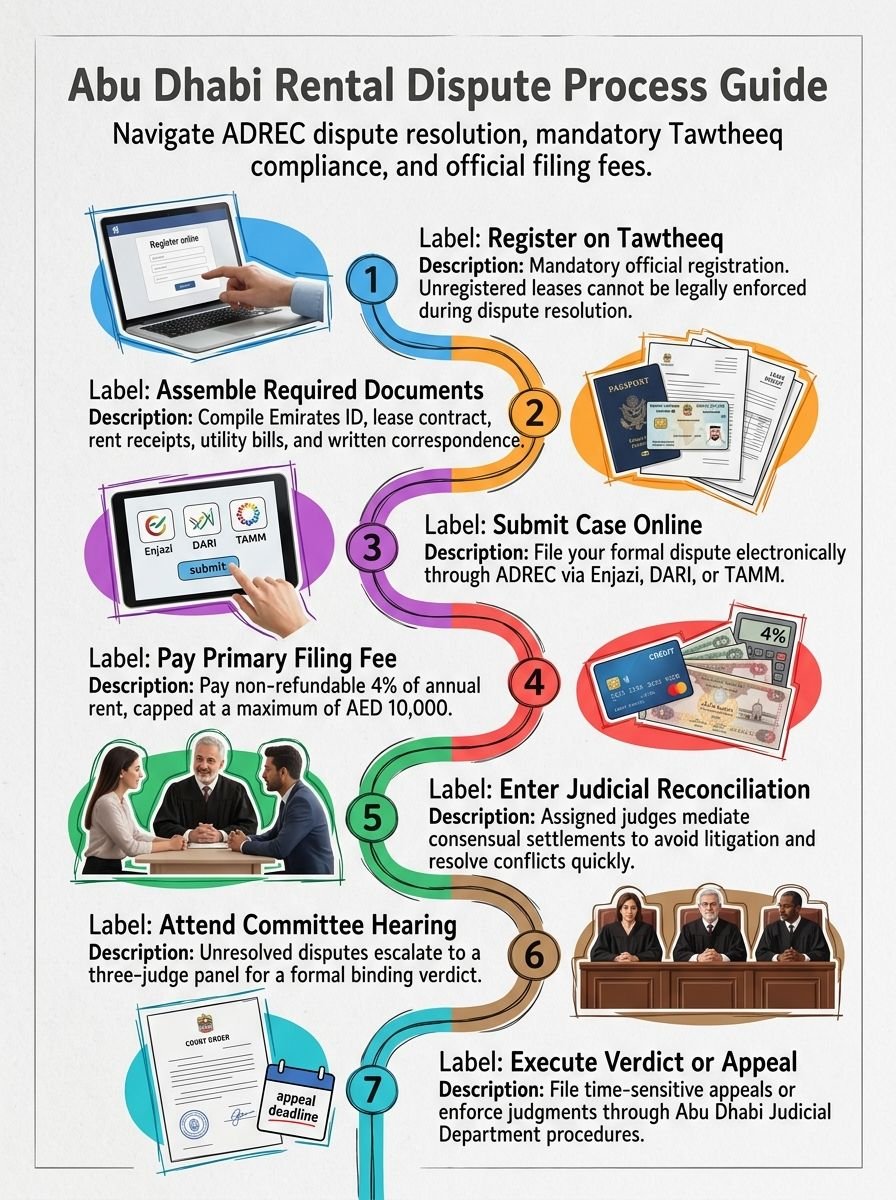
Filing a rental dispute in Abu Dhabi comes down to three moves: gather the right documents, submit your case to the rental dispute settlement committees, and pay the filing fee ADREC sets for 2026. Get these three right, and you protect your tenant rights from the start.
https://www.youtube.com/watch?v=7Qjc7qqWACE&vl=id:=Your AED 45,000 eviction trap: Why fighting pays off in DubaiB�
Required Documents for Filing
Specific documents need to be ready before any rental dispute filing moves forward. Here’s exactly what to gather:
- Tawtheeq-registered tenancy contract, the foundation of the entire claim, proving the legal rental agreement exists. 4
- Emirates ID copy, to confirm identity and residency status within the UAE.
- Passport and visa copies, to establish legal presence and the right to file through the Judicial Department.
- Rent receipts or proof of payment, showing financial obligations and transaction history with the landlord.
- All written notices exchanged between both parties, including emails, texts, or formal letters.
- A detailed application form that spells out every issue in the dispute clearly.
A few more items round out a strong filing: proof of service showing the other party got notified, bank statements backing any disputed amounts, and photos or videos documenting property damage. Medical reports or expert assessments help when habitability or safety is the issue, and witness statements can back up your version of events. Original lease amendments, utility bills, and any notary correspondence all support your timeline too.
Every application goes through the Enjazi system, which processes all registrations for the rental dispute settlement committees.
Steps to Submit the Case
Submitting a rental dispute case takes planning and attention to detail. Following these steps helps tenants, businesses, and investors move through the process smoothly.
- Access the ADREC platform online to start the case submission through the official system. 5
- Verify that the tenancy contract is registered on Tawtheeq, since this is mandatory for every lease agreement in Abu Dhabi.
- Gather all required documents, including the rental agreement, payment receipts, landlord correspondence, and proof of the dispute basis. 4
- Log into the DARI and TAMM platforms to track the case status and submit supporting documents electronically.
- Complete the case submission form with accurate details about the dispute, the parties, and the specific issues to resolve.
- Identify the exact nature of the dispute, whether it’s maintenance, rent increases, deposits, or lease termination.
Before filing, double check that the lease complies with Law No. 3 of 2015 and Executive Council Resolution No. 14 of 2016. Then calculate and pay the applicable filing fee, submit the complete case file through the online portal, and save the confirmation number for your records. After that, ADREC sends official notification about the reconciliation stage and next steps.
The digital process follows a specific sequence worth knowing by heart. Upload the Tawtheeq PDF to Enjazi, attach the Emirates ID and receipts to DARI, then complete payment through the TAMM wallet. The system generates a confirmation number right away.
In most cases, a reconciliation scheduled email arrives within 72 hours of finishing these steps. Following the Enjazi, DARI, TAMM sequence in that exact order keeps every part of the case connected across these integrated government systems.
Paying the Filing Fees
The filing fee needs payment at the exact time a rental dispute case gets submitted to the Rental Dispute Settlement Committee. The fee structure follows Administrative Decision No. 247/2015, which implements Abu Dhabi Law No. 3/2015.
The filing fee equals 4% of annual rent, capped at AED 10,000. For example, an annual rent of AED 200,000 means a fee of AED 8,000. Once annual rent hits AED 300,000 or more, the fee still stops at AED 10,000.
| Annual Rent (AED) | Filing Fee (AED) |
|---|---|
| 60,000 | 2,400 |
| 200,000 | 8,000 |
| 250,000 or higher | 10,000 (capped) |
Payment confirmation is proof the case moves forward. Without it, the committee won’t process the dispute any further.
That payment is non-refundable no matter how the dispute turns out. No waiver exists, even for financial hardship or a case that doesn’t succeed.
These fees fund the entire dispute resolution system, covering staffing, facilities, and case management. No exceptions apply, whether you’re a tenant, landlord, business, or investor seeking urgent legal help.
Payment confirmation must be on file before any hearing or reconciliation stage begins. The committee requires proof of full payment before scheduling a case, and this policy applies uniformly across every rental dispute filed under Abu Dhabi’s tenancy laws.
Key Stages of the Rental Dispute Process
Three main phases shape every rental dispute in Abu Dhabi. ADREC moves cases through reconciliation first, then a committee hearing, and finally appeals or enforcement if the dispute needs to go further.
Reconciliation Stage
The reconciliation stage sits at the heart of Abu Dhabi’s rental dispute process. This phase gives landlords and tenants a real shot at settling differences without going to court.
During this stage, sessions happen between the disputing parties, and an assigned judge reviews the dispute along with all supporting documents through the Enjazi system managed by the Judicial Department. 5 This approach builds trust among everyone involved, and fast-track settlements get prioritized to cut down case resolution time.
If both sides reach an agreement, the assigned judge prepares an enforceable agreement, which avoids lengthy court battles and expensive litigation costs entirely.
Disputes that stay unresolved after reconciliation move forward to committee hearing and court for further action. 7 This alternative dispute resolution method, backed by Abu Dhabi’s judicial framework, favors consensual solutions that protect both tenant rights and property owner interests under Law 4 of 2010. Most cases resolve favorably at this stage, which saves everyone time and money before things escalate further.
Committee Hearing
Once reconciliation fails to resolve a dispute, the Abu Dhabi Judicial Department moves the case to the committee hearing phase. Each rental dispute settlement committee has one chair judge and two judge members, three judges total, reviewing the case. 7
The committee weighs all submitted documentation, evidence, and legal arguments during this stage, and hearings typically happen within a set time frame after reconciliation fails. The Abu Dhabi Judicial Academy trains these judges to apply Law No. 20 of 2006 and related administrative decisions fairly. 1
Your case gets scheduled, and you present your position before the three-judge panel. The committee reviews the Tawtheeq registered tenancy contract details alongside every piece of supporting material submitted.
A formal verdict comes at the end of the hearing, settling most contested matters between tenants and property owners. This decision carries the full authority of the Abu Dhabi Judicial Department and legal weight for both sides, whether the case involves off-plan sale properties, mortgages, or other complex real estate matters.
Appeals and Enforcement
Appealing a rental dispute decision takes solid legal grounds, not just disagreement with the outcome. The Abu Dhabi Judicial Department carries out enforcement of committee decisions through specific administrative procedures outlined in real estate law.
Appeals must follow designated deadlines set by ADREC guidelines, or the right to challenge the ruling disappears. As detailed by MyBayut’s coverage of Abu Dhabi’s Rental Dispute Settlement Committees process, either party can appeal an RDSC decision within 15 days of judgment, but only if the disputed claim exceeds AED 50,000. Smaller claims typically have no further appeal route.
That threshold matters more than most people realize. I’ve seen investors miss the 15-day window and lose significant financial claims simply because they didn’t act fast enough. Each rental settlement committee decision stays subject to appeal procedures established under Abu Dhabi law, which protects both parties fairly. 7
Contracts, Registration, and What Gets Enforced
Only registered Tawtheeq contracts qualify for appeals and enforcement actions, which makes contract registration vital from day one. Unregistered contracts simply cannot be enforced through the judicial system, a lesson many businesses learn the hard way when advising on lease agreements.
- Long-term leases, usufruct arrangements, and Musataha agreements cannot be relinquished once signed. 8
- Enforcement actions may include eviction orders or financial settlements, depending on the ruling.
- The Abu Dhabi Judicial Department executes verdicts with precision and transparency.
- Tenants seeking urgent legal help should register contracts through smartpass systems and keep detailed documentation ready.
Businesses and investors benefit from understanding enforcement mechanisms early. They tie directly into project escrow accounts and financial obligations linked to real estate development projects.
Filing Fees and Associated Costs in 2026
Knowing the exact costs ahead of filing saves a lot of stress later. Here’s a detailed breakdown of filing fees and associated costs for 2026:
| Fee Category | Amount (AED) | Details and Notes |
|---|---|---|
| Primary Filing Fee | 4% of annual rent (capped at AED 10,000) | This is the main cost for submitting a case to ADREC, calculated on the yearly rental amount. If annual rent is AED 250,000, the fee equals AED 10,000 due to the cap. |
| Real Estate Appraisal Fees | Variable (per Administrative Decision No. 284/2015) | When property valuation becomes necessary, registered appraisers charge fees per municipal guidelines. Administrative Decision No. 284/2015 sets the appraisal policy. Rent increase disputes often require this assessment. |
| Escrow Account Services | Variable (per Administrative Decision No. 250/2015) | Real estate project disputes sometimes involve escrow arrangements. Administrative Decision No. 250/2015 outlines escrow account regulations, and such services carry separate charges when applicable. |
| Real Estate Broker Commission | Per Resolution No. 183 of 2017 | Broker-related disputes fall under Resolution No. 183 of 2017, which specifies commission rules for real estate brokers. Additional charges may apply depending on broker involvement. |
| Mortgage-Related Charges | Variable (per Administrative Decision No. 249/2015) | Mortgaged properties require compliance verification under Administrative Decision No. 249/2015. Disputes involving mortgaged units may trigger extra verification costs. |
| Developer Administrative Fees | Per Resolution No. 183 of 2017 | When developers are parties to rental disputes, Resolution No. 183 of 2017 applies administrative fees that may add to case costs. |
| Appraiser Registration and Licensing | Per Administrative Decisions No. 248/2015 and 251/2015 | Licensed appraisers registered under Abu Dhabi Law No. 3/2015 charge fees accordingly, covering registration and licensing for certified professional services. |
The filing fee calculation stays simple for most cases. At 4% of annual rent with a AED 10,000 cap, this ceiling protects tenants carrying high rental amounts. A 60,000 AED yearly rent yields a 2,400 AED fee, a 200,000 AED annual rent produces an 8,000 AED charge, and anything at or above 250,000 AED hits the 10,000 AED cap directly. For a 300,000 AED lease, the fee still stops at the capped 10,000 AED rather than the calculated 12,000 AED.
The Government of Abu Dhabi’s zero percent rental increase policy on residential, commercial, and industrial properties also affects dispute valuation methods going forward.
Additional costs show up depending on the specific situation. Property disputes involving appraisals, broker involvement, or developer participation trigger extra charges, so budgeting for potential professional services beyond the base filing fee makes sense.
Total costs vary based on case complexity and the parties involved. Simple disputes may need only the filing fee, while complex cases involving multiple services cost considerably more. Understanding these expense categories helps with financial preparation before starting the rental dispute resolution process at ADREC.
Conclusion
Understanding the Abu Dhabi rental dispute process helps tenants and landlords protect their rights with confidence. ADREC offers fair mediation, while Tawtheeq registration ensures a contract gets real legal protection.
Paying filing fees at 4% of annual rent, capped at AED 10,000, keeps the system accessible for most people. The 0% rent increase cap in 2026 adds another layer of peace of mind around housing costs.
My advice: register your tenancy contract today and keep every document ready. That way, resolving any rental conflict through the proper channels stays quick and fair.
FAQs
1. What is the Abu Dhabi rental dispute process in 2026?
If you and your landlord or tenant disagree, I recommend filing a case with ADREC, the Abu Dhabi Rental Dispute Centre. This body handles rental disputes across Abu Dhabi under Law No. 2 of 2025, which standardizes rent increase caps and eviction procedures.
2. What is Tawtheeq, and why does it matter for rental disputes?
Tawtheeq is the mandatory online registration system for all tenancy contracts in Abu Dhabi. You must have a valid Tawtheeq certificate to file with ADREC, as unregistered contracts are not recognized in dispute proceedings.
3. How much are the filing fees for a rental dispute case?
Filing fees at ADREC typically range from AED 200 to AED 500 depending on your claim value, though complex cases involving owners’ committees may carry additional administrative costs. I suggest checking the latest fee schedule on the Abu Dhabi Judiciary website before you file, since rates are reviewed periodically.
4. Can businesses in Abu Dhabi Global Market use ADREC for rental disputes?
Companies registered in Abu Dhabi Global Market, the financial free zone overseen by the ADGM Authority, usually follow separate commercial lease regulations. For standard residential tenancy disputes, I find that ADREC still applies, but criminal matters or human rights violations may be escalated to the public prosecution.
References
- ^ https://www.uaeexperthub.com/abu-dhabi-rent-increase-eviction-law/
- ^ https://www.engelvoelkers.com/ae/en/resources/tawtheeq-abu-dhabi (2026-06-15)
- ^ https://www.modon.com/real-estate/blog/what-is-tawtheeq-a-complete-guide-in-2026 (2026-07-24)
- ^ https://www.dubizzle.com/blog/property/resolve-rent-dispute-settlement-committee/
- ^ https://adrec.gov.ae/en/adrec-drc
- ^ https://www.dubizzle.com/blog/property/rental-dispute-settlement-committees/
- ^ https://www.adjd.gov.ae/EN/Pages/courts/Rental-Dispute-Settlement-Committees.aspx
- ^ https://adrec.gov.ae/en/rules_and_regulations/tenancy
- ^ https://adrec.gov.ae/en/news/press-release-26—rental-freeze-update