
An eviction notice from your landlord can turn your whole week upside down.
I’ve sat with tenant after tenant in Dubai who felt this same jolt of panic. Most assumed they had no options left. That’s almost never true, because Dubai tenant rights in 2026 actually give you more protection than the fear suggests.
The Rental Disputes Centre handled thousands of cases last year. 1 That volume alone tells you how often landlords and tenants clash over notice periods, rent, and lease terms.
I put this guide together after working through the actual laws, RDC procedures, and current case data behind eviction rules in Dubai. 3
So here’s the plan. I’ll walk you through exactly when a landlord can legally evict you, what notice they owe you, and how to file a complaint if they break the rules. Keep reading, and you’ll know exactly where you stand.
Key Takeaways
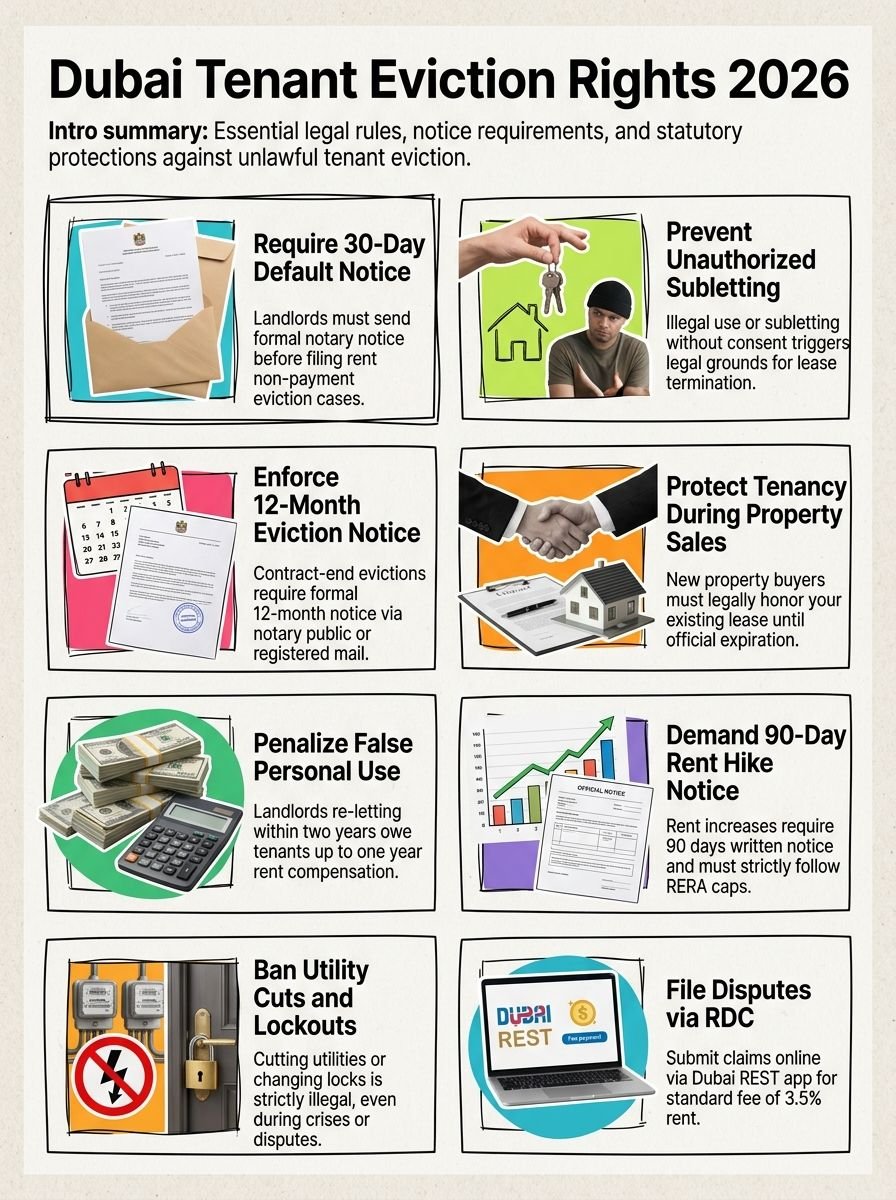
- Landlords must provide 12-month written notice via notary public or registered mail for end-of-tenancy evictions in Dubai.
- Non-payment of rent requires a 30-day notice and grace period before landlords can file eviction cases with the Rental Disputes Center.
- Tenants cannot face eviction during crises; landlords cannot cut utilities, change locks, or use emergencies as eviction grounds.
- The 90-day rent increase notification rule protects tenants from sudden hikes, with increases capped based on market comparison rates.
- Filing a complaint at the Rental Disputes Center costs 3.5% of annual rent, and most disputes resolve within 2 to 4 weeks.
Grounds for Eviction During the Tenancy Period

Dubai rental law spells out specific reasons a landlord can evict you mid-lease. It doesn’t leave room for guesswork. Below, I break down exactly what triggers an eviction notice and how the notice period protects you.
<a href=”https://www.youtube.com/watch?v=AYxkhKjY7Qs:MThe%20New%20Eviction%20Rules%20EXPLAINED%20for%20Landlords%20-%20YouTubeBqFREE%20RENTERS’%20RIGHTS%20ACT%20GUIDE%20%E2%80%BB%20https://bit.ly/RentersRightsActGuide%20WANT%20TO%20JOIN%20OUR%20NEXT%20SEMINAR?J”>The New Eviction Rules Explained for Landlords (YouTube)
Non-payment of rent after a 30-day notice
Rent non-payment creates real stress for landlords in Dubai, and I understand why they want a fast fix. The law still requires a formal written notice before any landlord can pursue eviction through the Rental Disputes Center.
That notice only counts if it arrives via Notary Public or registered mail. Once it lands, tenants get a grace period to settle the debt before anything else can happen.
| Location | Grace Period After Notice |
|---|---|
| Dubai | 30 days |
| Abu Dhabi | 30 days |
| Sharjah | 15 days |
If rent stays unpaid once the grace period ends, landlords may file an eviction case with the RDC. 1 When landlords follow this 30-day process correctly, filings tend to move fast, usually advancing to resolution within 7 to 21 days after the grace period expires, with about 12 days being typical from notice expiry to filing. Skip the formal notice step, though, and the case often gets rejected at intake, forcing the landlord to start over and lose weeks of rent in the process.
Late payments carry consequences that go beyond eviction risk. The Al Etihad Credit Bureau reports all late payments, and that hits your credit score hard.
Most rental agreements also include contractual penalties, typically AED 500 to AED 1,000 for overdue rent. Bounced cheques count as a civil matter now, so you won’t face criminal charges, though that offers little comfort during real financial hardship.
One option worth knowing about is ILOE insurance. It covers job loss, pays up to AED 20,000 a month toward rent, and you can claim it within 30 days of losing your job. Expats and business owners should look into this coverage before non-payment becomes a crisis, since formal notice delivery is what gives you time to fix the arrears before an eviction case ever reaches the RDC. 2
Property misuse or damage
Property misuse and damage sit high on the list of eviction grounds in Dubai, and the rules here matter for every tenant. A landlord can move to evict you mid-lease for any of these reasons:
- Using the unit for illegal or immoral activity
- Unauthorized alterations or gross negligence that causes serious damage
- Subletting without your landlord’s written consent
- Structural damage severe enough to risk the building’s safety, confirmed through Dubai Municipality technical reports
Security deposits cover actual damage, not everyday wear. Standard refundable amounts run 5% of annual rent for unfurnished units and 10% for furnished ones, and landlords must return that deposit within 30 days of move-out once you’ve handed back the keys, according to RERA guidelines cited by property-law resources such as Kayrouz & Associates and Engel & Völkers. Deductions only apply to verified damage, unpaid DEWA or chiller bills, or unpaid rent, nothing else.
Taking timestamped photos at move-in saved me during a dispute early in my career, and I recommend the same to every tenant I talk to.
Document everything from day one. Your photographs become your strongest defense against unfair damage claims.
Major maintenance and structural repairs fall on the landlord unless your contract says otherwise. The line that matters most is between routine wear and tenant-caused damage: if carelessness or an intentional act causes the damage, your landlord can pursue eviction through the RDC. Flooding from negligence or removing a load-bearing wall both qualify as serious violations.
Landlords must prove the damage through an official assessment. A minor scratch or fading paint won’t hold up as grounds for eviction, since the burden of proof rests entirely on the property owner to show intentional or grossly negligent damage.
Violation of tenancy contract terms
Broken lease terms send plenty of tenants into eviction proceedings, and unauthorized subletting tops the list of common triggers. If your contract bars subletting and you do it anyway, your landlord has solid legal ground to act.
Maintenance obligations trip people up too. If your lease assigns repairs under AED 500 or AED 1,000 to you and you skip them, that counts as a breach just the same.
- Subletting without written landlord consent
- Ignoring repair obligations your lease assigns to you
- Damaging the property beyond normal wear and tear
Before any of this leads to eviction, though, your landlord must send written notice first, giving you 30 days to fix the problem. 4 Article 7 of Law No. 26 of 2007 protects both sides here by requiring specific grounds and a proper process before either party can end a lease early.
Your landlord can’t evict you the moment a violation happens. The law requires that 30-day window to correct the issue, and it’s your real chance to stop the breach and keep your tenancy alive. 5
Grounds for Eviction at the End of the Tenancy Contract
Once your lease term ends, a landlord gains a separate set of legal grounds to end your tenancy. Here’s what allows them to move forward at that point.
<a href=”https://www.youtube.com/watch?v=DSrwQKJkIRw:PDubai%20judge%20reveals%20key%20tenant%20rights%20on%20rent%20…%20-%20YouTubeB=Share%20your%20videos%20with%20friends,%20family,%20and%20the%20world.J”>Dubai Judge Reveals Key Tenant Rights on Rent (YouTube)
12-month written notice required
Here’s something every tenant needs to know. Article 25(2) of Law No. 26 of 2007 requires landlords to give a 12-month written notice for end-of-tenancy evictions. 6 That notice has to name a valid reason, whether it’s a sale, personal use, or major renovation, and vague statements don’t count.
Delivery method decides whether the notice even holds up legally.
| Delivery Method | Legally Valid? | Proof It Leaves Behind |
|---|---|---|
| Notary Public | Yes | Exact date on record |
| Registered Mail | Yes | Postal timestamp, usually within 2 to 5 days |
| WhatsApp, email, or a phone call | No | None accepted by the RDC |
Insist on notary or registered mail delivery, and refuse to treat anything else as valid legal notice. This 12-month window gives you real time to plan your next move, whether you rent a villa, apartment, or commercial space.
The 12-month notice requirement exists to give tenants fair warning and time to secure alternative housing without facing sudden displacement.
The RDC takes these notice requirements seriously, and violations carry a real price. Compensation can reach up to one year’s rent if a landlord breaks the rules, such as re-letting the property too soon.
Personal-use evictions come with a 2-year restriction on re-letting; non-residential properties extend that to 3 years. 7 If your landlord claims personal use and then rents the unit out early, you can pursue compensation. Keep copies of every notice you receive and note exactly how it was delivered.
Landlord’s intention to sell the property
Selling the unit is a lawful reason for eviction, but only at the end of your tenancy contract, never mid-lease. Landlords must issue that same 12-month written notice via notary public or registered mail before a sale-based eviction can proceed.
Your lease stays protected until ownership actually transfers. This is a protection many tenants overlook: a sale does not cancel your existing contract.
- The new owner must honor your current lease until it expires
- A fresh notice must come from the new owner for any future eviction
- You cannot be forced out immediately after a sale closes
- Eviction can only happen once the full 12-month notice period passes
The RDC dismisses eviction cases where notice requirements fall short, so documentation carries real weight. I’ve filed complaints on behalf of tenants, and officials scrutinize procedural violations closely.
Sale qualifies as one of the few specific legal grounds for end-of-term eviction, nothing less. If those grounds aren’t lawfully met, you can stay put until your lease naturally expires.
Landlord’s personal use of the property
Eviction for personal use confuses a lot of tenants, so let’s clear it up. A landlord can evict you if they, or a first-degree relative, need the unit, but strict rules govern how that happens.
They must give you a formal written notice of 12 months through a notary public or registered mail, never through a text message or a casual conversation. 8 Tenants who receive an informal notice often assume they have more time than they actually do, which is exactly the trap this rule exists to prevent.
- Notice must run a full 12 months through a notary public or registered mail
- The landlord must name themselves or a first-degree relative as the intended occupant
- Re-letting within 2 years lets you claim compensation up to a year’s rent (3 years for non-residential units) 7
- The RDC can request evidence to confirm the personal-use claim is genuine
I’ve seen tenants recover meaningful compensation after a landlord broke this rule and re-let the unit shortly after claiming personal use. If you suspect your landlord misused this process, file a complaint with the Rental Disputes Center and let them verify the facts.
Key Protections for Tenants Under Dubai Rental Law 2026
Dubai rental law gives tenants real leverage against unfair treatment. Here’s what actually works in your favor in 2026.
<a href=”https://www.youtube.com/watch?v=9RfpPTVOIQQ:JDubai%20Rental%20Law%20Explained%20%E2%80%93%20Key%20Rules%20Every%20…%20-%20YouTubeB%EF%BF%BD”>Dubai Rental Law Explained: Key Rules Every Tenant Should Know (YouTube)
The 90-day rule for rent increase notifications
One rule shields you from sudden rent hikes more than any other. Landlords must give written notice at least 90 days before your renewal date if they plan to raise your rent, and this comes straight from Decree No. 43 of 2013 and the RERA Rental Index regulations.
Miss that 90-day window, and your lease renews automatically at your current rate. No increase takes effect. The notice also has to be in writing, delivered by registered mail or a notary public, since vague or verbal notices simply don’t count.
Even with proper notice, rent caps still apply based on how your unit compares to the market average.
| Current Rent vs. Market Average | Maximum Allowed Increase |
|---|---|
| Within 10% of market average | 0% |
| 11% to 20% below market | Up to 5% |
| 21% to 30% below market | Up to 10% |
| 31% to 40% below market | Up to 15% |
| More than 40% below market | Up to 20% |
You can check your specific permissible increase using the Dubai REST app or the DLD website by entering your unit details. Do this before your renewal date arrives, not after.
One thing worth watching for in 2026: Dubai Land Department rolled out a Smart Rental Index update in 2025 that refines how rent gets benchmarked, factoring in building quality, amenities, and location demand on top of the original percentage bands. That means the market-average comparison isn’t fixed year to year, so it pays to verify your unit’s exact index value rather than assume last year’s figure still applies.
Restrictions on eviction during crises or emergencies
Dubai’s rental laws hold firm even during tough times. Military conflict, economic downturns, and other crises cannot serve as grounds for eviction.
Law No. 26 of 2007 and Law No. 33 of 2008 remain the only lawful basis for eviction in Dubai. 8 No new eviction grounds appear just because of an emergency. Your contract stays binding even if you leave the property temporarily during a crisis.
Landlords face strict limits during these periods, and several tactics are flatly illegal:
- Cutting off water, electricity, or other essential utilities
- Changing the locks to pressure you into leaving
- Treating your temporary absence as grounds for eviction
- Making informal demands to vacate outside the legal process
These tactics show up often in tenant complaints during crises, and they tend to get dismissed fast once tenants document what happened. Landlords who try them typically receive official warnings, and tenants often win remedies that include restored services and compensation.
If you face any of this, photograph the situation, save every message, and file an immediate complaint with the RDC or Dubai Police. Your lease stays valid for its full term no matter what crisis unfolds around it.
Filing a Complaint with the Rental Disputes Center
Filing at the Rental Disputes Center, or RDC, gives you a fair way to settle tenant issues without heading to court. Preparing your case well makes a real difference in how fast it moves.
- Confirm your Ejari contract is current
- Gather proof of any registered notice you received
- Collect your last three months of payment receipts
- Take timestamped photos of the property’s condition
- Write a clear statement of the remedy you want
- Submit everything online through Dubai REST
Complete, well-organized documents speed up intake confirmation, which typically arrives within 48 hours.
How to file and what it costs
- File in person at RDC offices, online via Dubai REST, or through the DLD website 10
- Filing fees run 3.5% of annual rent, with a minimum of AED 500 and a maximum of AED 20,000
- Submit your Ejari contract, disputed notices, payment receipts, photos, and written communications together
- Label and organize every document before the arbitration or mediation team reviews the case
Timelines, hearings, and appeals
- Simple cases resolve in 2 to 4 weeks; complex cases can take 1 to 3 months through mediation or arbitration
- You can attend hearings remotely, whether you’re inside the UAE or abroad
- The losing party typically covers the RDC filing fee after judgment
- You get 15 days to contest a verdict through the RDC appeal process 11
Landlords settle more often than most tenants expect once a case is filed. In Q2 2025 alone, the RDC facilitated 443 reconciliation agreements worth a combined AED 190.7 million, with an average settlement period of just six days per case, according to Q2 2025 Dubai Land Department figures reported by Arabian Business. That backs up what the 2 to 4 week estimate already suggests: filing often moves faster than tenants assume.
Your lease agreement terms guide the entire proceeding, so keep copies accessible throughout the dispute. These steps protect your rights when you need legal help fast in Dubai’s rental market.
Conclusion
Understanding Dubai tenant rights protects your home and your wallet. This guide covered exactly when landlords can evict you, what notice periods apply, and how the Rental Disputes Center resolves conflicts.
Dubai’s rental laws give tenants real protections. These range from the 90-day rent increase notification rule to security deposit safeguards, including that 30-day refund deadline after move-out.
Know your lease terms. Keep records of every payment, and document everything with dates and photos.
File a complaint quickly if your landlord breaks the rules. Taking action today keeps your tenancy secure tomorrow.
FAQs
1. When can a landlord in Dubai evict a tenant in 2026?
From what I’ve seen in practice, a landlord can evict you only for specific legal grounds under Dubai Law No. 33 of 2008, including unpaid rent, personal use of the property, or necessary renovations.
2. How much notice must a landlord give before eviction?
The law requires a 12-month written notice delivered through a notary public or by registered mail.
3. Can a tenant fight an unfair eviction notice?
Yes, I advise filing a case with the Rental Dispute Settlement Centre (RDSC) at Dubai Land Department. Bring your lease agreement, rent payment receipts, and the eviction notice.
4. Does a rent increase count as a valid reason for eviction?
No, landlords cannot evict tenants solely to raise rent, as increases are regulated by the RERA Rent Calculator.
References
- ^ https://gorentify.com/late-rent-payment-policy-uae-a-2026-guide-to-tenant-rights-rewards/
- ^ https://pmc.ncbi.nlm.nih.gov/articles/PMC11160939/
- ^ https://www.jdsupra.com/legalnews/analysis-of-the-regulatory-framework-6197673/
- ^ https://www.legal500.com/developments/thought-leadership/introduction-the-uae-has-adopted-large-scale-initiatives-to-embed-advanced-technologies-in-public-services-regulation-and-technology-enabled-dispute-resolution-this-evolution-in-the-area-of-conflic/ (2026-06-16)
- ^ https://scholarship.law.cornell.edu/cgi/viewcontent.cgi?referer=&httpsredir=1&article=4342&context=clr
- ^ https://www.uaeexperthub.com/landlord-eviction-notice-dubai-12-month-rule/
- ^ https://khlegal.ae/tenancy-eviction-notice/
- ^ https://thegulfpulse.com/dubai-eviction-rules-2026/ (2026-04-20)
- ^ https://www.facebook.com/ArabianBusiness/posts/the-new-law-will-be-warmly-welcomed-by-tenants-across-dubai/1582845873204845/
- ^ https://rdc.gov.ae/en/frequently-asked-questions/
- ^ https://www.lexology.com/library/detail.aspx?g=2a7f3c80-d233-45e3-b093-1b54113da98b