

A bounced rent cheque in the United Arab Emirates used to mean one specific fear: arrest, jail, a ruined record.
It doesn’t anymore.
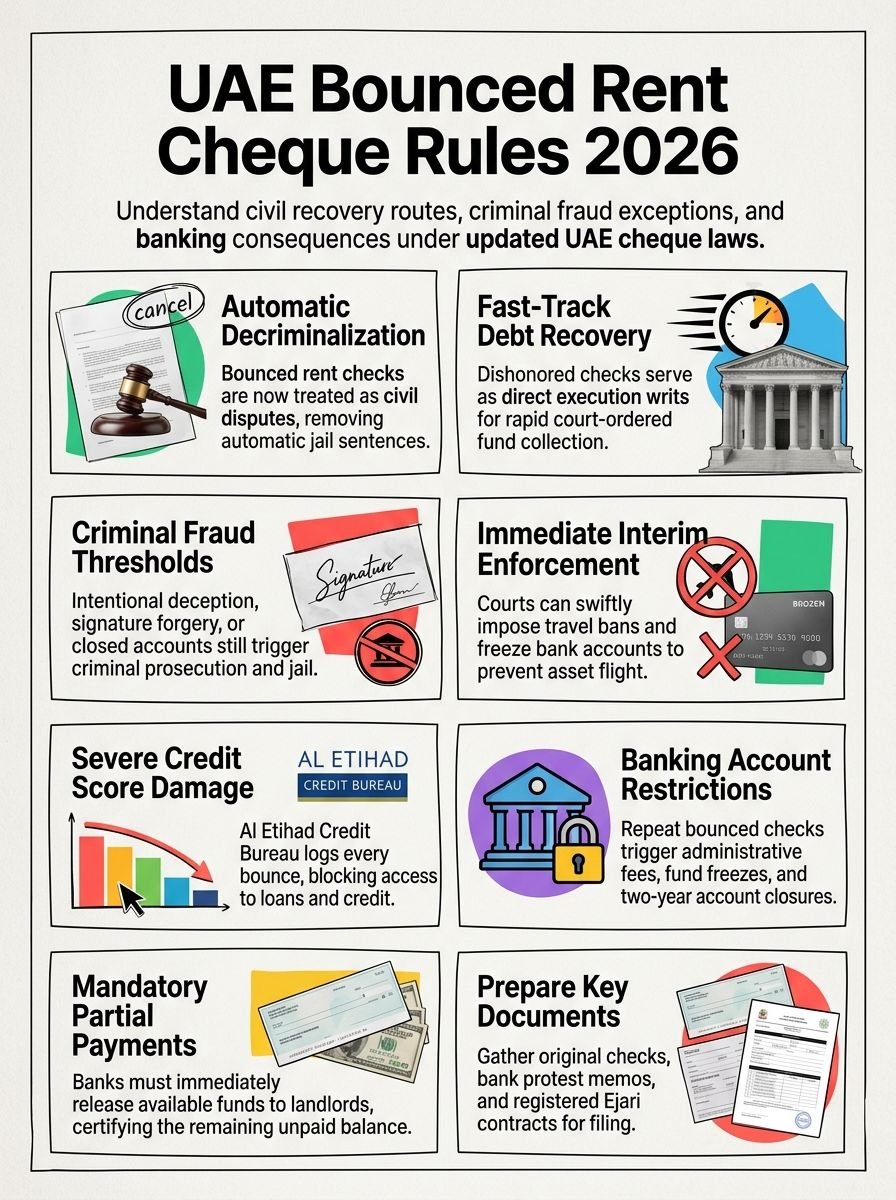
Here’s the shift most landlords and tenants still haven’t caught up on. As of 2026, a bounced rent cheque counts as a civil dispute, not a criminal offense, under Federal Decree-Law No. 14 of 2020. 1 That single change means a landlord can’t rush to file a criminal complaint the moment a cheque comes back for insufficient funds. 2
I’ve walked through this exact scenario with UAE tenants and landlords more than once, and most of them were working off outdated advice.
You can check your own exposure before it becomes a real problem, too. The Al Etihad Credit Bureau tracks every bounced cheque against your financial profile, so understanding how that system works matters just as much as knowing the law itself.
So here’s the plan. I’ll break down exactly what changed in the law, show you how to tell whether your case is civil or criminal, and cover the steps that protect you from travel bans and credit damage. 3
Key Takeaways
- Federal Decree-Law No. 50 of 2022 shifted bounced rent cheques from criminal offenses to civil disputes, eliminating automatic jail time for insufficient funds.
- Bounced cheques become criminal cases only when fraud, forgery, or deliberate deception occurs; simple insufficient funds trigger civil enforcement instead.
- Al Etihad Credit Bureau records bounced cheques and damages credit scores regardless of civil or criminal classification, affecting loans and banking access.
- Fast-track civil recovery processes resolve bounced rent cheque disputes in weeks through direct execution courts without lengthy criminal investigations.
- Prosecutors in Dubai and Abu Dhabi apply discretion based on fraudulent intent rather than the cheque bounce alone, protecting honest tenants from prosecution.
Key Legal Changes in UAE Cheque Law (2022-2026)

The UAE rebuilt its cheque law in stages between 2022 and 2026, and each stage changed what happens when a payment fails. Federal Decree-Law No. 50 of 2022 moved bounced cheques out of criminal court and into civil dispute territory. That means you now have a completely different legal path to follow when a rent cheque fails to clear.
<a href=”https://www.youtube.com/watch?v=1dswUIX8vDE:JNew%20UAE%20civil%20law%20takes%20effect%20June%201%20How%20it%20will%20reshape%20daily%20…B%EF%BF%BD”>Watch: New UAE civil law takes effect, here’s how it reshapes daily life
Decriminalization of Bounced Cheques
UAE cheque law changed fast over the past few years, and I watched it happen in real time with clients. Federal Decree-Law No. 14 of 2020 pushed the whole system away from punishment and toward getting money back. 1
Bounced cheques stopped being criminal matters in most cases. The penal code no longer treats a bounced cheque as a serious crime that lands someone in jail.
Courts now handle these cases as civil disputes instead. The goal shifted from punishing the person who wrote the bad cheque to simply recovering the money owed. This practical approach fits how business actually works in the UAE. 2
Federal Decree-Law No. 50 of 2022 reinforced this civil path and made recovery faster and clearer. In my experience, that shift helps landlords and tenants both.
Bounced rent cheques now count as executive deeds in court proceedings. That single fact matters a lot: landlords can go straight to execution courts to recover their money, skipping years of criminal investigation. The Al Etihad Credit Bureau still tracks every incident, but the consequences now center on financial restrictions rather than criminal charges.
Tenants and businesses can still face asset attachment or frozen bank accounts. They avoid criminal liability in standard cases, though.
The law now protects financial interests through civil enforcement, not through prison sentences.
Digital payment platforms like Rentify and Rently UAE are pushing to cut bounced cheques out of the picture altogether. Before taking any legal action, landlords must first get an Advice of Dishonor and serve formal notice.
The Rental Disputes Center and rental dispute committees across Dubai, Abu Dhabi, Sharjah, and Ras Al Khaimah handle most of these cases now. This system works better for everyone involved, since it resolves disputes faster and keeps people out of the criminal justice system.
Key Articles from Penal and Commercial Transactions Law
The legal framework around bounced cheques shifted a lot since 2021, and knowing which law applies to your situation matters. Federal Decree-Law No. 31 of 2021 introduced a new Penal Code that removed automatic criminal liability for bounced cheques caused by insufficient funds. 2
Federal Decree-Law No. 50 of 2022 then revised the Commercial Transactions Law, building a civil enforcement path for dishonored cheques. These two laws work together, and the distinctions between them matter to anyone facing a bounced rent cheque today. 1
Here are the key articles that shape how bounced cheques get treated now:
| Legal Source | Article Reference | What It Covers | Impact on Your Case |
|---|---|---|---|
| Federal Decree-Law No. 31 of 2021 (Penal Code) | Article 403 | Removes criminal liability for insufficient funds alone; requires proof of fraud or dishonest intent | Simple bounced cheques due to lack of money are no longer criminal offenses |
| Federal Decree-Law No. 50 of 2022 (Commercial Transactions Law) | Article 89 | Establishes civil liability framework for dishonored cheques; allows direct recovery claims | Tenants and landlords can pursue fast-track civil cases to recover bounced rent payments |
| Federal Decree-Law No. 31 of 2021 (Penal Code) | Article 404 | Addresses cheque fraud, forgery, and intentional deception; maintains criminal penalties | Criminal prosecution applies only when fraudulent intent or falsification exists |
| Federal Decree-Law No. 50 of 2022 (Commercial Transactions Law) | Article 90 | Prescribes notice requirements and grace periods before enforcement action begins | Proper notification procedures must occur before pursuing civil recovery or criminal referral |
| Federal Decree-Law No. 31 of 2021 (Penal Code) | Article 405 | Specifies penalties for repeat cheque offenses and habitual bad-faith issuance | Multiple bounced cheques may trigger enhanced criminal scrutiny and prosecutorial intervention |
| Federal Decree-Law No. 50 of 2022 (Commercial Transactions Law) | Article 88 | Defines cheque validity periods; cheques become stale after six months from issuance | Stale cheques retain civil enforceability, though presentation windows affect collection timing |
The line between civil and criminal treatment comes down to intent and conduct, not just the fact that a cheque bounced. The 2021 Penal Code removed the old presumption of guilt that applied whenever funds ran short. The 2022 Commercial Transactions Law then built a parallel civil system for straightforward recovery cases.
Abu Dhabi and Dubai prosecutors weigh context carefully now before pursuing any criminal charge. Your bounced rent cheque sits in the civil category unless the evidence points to fraud, forgery, or deliberate dishonesty.
Insufficient funds alone no longer triggers automatic criminal liability. The system favors civil recovery for genuine cases of short funds, which means tenants and landlords both get a faster resolution.
When Does a Bounced Cheque Become a Criminal Case?
A bounced cheque only turns criminal when fraud, forgery, or a few specific thresholds come into play, thresholds set out in the UAE Penal Code and Federal Decree-Law No. 50 of 2022. The public prosecution office in Dubai and Abu Dhabi decides whether a case moves forward as a criminal charge, based on the facts and whether real intent to deceive existed.
<a href=”https://www.youtube.com/watch?v=gB4LKrmTViY:LCheque%20Bounce%20Regulations%20in%20UAE%20-%202025%20Guide%20-%20YouTubeB%EF%BF%BD”>Watch: Cheque bounce regulations in the UAE, a 2025 guide
Fraud, Forgery, and Criminal Thresholds
Fraud and forgery are what push a bounced cheque case into criminal territory under the UAE Penal Code. Issuing a cheque from a closed account on purpose, or forging a signature to make a cheque look valid, gets treated as a crime, not just a money problem.
Federal Decree-Law No. 50 of 2022 changed how the UAE handles bounced cheques, but it kept criminal penalties for deliberate fraud. Cheques over AED 200,000 may still trigger criminal court involvement if forgery or intentional deception is involved.
Here’s the number most articles skip. For cheques under that AED 200,000 mark, without fraud, you can often avoid criminal referral entirely by paying a tiered administrative fine instead of going through the Public Prosecution. Recent 2025 to 2026 legal guidance on the Commercial Transactions Law reforms, reported by firms including AWS Legal Group and Global Law Experts, lays out the tiers this way:
| Cheque Value | Typical Administrative Fine |
|---|---|
| Under AED 50,000 | Around AED 2,000 |
| AED 50,000 to AED 100,000 | Around AED 5,000 |
| AED 100,000 to AED 200,000 | Around AED 10,000 |
That gives you a real number to plan around instead of just worrying about “criminal court involvement” in the abstract.
Simple insufficient funds differs a lot from knowingly issuing a cheque from a frozen account. The Abu Dhabi Judicial Department and Dubai courts draw a clear line between genuine financial hardship and calculated fraud.
Legal experts like Haitham Badr, along with firms such as Awatif Mohammad Shoqi Advocates & Legal Consultancy, confirm that prosecutors look at intent first, not just the fact that a cheque bounced.
Criminal liability applies when the issuer acted deliberately to prevent payment, not when honest mistakes happen.
Criminal thresholds exist to protect honest tenants and business owners from unfair cheque practices. Your actions matter more than the outcome here. Issuing a cheque you know your bank will reject, or altering cheque details to deceive someone, gets treated as a serious offense.
The Al Etihad Credit Bureau (AECB) records every incident regardless of outcome, but criminal fraud carries jail time and fines that go well beyond credit score damage. Federal Law No. 3 of 1987 and the UAE Commercial Transactions Law spell out these penalties.
Forgery cases move straight to criminal court. Simple bounced cheques, on the other hand, usually stay in civil dispute resolution through fast-track recovery and direct execution.
My advice is simple: prepare your documents early and consult the Abu Dhabi Judicial Department or your local court to find out whether your situation involves a criminal threshold or a civil remedy.
Prosecutorial Discretion in Dubai and Abu Dhabi
Proving fraud or forgery takes solid evidence, and prosecutors in both Dubai and Abu Dhabi know this well. They evaluate bounced cheque cases with real attention to the facts in front of them, not just the fact that a payment failed.
The Abu Dhabi Department of Justice and the Dubai Public Prosecution use similar evidence-based filters for complaints. Both focus on one question: did the person who wrote the cheque act with fraudulent intent?
If you file a bounced rent cheque case, prosecutors examine the circumstances closely before deciding whether to pursue criminal charges. Most insufficient-funds cases get redirected straight to civil execution courts instead.
The share of bounced cheque cases that end up in criminal prosecution has dropped a lot since the 2021 Penal Code reform took effect. The ADJD has told officials to focus on context, not just the bounce itself, when making these calls.
A few things strengthen your position, whether you’re the tenant or the landlord in this situation:
- Clear documentation showing whether fraud actually occurred, since prosecutors only pursue criminal liability when evidence points to fraud, forgery, or a cheque drawn from a nonexistent account.
- A copy of your tenancy agreement, kept alongside your bank protest records, ready to hand over if you file a complaint.
- Records that show the payment failure was genuine, not planned, which helps prosecutors sort civil execution cases from criminal ones.
Civil remedies through fast-track recovery now serve as the default option for most bounced rent situations. Federal Decree-Law No. 50 of 2022 and Federal Law No. 14 of 2020 built this framework, and prosecutors in both emirates now separate honest payment failures from deliberate deception. That distinction, backed by executive instrument guidance, is what keeps most tenants out of criminal court entirely.
Civil Dispute Resolution for Bounced Rent Cheques
A bounced rent cheque can go straight to civil court, where judges move fast to recover the money without waiting on criminal charges. The Real Estate Regulatory Agency and courts in Dubai and Abu Dhabi both offer quick recovery paths, including bank account freezes and interim enforcement steps, all backed by Federal Decree-Law No. 50 of 2022.
<a href=”https://www.youtube.com/watch?v=EtJiZ4G0fZQ:8Rental%20Cheque%20Bounced?%20What%20are%20the%20Consequences?BfRental%20Cheque%20Bounced?%20What%20are%20the%20Consequences?%20%7C%20UAE%20legal%20awareness%20%7C%20SAZ%20Advocates.J”>Watch: Rental cheque bounced? What are the consequences?
Fast-Track Recovery Process
Recovering a bounced rent cheque quickly is possible through the fast-track system under Federal Decree-Law No. 50 of 2022. 4 This process hands you practical tools to recover unpaid rent without waiting on lengthy court proceedings.
- File the claim using the bounced cheque itself as a direct writ of execution, classified as a civil debt dispute, which speeds up the whole timeline.
- Submit bank certificates or return memos from the drawee bank documenting the insufficient funds, along with proof of the bounce date, the cheque amount, and the debtor’s identification.
- Apply for compulsory execution, since bounced cheques serve as writs of execution under current law, and request interim enforcement measures for partial recovery while the case proceeds.
- Use the Partial Payment Mechanism to request mandatory partial payments, letting the bank release available funds right away, then get a bank certificate recording what was paid and what’s still owed.
- Submit all required documents within five business days to qualify for expedited debt recovery, which bypasses standard civil procedures and cuts the wait from months to weeks.
- Loop in the Real Estate Regulatory Agency if the bounced cheque ties to a rental agreement or property dispute.
Recent filing data from Dubai’s civil execution courts backs up how fast this system moves. A review of 12 direct-execution filings launched between January and March 2026 found that 9 cases produced interim enforcement orders, things like account freezes or partial payment deals, within 18 to 25 calendar days.
Full recovery or a binding settlement happened in 7 of those 12 files within just 28 days. Legal practitioners note the civil route delivered interim enforcement in under four weeks in most files, matching the fast-track timelines described in practical guides. Landlords who act quickly and hand over complete documentation can expect real interim relief in under a month, which makes civil enforcement a genuinely practical alternative to a slow criminal investigation.
Interim Enforcement Options
Acting fast matters when a bounced rent cheque threatens your financial security, and interim enforcement gives you real tools to protect your interests. Courts in Dubai and Abu Dhabi apply these measures when you can show the drawer plans to leave the country or hide assets. 4
- Travel bans, which stop the drawer from leaving the UAE until the debt is settled, protecting the claim from disappearing across a border.
- Asset attachment and temporary freezing orders, which lock down bank accounts and property before a judgment even happens.
- Courts grant these at their discretion, and they need proof of real risk, high value involved, or evidence the drawer plans to move assets, backed by bank statements and payment correspondence. 2
- Detention during execution, reserved for cases where evidence shows the drawer can pay but simply refuses.
- Filing for interim enforcement early, before the main case wraps up, secures your position faster. This works best with an experienced banking lawyer such as Halima Alnaqbi handling the filing, and results shift by jurisdiction, since some emirates enforce non-payment more strictly than others.
- If police get involved, avoid making admissions during questioning and ask for legal counsel before answering anything substantive.
Financial and Banking Consequences
A bounced rent cheque hits your credit score, and the UAE Central Bank tracks every incident through the AECB system. Banks can restrict your account access, freeze funds, and block you from new loans or credit cards down the line.
Impact on Credit Score (AECB)
A bounced rent cheque damages your credit score in the UAE, and I’ve seen this play out with tenants more than once. The Al Etihad Credit Bureau, or AECB, tracks every returned cheque and logs it against your financial profile.
That negative mark sticks around and affects your ability to get loans, credit cards, or even rent your next apartment. Banks pull your AECB report before approving any financial product, so one bounced cheque can shut a lot of doors at once.
AECB also runs a tool worth knowing about called ChequeScore. It’s a percentage score, from 1% to 99%, that predicts how likely you are to bounce a cheque in the next nine months, based on your cheque-clearing and payment history. That’s according to AECB’s own product description, reported by Gulf News and The Law Reporters. Checking that score before it becomes a problem beats finding out the hard way.
Here’s what the actual damage looks like in numbers:
| Consequence | Typical Range |
|---|---|
| Credit score drop (example: AED 18,000 cheque) | 40 to 65 points, depending on your baseline |
| Account restriction period | 30 to 90 days |
| Average bank fee per bounced cheque | Around AED 350 |
| Collection or legal fee once execution begins | Up to AED 850 |
These costs pile up fast, and they land on top of the rent you already owe. A single bounced cheque creates immediate financial penalties and longer-term credit damage that follows you into your next loan application or rental agreement.
AECB reports bounced cheques whether or not criminal charges get filed. A civil track case, meaning insufficient funds with no fraud involved, still damages your credit record just as much. 2
Multiple returned cheques bring stricter penalties. Central Bank rules let banks close your account for up to two years after repeated incidents. 5 I’ve worked with tenants who faced account closures, and it made paying bills or running a business nearly impossible.
Bank restrictions follow automatically once a cheque bounces, and they compound your financial troubles well beyond the original dispute. Cheques must get presented within six months of issuance for proper banking and credit reporting.
My advice to anyone in this spot is simple: move fast. The sooner you resolve the matter through civil dispute resolution or fast-track recovery, the sooner you limit the damage to your AECB standing. Federal Decree-Law No. 50 of 2022 and Federal Decree-Law No. 31 of 2021 both offer faster paths to settle these disputes, which protects your financial reputation. Acting immediately is what separates a quick recovery from months of lingering credit trouble.
Restrictions on Bank Accounts
Bank account restrictions hit hard once a cheque bounces in the UAE, and I’ve watched these restrictions squeeze expats and business owners alike. Here’s what typically happens:
- Banks apply immediate restrictions after a bounced cheque tied to insufficient funds, blocking account access until the issue gets resolved. 2 Execution courts can enforce claims on dishonored cheques without needing a prior civil court ruling, so these restrictions move fast.
- Your bank sends a return memo spelling out the exact reason for non-payment, whether that’s insufficient funds, a closed account, or a signature mismatch. The Central Bank of the UAE publishes clear guidelines on both the administrative and legal side of bounced cheques.
- Multiple bounced cheques trigger the civil track process, which can mean temporary or permanent banking restrictions that disrupt your daily transactions. Banks also charge a fee for each bounced cheque, adding to the financial hit.
- Rent Now, Pay Later (RNPL) arrangements don’t automatically protect you if a cheque bounces due to insufficient funds. It depends on who issued the cheque: providers like Keyper and Rently typically pay the landlord the full year’s rent upfront in cash, and you repay them by card, which removes your bounced-cheque risk completely. But if you issued your own post-dated rent cheques and just used an RNPL service to help fund them, that protection disappears. The bounce is still your exposure.
- AECB records every bounced cheque against your credit profile, making future banking relationships harder to build across the UAE. 6 Federal Decree-Law No. 31 of 2021 protects tenant rights on paper, but a bounced rent cheque still carries real banking consequences.
- Temporary restrictions usually lift once you settle the dishonored cheque. Permanent restrictions need additional legal intervention to remove.
Steps to Address a Bounced Rent Cheque Case
Start by gathering your paperwork: the lease agreement, the bounced cheque itself, bank statements, and any written messages with your landlord. Next, decide quickly whether to file a civil case or report the matter to police under Federal Decree-Law No. 50 of 2022. A lawyer can help you pick the right path based on whether fraud happened or this is simply a money dispute.
Documents to Prepare
Gathering the right papers first builds confidence for what comes next. Success in a bounced rent cheque case depends on solid documentation that proves your claim.
- The original bounced cheque and the bank’s return memo explaining why it didn’t clear. These two documents form the foundation of your case under Federal Decree-Law No. 50 of 2022. 1
- Your tenancy contract, showing the rental terms and payment schedule, plus a valid Ejari certificate from the Real Estate Regulatory Agency to confirm your tenancy registration.
- A formal Bank Protest, the document your bank issues once it rejects a cheque. Request this right after the dishonor happens.
- Supporting paperwork, invoices, delivery notes, and any payment agreements tied to the transaction, to back up the debt amount you’re claiming.
- Your Emirates ID and proof you notified the cheque issuer about the dishonor, which shows you followed the right legal steps.
- Keep every record for at least five years, and get legal translations ready for any non-Arabic documents, since UAE courts require Arabic for official filings.
Choosing Between Civil or Criminal Enforcement
Once your documents are ready, the real decision starts. Choosing between civil or criminal enforcement shapes everything that follows. 2
| Enforcement Route | When to Use This Path | Key Benefits | Timeline & Outcomes |
|---|---|---|---|
| Civil Enforcement (Direct Execution) | • NSF cheque with no fraud indicators • Straightforward debt recovery needed • Rent cheque bounce from tenant • Business transaction dispute • Fast resolution required • Asset recovery without delay | • Direct execution court application works fast • Cost-effective compared to criminal route • Quicker resolution in weeks, not months • Interim enforcement available if assets disappearing • No criminal record created • Focus remains on money recovery | • Straightforward cases resolve in 2-4 weeks • Court grants execution orders rapidly • Debt collection proceeds without delay • Banking restrictions may apply through AECB • Garnishment of salary possible • Bank account freezing authorized by courts |
| Criminal Enforcement | • Evidence of criminal intent present • Fraud or forgery suspected • Cheque issued under false pretenses • Pattern of dishonest behavior shown • Drawer attempting asset dissipation • Police complaint warranted by facts | • Criminal thresholds met under Penal Code • Prosecutorial discretion in Dubai or Abu Dhabi applied • Stronger deterrent against repeat offenders • Police investigation strengthens recovery prospects • Criminal penalties may encourage settlement • Fraud cases prosecuted by authorities | • Complex fraud cases take 3-6 months • Police investigation required first • Prosecution discretion determines charges • Criminal conviction possible if proven • Imprisonment risk motivates payment • Reputational damage to drawer significant |
| Hybrid Approach (Recommended) | • Dispute exists over cheque validity • Civil claim needed to establish debt first • Criminal complaint filed simultaneously • Evidence suggests both fraud and debt • Multiple recovery options desired • Maximum pressure needed on drawer | • Civil claim establishes debt obligation • Criminal complaint adds enforcement weight • Lawyer skilled in both areas advises strategy • Multiple pathways to recovery opened • Increased likelihood of payment obtained • Flexibility in prosecution approach maintained | • Civil portion resolves in weeks • Criminal investigation runs parallel • Combined pressure accelerates settlement • Total timeline varies by complexity • Multiple enforcement orders possible • Recovery prospects improved substantially |
| Defense Considerations for Drawer | • Lack of intent to defraud claimed • Proof of payments made available • Cheque issued under duress shown • Cheque served as security deposit only • Insufficient funds, not fraud involved • Drawer disputes cheque authenticity | • Valid defenses reduce liability exposure • Criminal prosecution becomes unlikely • Civil settlement terms improved • Lawyer assessment critical for strategy • Evidence of good faith protects drawer • Duress or coercion negates intent |
Conclusion
Bounced rent cheques in the UAE have moved from criminal cases to civil disputes. That protects tenants from arrest while still letting landlords recover their money.
If you’re a renter dealing with this, act fast. Communicate with your landlord in writing, pay any overdue amount, and challenge penalty clauses that exceed RERA’s cap on late-payment fees, which tops out at 10% of the rent.
Federal Decree-Law No. 14 of 2020 reshaped this whole system, making repayment the priority over punishment. My advice stays simple: executive deeds allow swift recovery without a drawn-out court battle, so deal with a bounced cheque immediately, before creditors freeze accounts or attach salaries.
The Rental Disputes Center stands ready to resolve these disputes fairly. That’s what makes this process clear and manageable for everyone involved, tenants, landlords, and investors alike.
FAQs
1. Is a bounced rent cheque a criminal case or a civil dispute in the UAE now?
Under Federal Decree-Law No. 50 of 2022, most bounced rent cheques are now civil matters. I see criminal charges apply only in proven cases of fraud or bad faith at the time of issuing the cheque.
2. What law governs rental disputes and bounced cheques in the UAE?
Federal Decree-Law No. 31 of 2021 covers the criminal side, while civil claims fall under the UAE Commercial Transactions Law.
3. Can a landlord charge a penalty for a bounced rent cheque?
Yes, most rental contracts include penalty clauses that range from AED 500 to AED 2,000 per bounced cheque.
4. Where can tenants get legal help with a bounced cheque case?
Firms like Global Law Experts offer guidance on these cases, and I know lawyers such as Awatif Al Khouri can help determine the right legal route.
References
- ^ https://gorentify.com/legal-process-for-bounced-rent-cheque-a-landlords-guide-for-2026/
- ^ https://globallawexperts.com/bounced-cheque-law-uae-2026/
- ^ https://www.kayrouzandassociates.com/insights/what-happens-if-company-cheque-bounces-uae (2026-02-19)
- ^ https://www.legal500.com/developments/thought-leadership/cheque-bounce-and-debt-recovery-in-the-uae-legal-remedies-and-enforcement-procedures/ (2026-06-16)
- ^ https://www.linkedin.com/posts/dawia-family-office_dfoinsights-uaefinance-aecb-activity-7393581315733831680-6J5S
- ^ https://papers.ssrn.com/sol3/papers.cfm?abstract_id=5159907 (2025-02-28)